

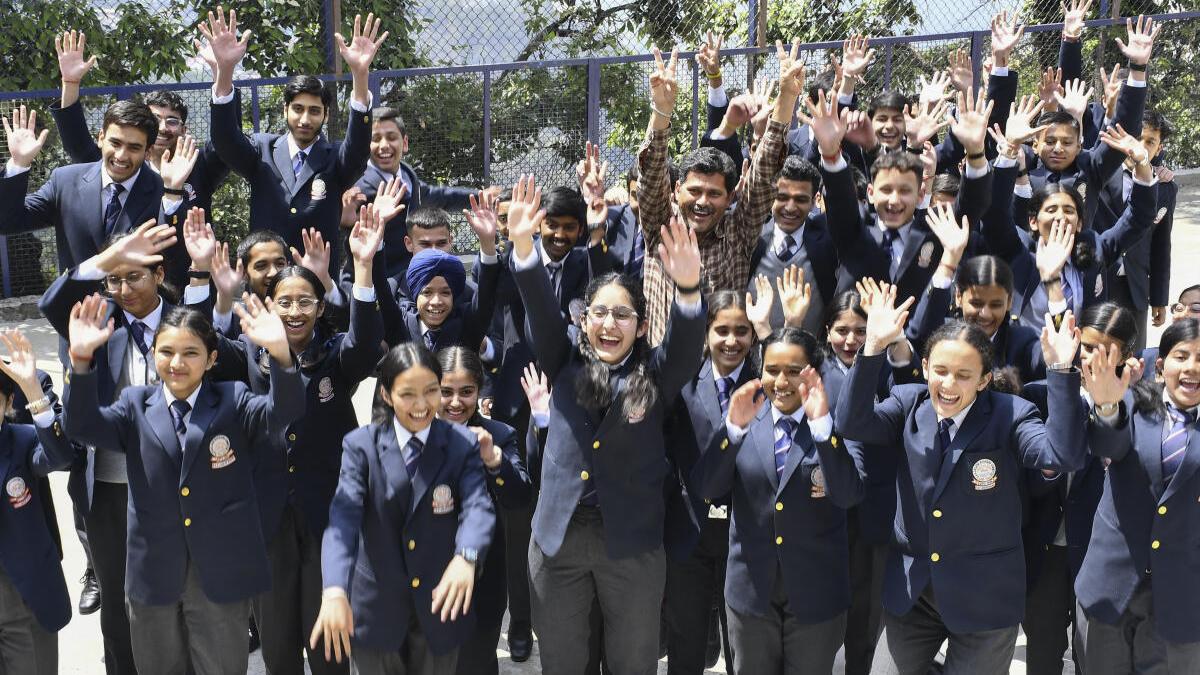
Himachal revives public education but hidden gaps and untested values remain
Himachal Pradesh, a State born out of many struggles, was not formed on a linguistic basis but on the aspirations of mountain people. Today it stands out to be among the best in some of the social development indicators amongst Indian states, with education being one of them.
(Sign up for THEdge, The Hindu’s weekly education newsletter.)
How has Himachal achieved this and does it reflect the true sense of developmental model or is it just ticking the boxes, that has taken it to the top? I would say the State has made some major disruptions in the education sector which need to be closely looked at.
The NAS (2025) report states that HP jumped from 21st position in 2021 to top 5. It signalled through example that public education battered by decades of contractualisation and neglect could be revived. But, as we know, signals cannot be formal conclusions. So let us explore a bit more.
As per UDISE, at the secondary level, in 2021-22, the dropout rate in Himchal Pradesh stood at 1.46, following Chandigarh and Lakshwadeep, where the dropout rate was zero and Manipur where it was 1.27. As of 2024-25, the dropout rate in Himachal Pradesh is 6.2.
But the total enrolment of students in government schools has fallen from 10.5 lakh in 2003-04 to 7 lakh in 2024-25. Contractualization has happened across the State, yet the outcomes are improving. Is it a paradox?
Dropout rates are low. According to the UDISE report of 2023-24, the dropout rate is zero at primary, and 0.6 at the upper primary. Well, the answer lies in various arguments – like the decline in population growth; fertility rate being as low as 1.5%. But things need to be assessed a little more.
Children who remain in government schools are better served than before. This is a fact worth recognising. But those who left government schools for private institutions, which was less than one thousand in 2003-04, has now reached 2,600. Does shedding a portion of student strength to private sector schools lead to better performance?
Consolidation and hidden absences
Another issue is the consolidation question. The incumbent Sukhu government in the State merged over a -thousand under-enrolled schools. This is part of the “national restructuring” process in which schools with less than 20 students rose from 1,665 in 2003-04 to 6,000. There were nearly empty institutions in many parts of the State. However, this cannot be a guiding principle.
Consolidation in regions like Lahaul and Spiti cannot have the policy logic of the plains. Lahaul and Spiti district has been an outlier in the UDISE data since long. When schools are merged in such regions with high altitude, snowfall, seasonal migration and distance, some children just stop attending school. However, they do not qualify in the dropout figures as formally they have never withdrawn. Instead they appear as absences in Net Enrolment Ration. That is the catch.
The NER at the secondary level in HP in 2024-25 stands at 40.9%. What does it mean? It means that six out of 10 children are either not enrolled at all or enrolled at an age beyond the prescribed age. This is something the data points do not read and obscure. Simply put, low dropout and low NER coexist when a large number of children never entered the formal education system or entered late.
Equity gains and class sorting
Another interesting feature is about those who stayed back in government schools. The children who stayed in government schools are mostly from Scheduled Castes, Scheduled Tribes and Other Backward Communities. The UDISE 2024-25 report has stated that the gross enrolment ratio for secondary section in HP is 100% for SC students and 80.4% for ST students, which is a remarkable achievement. This is 34 percentage points more than the all-India figures for ST students. Despite difficult terrains and geographies, such an achievement is indeed a great milestone and this also demonstrates the redistribute potential of a functioning public education system.
A significant portion of the general category students moved to private institutions. This is also a kind of class sorting taking place in HP. Does this mean that government schools serve those who have no other option?
I think this is a structural question about what happens when a section of the people lose faith in State institutions over a long period and which is being partially restored. And, to restore that faith, it is not pedagogical changes that are necessary, it is the political will that is more important. There must be acknowledgement of the fact that exodus to private institutions by a section of the households was a kind of verdict of contractual hiring, absent teachers, and poor infrastructure. While acknowledging it, the need is also to unleash tasks to reverse the pattern.
The student teacher ratio is for sure improving; the UDISE data, however, further warns that the number of primary teachers fell from 27,093 in 2003-04 to 20,000, in 2024-25. The number of primary schools with just one teacher has jumped from 1,488 to 3,300 during the same period. There is an imminent need for teacher appointments, with transparent recruitment.
Beyond test scores
What is testable has been tested: NAS testing measures such as Maths, Science, and language that produce rankings. However, there is no measure of critical thinking and civic awareness amongst the pedagogical methods.
Building capacities for collective action and the quality of the relationship between the pupil and teacher are of utmost importance. The IPCC (Intergovernmental Panel on Climate Change) VI has pointed out that the current generation, in fact all those born after 1996, have not seen a single normal season, and are a witness to regular disasters and live in the ‘times of uncertainty’. In such a background what is important is not just the inculcation of criticality but also building of collective consciousness.
These aren’t soft concerns. They are the foundational principles of democratic education, which Dr Y.S. Parmar, the founding chief minister of the State, was mindful of and drove the expansion of education in post-independent Himachal, not as an investment tool for capital but for a self–governing society.
The State’s achievement is that it has shown the school can be made to work and this has been unambiguously clear. What the State needs now is to move away from the test-score optimisation methodology and deepen community participation through school management committees for a broader mission.
(Tikender Singh Panwar has served as the directly elected Deputy Mayor of Shimla City, contributing to urban planning and development.)
Published – May 06, 2026 08:30 am IST