




China becomes AI’s biggest testing ground
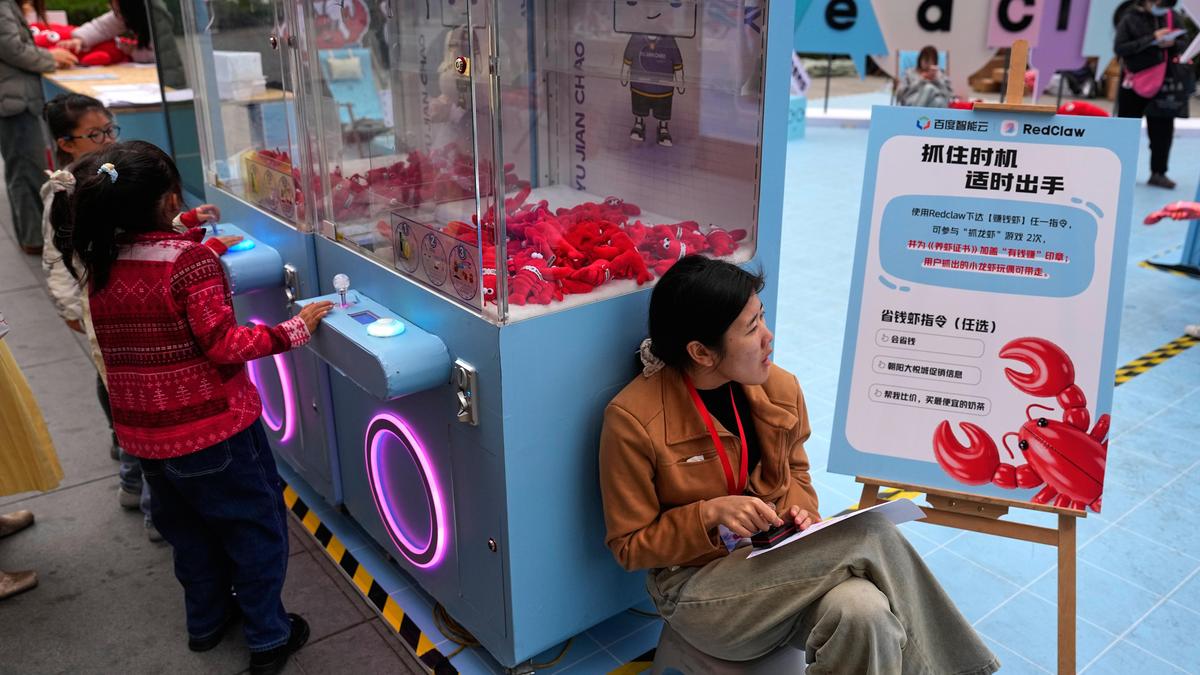
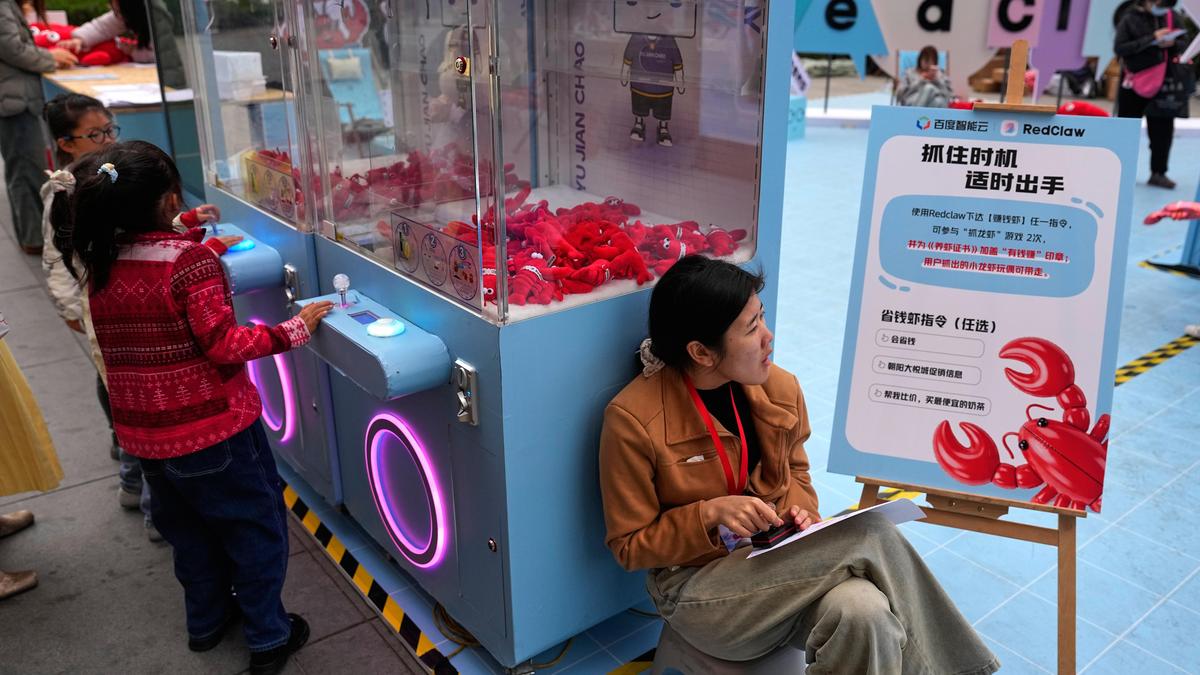
A staff member rests as children play games at a RedClaw AI promotion booth set up outside a shopping mall in Beijing on March 28, 2026.
| Photo Credit: AP
On a recent weekday, around 50 people gathered outside the headquarters of a Chinese mobile internet company, waiting to get help with installing an artificial intelligence (AI) assistant.
The scene in Beijing, China’s capital, was repeated for days at several events and was also seen in the southern technology hub Shenzhen in March, as engineers helped crowds trying to set up the popular AI “agent” OpenClaw on their laptops.
“I’m worried about falling behind in technological developments,” said Sun Lei, a 41-year-old human resources manager at the Cheetah event. She said she hoped the tool might help her source and screen resumes across various recruitment platforms.
More than a year after OpenAI’s Chinese rival DeepSeek stunned the world with its advanced AI model, China has become a testing ground for mass use of AI tools. Chinese people and businesses have rapidly embraced AI for all sorts of things, from booking and planning travel, ordering food and hailing rides. Of its 1.4 billion population, more than 600 million were using generative AI as of December, a 142% increase from a year earlier, according to a report by the government-controlled China Internet Network Information Centre.
With the recent surge in the use of “agentic” AI like OpenClaw, the consumption of data by AI models has also risen. Measured in what computer scientists call tokens, or units of data such as part of a word, the weekly share used by Chinese AI models has recently surpassed U.S. models, according to OpenRouter, an AI “gateway platform” that tracks data and enforces security across different AI models.
“The (AI) competition is clearly shifting from models to ecosystems,” said Lizzi Lee, a fellow at the Asia Society Policy Institute’s Center for China Analysis focused on economics and technology. “Chinese users are basically acting as real-time testers at scale.”
Chinese technology companies like Tencent, Alibaba and Baidu are also racing to commercialise AI. Tencent integrated OpenClaw into WeChat, China’s own “super-app” which is a messaging tool that can also be used to order food and make payments.
OpenClaw, originally created by Austrian software developer Peter Steinberger last year, won quick and enthusiastic use thanks to its ability to use various tools to complete complicated tasks.
Zhao Yikang, a Chinese college student in Macao, uses OpenClaw in both his studies and daily life.
“AI can understand things in a second,” Zhao said. “You just need to act as a commander and tell it what to do.”
Preparing to start a photo services business after graduation, Zhao asked AI to build a company website. Within 10 minutes, it had generated a fully functional site for less than 5 yuan (Rs 70).
Chinese companies increasingly are setting internal targets for boosting use of AI to improve efficiency, said Janet Tang, a partner & managing director focused on technology at consultancy AlixPartners.
There are “a lot of application scenarios,” said Wang Xiaogang, co-founder of the Chinese AI software company SenseTime and chairman of ACE Robotics. “The industry is developing very fast and the people, they are very open and they’re eager to try the AI in a lot of scenarios.”
Published – May 06, 2026 01:51 pm IST