




Researchers build synthetic materials that ‘learn’ to change shape
When you exercise, your muscles become stronger. When you sow a plant, its stem will bend so that its leaves get more sunlight. Both these changes are examples of adaptation — when a biological material senses its environment, then reorganises its internal structure to survive better. All life must adapt over time to changing conditions. Populations that don’t could become extinct.
However, most non-living materials do not actively adjust their internal structure in response to new conditions after they are made. When a metalsmith forges a bar of steel, its internal structure is mostly fixed from that point on, though it can still change due to heat, stress, etc. If you want a new bar with different properties, you need to engineer it anew.
However, in a new study in Nature Physics, researchers from Europe have challenged this difference. The team has reportedly built a synthetic material that can learn physically, by actively changing their internal mechanical properties based on external conditions.
Chain of units
The team used metamaterials for this work. These are special materials whose properties are not determine by their chemical composition alone but also by the structure, or the way in which they’re physically arranged. As a result, they often have properties that natural materials don’t. In the last decade or so, scientists have used metamaterials to bend light in counterintuitive ways, shield buildings from earthquakes, and hide objects from radar, among other feats.
In the new study, the team built a robotic metamaterial consisting of a chain of connected units. Each unit had a small motor, an angle sensor, and a microcontroller. Using these components, a unit could send and receive data to/from its adjacent units and change how much it bent in response. This way, the whole metamaterial could be as rigid as a metal spring or as flexible as a rubber band, or something else in between, based on how each unit responded to feedback from the two units attached to it. The researchers used a method called contrastive learning to ‘teach’ the metamaterial a particular shape.
While contrastive learning exists in machine-learning as an algorithm, the researchers implemented it here using only a hardware-based system.
Four steps to learn
First, the researchers kept the metamaterial chain in a straight line and set starting values for the stiffness of each unit. The stiffer a unit, the lesser it would bend in response to feedback.
Second, they applied an input: bending one unit in the chain by a fixed angle. This would change the rest of the chain into a particular shape, called the free state. Then, they would hold the input fixed and manually turn the other units so that the chain formed a new shape, like a ‘U’ or an ‘L’. This was called the clamped state.
Finally, the microcontroller in each unit would compare its angle in the free state to that in the clamped state, and use the difference to adjust its stiffness using the motor. When the researchers repeated these four steps again and again, the metamaterial chain went from the free state to the clamped state in fewer steps. This is called contrastive learning because each unit ‘learns’ by contrasting the free and clamped states to figure out what it should do.
Thus, as the researchers explained in their paper, “Unlike traditional materials that are designed once and for all, our metamaterials have the ability to forget and learn new shape changes in sequence, to learn several shape changes that break reciprocity, and to learn multistable shape changes, which in turn allows them to perform reflex gripping actions and locomotion.
“Our findings establish metamaterials as an exciting platform for physical learning, which in turn opens avenues for the use of physical learning to design adaptive materials and robots.”
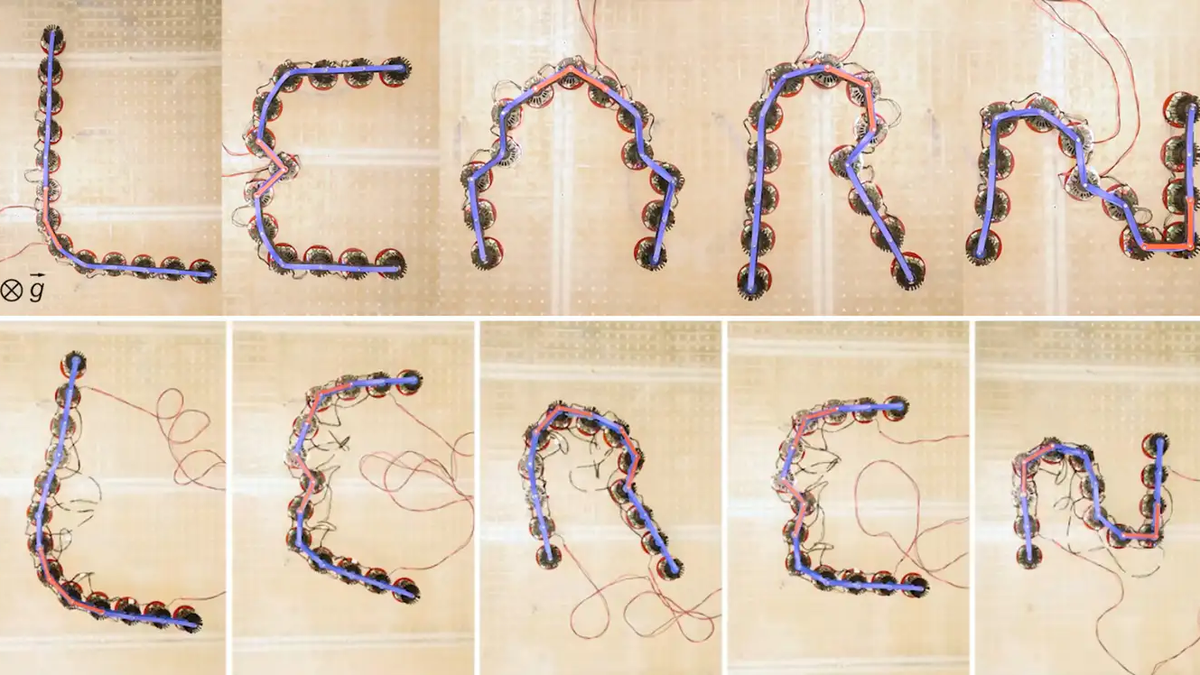
The researchers reported that in one test, a chain of six units eventually ‘learnt’ to form a U-shape in a single step from a straight line. Another 11-unit chain also ‘learnt’ to spell each letter of the word ‘LEARN’ in sequence, at each step ‘forgetting’ one shape and ‘learning’ the next one. The researchers likened this ability (with some qualifications) to the adaptability of simple organisms.
Talking to each other
A usual question that arises after researchers report a successful finding in a lab is whether they would find the same thing at a larger scale or in the real world. The authors of the study addressed this question using only simulations, where they ran computer models of metamaterial chains with thousands of units. These models were not very complicated, however, as each unit had only the three components and ‘learnt’ only based on two inputs — the units on either side.
However, the models showed that as the chains became longer, the metamaterial ‘learnt’ at a slower pace. This was because the amount of deformation passing through the chain decayed over a particular length. Put differently, a ‘signal’ arising from one unit weakened significantly by the time it reached a distant unit.
The researchers found a simple fix: they allowed each unit to ‘talk’ to the nearest unit as well as the next-nearest unit, i.e. the units one and two steps away. With this rule, each unit’s microcontroller received data about the angle of the unit two steps away, and used it with the ‘knowledge’ that the angle was X two steps away, not one. This allowed the inputs to propagate further along the chain than before. The researchers were able to have a 48-unit chain morph into the outline of a cat using just three inputs as a result.
The way the chain works is an example of local decision-making. It is unlike, say, the human body, where the brain receives inputs from multiple senses and makes many decisions, which the nervous system finally relays to different parts. Machine-learning models also use techniques like backpropagation, where the output generated near the end of a model is used to ‘teach’ computers near the beginning.
The metamaterial chain, however, made no such effort. Its ‘learning’ was based on the units before and after (or the next-nearest). This is useful in technological applications because it removes the need for complex networks to transfer data.
Taking a walk
The researchers also found that the chain responded differently depending on which side it was nudged. When they nudged one six-unit chain from the left end, the right end bent one way. But when they pushed it from the right end, the left end bent in a different way. This non-reciprocity, the researchers argued, allowed the metamaterial to ‘learn’ different ways to attain a final shape without requiring separate training.
In a commentary accompanying the paper, Karen Alim, of the Technical University of Munich, Germany, who wasn’t associated with the study, wrote that such non-reciprocity tests scientists’ understanding of ‘intelligence’ in materials beyond the bounds of traditional physics.
For example, physics dictates that when you push a spring, it will push back. This is because the spring wants to settle into its lowest energy state: where it is not compressed. In this context, the spring can be said to ‘learn’ by finding the valley in its energy landscape. That is, if you take the spring to a different point in this landscape, by compressing or extending it by some amount, it will respond by making a beeline for just one spot: the valley.
However, per Dr. Lim, the chain metamaterial is non-reciprocal, so it doesn’t have a simple energy landscape. In non-reciprocal systems, the energy required to move from point A to point B depends on the path the object takes — since there is more than one option. In these cases, it becomes a question of how much physical effort each path takes.
So while the spring ‘learns’ by minimising energy, the metamaterial chain ‘learnt’ by minimising work — in this case the work done by the motors. As a result, the chain was able to ‘learn’ different paths to a final shape the way a spring never can.
“Breaking down the complexity of learning in artificial intelligence systems and the brain into physical concepts appears to be an insurmountable task. The programmable metamaterial wire presented by [the team] is a brilliant reduction in complexity that is key to disentangling the essential physics concepts that enable learning and constrain the space of learnable states,” Dr. Lim wrote.
Like a switch
The researchers also unexpectedly found bistable units — meaning they could act like switches. For example, when a moving object came in contact with a six-unit chain, the chain coiled itself around the object and gripped it. To release the object, the researchers only had to nudge one particular unit, which uncoiled the rest of the chain. (This unit was bistable.)
This is also why Dr. Lim wrote that the metamaterial chain should thus be seen as a dynamical system, i.e. something capable of adapting. According to her, the chain was able to perform life-like actions, like gripping an object, because it could ‘navigate’ through different stable states by minimising the work along specific paths.
Indeed, while the chains in the team’s experiments illustrated what a metamaterial chain with just a few controllable parameters was capable of, they are also not ready for real-world use. The team needed an air table and impractically large components to make them work. But if these requirements are eased, such metamaterial chains could in future be used as advanced prosthetic limbs and in soft robots that need to respond agilely to obstacles.
Overall, they concluded, their “work paves the way for the design of adaptive metamaterials as well as soft and distributed robotics”.
mukunth.v@thehindu.co.in