




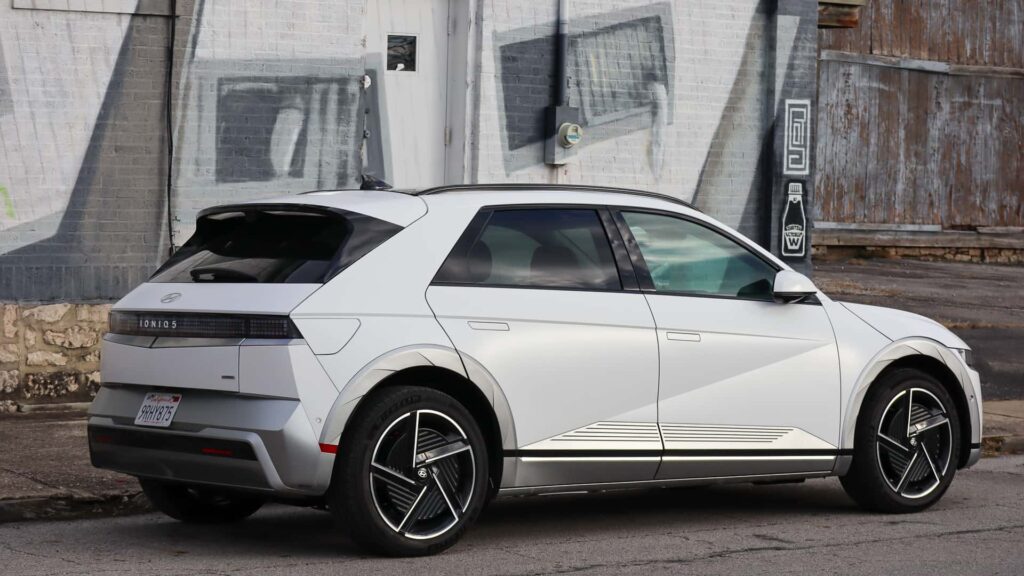
Hyundai Is Upping Its EV Warranty Over A Common Failure. But Many Owners Are Still Upset
- Hyundai is extending the warranty coverage of the ICCU, a part with a well-documented history of failures in its E-GMP vehicles.
- Owners will now receive the peace of mind that the ICCU is covered for 15 years, or 180,000 miles.
- Sister brand Kia has not yet released a similar extension.
When buying a new car, there are few things more reassuring than a good warranty. It’s the paperwork equivalent of a brand putting its hand on your shoulder to say “we’ve got you” just in case there are any craftsmanship issues later on. That seems like the feel Hyundai is going for to reassure its customers that a component with a well-documented occurrence of failure will be covered for a really, really long time.
The part in question is Hyundai’s Integrated Charging Control Unit (ICCU), the vehicle’s onboard charger and power converter. After countless customer complaints over the past few years, the automaker has decided to up the warranty to a whopping 15 years and 180,000 miles. While that might seem generous compared to the original 5-year, 80,000-mile warranty period, some customers and would-be buyers say that it’s just not enough.

Photo by: InsideEVs
Before we dig in, let’s talk about what the ICCU is and what happens when it breaks. Essentially, the component is responsible for onboard charging (including the 12-volt battery, DC fast charging, and AC charging), DC-to-DC conversion, and vehicle-to-load functions. It’s actually a pretty spectacular piece of engineering, but there’s just one problem: it’s not exactly known for reliability.
We’ve documented this before, and the unfortunate reality is that many E-GMP platform owners have reported failures online, to outlets like Consumer Reports, and even the U.S. Government hoping for a fix. Hyundai has now given consumers more coverage for the issue, presumably to both fix the problem in affected cars and in hopes to restore good faith.
Here’s what Hyundai told TorqueNews in a statement:
Hyundai Motor America is committed to the safety, quality, and long-term reliability of our vehicles. Based on ongoing monitoring of ICCU performance in certain Hyundai electric vehicles, Hyundai has approved a Warranty Extension for the Integrated Charging Control Unit (ICCU) in affected U.S. vehicles.
This action extends ICCU coverage to 15 years or 180,000 miles, whichever occurs first, and is offered at no cost to customers. Customers experiencing related symptoms, such as warning lights, reduced power, or charging limitations, are encouraged to contact their local Hyundai dealer for diagnosis and support.
Customer safety and confidence remain our top priorities. Customers can check the status of their vehicle by entering their VIN at HyundaiUSA.com/campaignhome
At the time of writing, Kia has not announced a similar extension, but a spokesperson told Electrek in a statement that it would be updating Kia EV6 owners and dealerships of a “similar program in the coming days.”
Owners are saying that the updated warranty isn’t enough—they want the core problem to be fixed.
Several took to Reddit where the fix was called the “bare minimum” that Hyundai could do. Some reported that their vehicles have had multiple ICCU replacements and that waiting on parts can take longer than a month. Would-be owners also chimed in, sharing that they avoided buying a Hyundai or Kia EV in the past specifically because they were aware of ICCU failures.
“Anything short of a lifetime and unlimited mileage warranty for the ICCU is flatly unacceptable until they fix the problem,” wrote one user.
It’s worth noting that Hyundai isn’t alone in these types of issues. Tesla vehicles have also had a high documented failure rate of the Power Conversion System (PCS)—which handles similar functions to the Hyundai ICCU—in the Model 3 and Model Y. And, despite being encased in the high voltage battery, is not covered under Tesla’s high voltage battery warranty.
Recently, the Tesla Cybertruck also garnered a significant amount of attention over PCS failures that disable AC charging. Tesla has begun offering affected owners free Supercharging upon failure so that their trucks could be still be driven until fixed. But Hyundai’s issues have persisted for quite some time, and multiple recalls have not fully solved the issue.
To Hyundai’s credit, extending the warranty is absolutely better than ignoring the problem. For some owners who don’t plan on keeping their vehicles until the extended warranty period is up, it’s more than enough. For others (especially people shopping for a used EV), it’s a red flag.
It acknowledges that there is an issue and buys Hyundai time for a more permanent fix. But in the rapidly developing EV market, consumers won’t wait forever for a problem to be wholly solved. The question is whether Hyundai can fix the problem before it does irreparable damage to the company’s EV lineup. We’ll see what the answer is.