




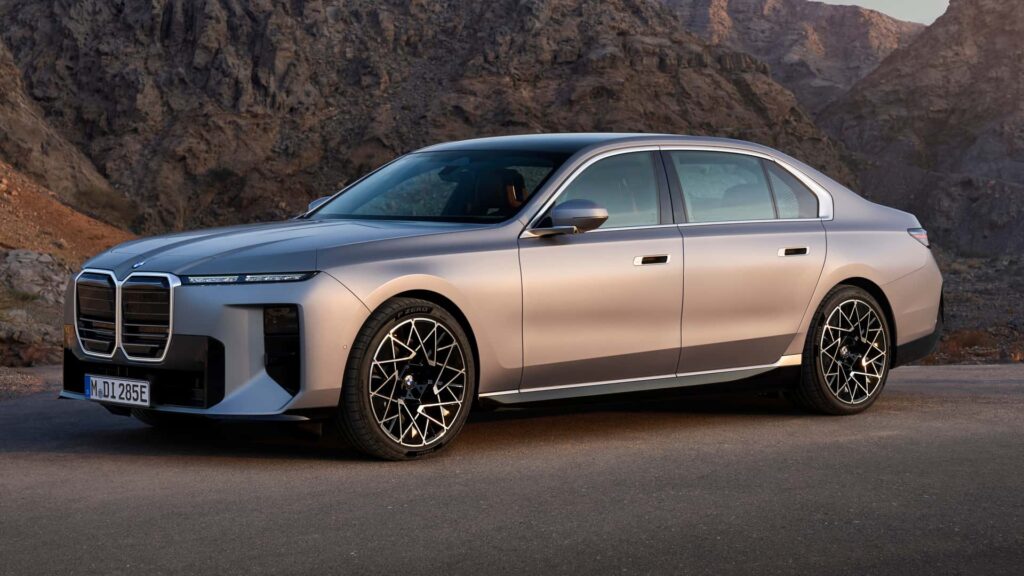
2027 BMW i7 Gets More Range And Faster Charging With Neue Klasse Flavor
- BMW is bringing its next-generation software and electrical architecture to all 7 Series trims.
- The i7 now gets a huge range boost, thanks to high-performance cylindrical cells.
- With peak charging power now at 250 kilowatts, the 10-80% time has dropped significantly.
BMW just pulled the wraps off the refreshed 2027 7 Series, and the update goes far deeper than a facelift. The electric version of the flagship now gets a new high-voltage battery, faster charging, and a revised powertrain. The broader 7 Series lineup also gets sharper exterior styling and a heavily revised interior with BMW’s latest cockpit technologies. The biggest change is probably the incorporation of next-gen software and a zonal electrical architecture to the existing platform and all 7 Series trims, including gas, plug-in hybrid, and all-electric.
One of the biggest changes is under the floor. The i7 gets a new battery pack developed in collaboration with Rimac Technologies. It retains the same external dimensions as before but now houses sixth-generation cylindrical cells instead of the outgoing fifth-generation prismatic units. That swap will deliver a 20% improvement in energy density and push usable capacity up more than 10% to 112.5 kilowatt-hours (net). BMW said the i7 60 xDrive can now exceed 350 miles of EPA-estimated range, though it notes that figure is preliminary.

47
Source: BMW
It’s a meaningful improvement from the current i7 eDrive 50’s 314 miles of range, but nowhere near what its own siblings can now achieve. Both the Neue Klasse iX3 and i3 are now rated for well over 400 miles of range, although they’re lighter and smaller vehicles.
Charging speed gets a meaningful jump, too. The maximum DC charging rate has increased from 195 kilowatts to 250 kW, and at compatible stations, the i7 can go from 10% to 80% in 28 minutes. Its maximum current flow now stands at 630 amps, which BMW claims is beyond anything else in the segment. Every i7 also now ships with a Tesla-style North American Charging Standard (NACS) port as standard, opening up access to the Supercharger network.
The automaker has also improved the drive units. BMW claims the rotors no longer need rare earth magnets and have gained silicon carbide inverters. They also get optimized wheel bearings that together improve overall vehicle efficiency by up to 7%. Despite riding on the same Cluster Architecture, BMW said all 7 Series trims now get the new electrical architecture developed for the Neue Klasse platform. That includes a new centralized computer with 20 times more processing power than the current i7, and a zonal architecture that reduces the wiring harness weight by 30% and length by 2,000 feet. In theory, all that should translate to more over-the-air software updates and more AI features in the future, BMW said.
Photo by: BMW
Two i7 variants will launch at the debut: 50 xDrive and 60 xDrive. The former makes 449 horsepower and 487 pound-feet of torque, hitting 60 miles per hour in about 5.3 seconds with a 130 mph top speed. The i7 60 xDrive steps up to 536 hp and 549 lb-ft, cutting the 0-60 mph sprint to around 4.6 seconds with a 149 mph top speed. Both are all-wheel drive.
On the design front, the i7 now looks sharper and more stately. The front end gets a slimmer, more vertical illuminated kidney grille with updated graphics, revised headlamp design, and a larger BMW logo on the hood. At the rear, you get slimmer taillights and a smoked glass finish. A new “Ceremonial Light Carpet” embeds 194,000 pixels in the door sills to project animations onto the ground during entry and exit.
Photo by: BMW
Inside, the i7 gets BMW’s Panoramic Vision display, a pillar-to-pillar projection spanning the entire width of the lower windshield. It’s identical to the new iX3 and the i3, displaying critical information like range, charging, media, and navigation in your line of sight. There’s also a new 17.9-inch central display and a new 14.6-inch passenger screen. At the rear, the optional BMW “Theater Screen” will continue to get up to 8K resolution and now includes a built-in camera for Zoom video calls.
Don’t expect any of this to come cheap. The refreshed i7 will start at $106,200 for the 50 xDrive and $124,700 for the 60 xDrive, plus a $1,550 destination charge. That’s slightly more expensive than the gas trims, which start at $99,800. Production will begin at the BMW Group Plant Dingolfing in July 2026. The updates are also coming to the plug-in hybrid 750e xDrive, but that will be available next year, with its production starting in the fourth quarter of this year.
Contact the author: suvrat.kothari@insideevs.com