



One-horse races are no triumph for democracy
There was an industrialist whose company was doing exceptionally well. In a decade since its inception, it captured over 40% of the market share. When I asked him, “Having reached thus far, what do you perceive as your biggest challenge going forward?”, he paused for a while, his eyes gazing into the distant future, and replied gravely: “Lack of competition.”
Ask cricketing legends who have been successful batsmen and they will tell you that their finest innings were those played against formidable bowling attacks, not the centuries scored against minnows. Even spectators enjoy a seesaw, hard-fought contest more than a tame one-sided affair, even if it involves their favourite player trouncing a neophyte.

As in business and sports, competition is the haemoglobin of a democracy. It gives meaning to the precept of “rule by the people” by allowing citizens to “fire” incumbents and choose alternatives, thereby liberating them from the TINA (“there is no alternative”) trap. However, that presupposes the existence of rivals with the capacity to contest, and challengers who aspire to win against the odds because they believe in the fairness of the system.
Mandates require genuine contests
It is ironic that the rules of the game, as far as elections are concerned, do not consider competition essential to an electoral outcome. Section 53(3) of the Representation of the People Act, 1951, provides for “unopposed” winners, which means that competition takes place only when enough players enter the fray. Otherwise, one can have a contestant but no contest, a winner without a game, and a people’s representative without a single vote cast in his favour — a walkover “killing” both the game and its spirit.
For a player to tout his victory there should have been a contest. For a government to claim legitimacy, the electorate must believe that those elected ‘earned’ (pun unintended) their position through a fair process. You can win power without a contest; not a mandate. Competition also gives ‘losers’ hope that they can try to win in the future, making them accept fair electoral outcomes. Peaceful transition of power is one of the healthiest achievements of any electoral democracy.
Competition and contestation enable differing ideologies and social classes to flourish. Going by the economic logic of competition breeding efficiency, it would be reasonable to expect political parties to refine their policies as opponents always look to highlight failures. Political scientist Robert Dahl referred to a system with high participation but low contestation (like one-party States with high voter turnout) as a “plebiscitary autocracy” rather than a true democracy.
However, competition also presupposes a level playing field and a neutral referee to ensure that. The absence of either tilts the scales against challengers, minimising their chances of success while also denting their morale and undermining the people’s confidence. In fact, the partisanship of a referee tends to rob the victor of the sweet taste of success, even if deserved. One might be seeded higher, have played better than the opponent, enjoy spectators’ support, and even deserve to win, but if the referee is seen as partial, the triumph appears tainted.
In West Bengal
Take the example of the West Bengal Assembly elections. Anti-incumbency could well have influenced the voters’ choice, and the winning party may have run an effective campaign for its resounding victory. And yet, its performance stands tarnished by accusations of favouritism against the constitutionally designated umpire mandated to provide the “superintendence, direction, and control” of the electoral process.
The outcome is being linked to the Special Intensive Revision (SIR) of electoral rolls (ER), and analysts have presented constituency-wise data showing deletions of electors that exceed the victory margins, suggesting that the result might have been different but for the SIR.

That the SIR was unwarranted is established by the inability of the process to identify those “ineligible” in terms of Article 326, which was the Election Commission of India (ECI)’s war cry when it commenced the SIR in Bihar in June 2025. Neither at the end of the Bihar SIR nor for the States in the second round has the ECI released figures on the “ineligible” electors weeded out for not meeting the eligibility conditions under Article 326. There have, no doubt, been deletions through the SIR, but these pertain to “permanently shifted, dead, or duplicate” entries, which could have been removed through the normal revision process mandated before every poll.
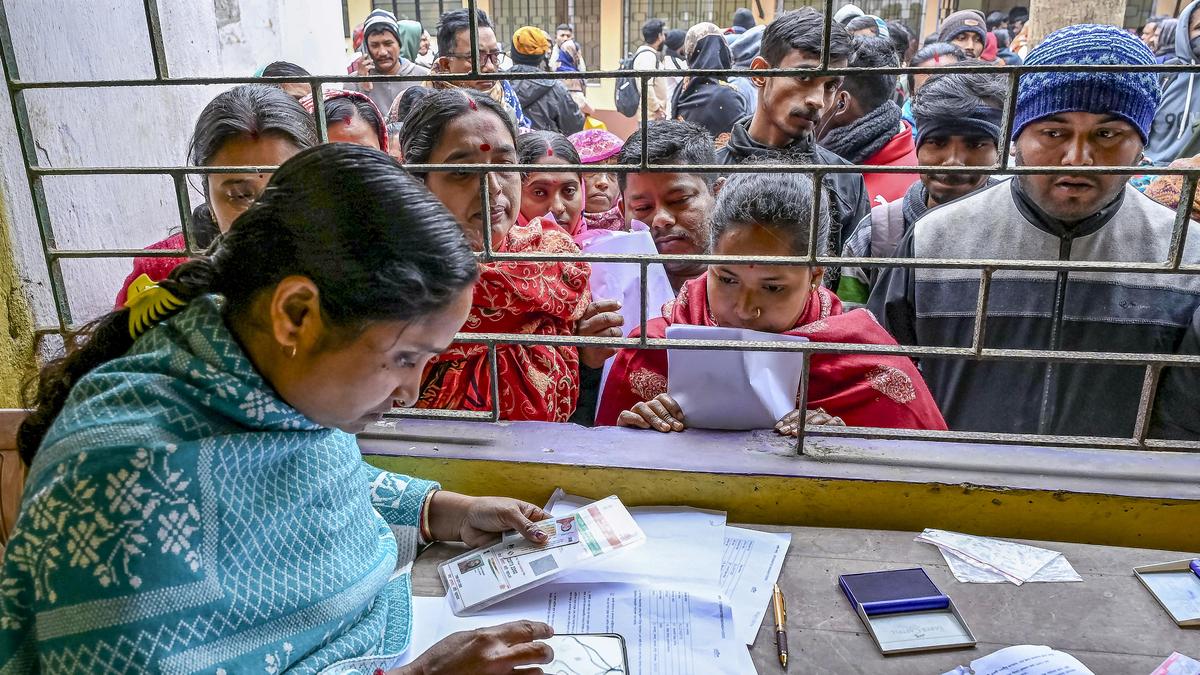
What we had instead in West Bengal was over 60 lakh electors included in the electoral rolls under the “under adjudication” category, with 27.16 lakh of them deleted after a lightning exercise carried out by judicial officers hastily appointed by the Supreme Court of India. Over 700 judicial officers sprinted through a marathon in their ‘supreme’ effort to accomplish the impossible task of disposing these cases in a short span of time. Those whose claims were rejected were asked to appear before non-existent Appellate Tribunals.

How, when, and even whether their appeals will be heard is hard to tell, going by the experience of those placed on the doubtful voters (D-voter) list a few years ago in Assam. No official data is in the public domain to indicate whether their voting rights have been restored or whether they remain in limbo. Soon, the 27 lakh affected in West Bengal may join those “missing in action”. The cruel irony is that the ECI excluded Assam from the current SIR process, even though the National Register of Citizens prepared there a few years ago classified over 19 lakh people as “non-citizens”, yet their voting rights remain unaffected.
A neutrality that faces scrutiny
The ECI has invited an indelible taint by engineering a system that made such omission possible under its ‘superintendence’. What sanctity does its slogan, “No voter to be left behind”, hold if 27 lakh electors were treated as jetsam? How could the ECI “direct” the use of the illogical “logical discrepancy” tool that created discrepancies of its own? Why did it allow the legitimate functions of the Electoral Registration Officer to be exercised by a system beyond its “control”? Why did it announce the election schedule if it was not confident of finalising the electoral rolls on time? Why did it abdicate the legal provision that allowed the existing rolls to remain valid in the case of “under adjudication” electors who could not go through the full process because of a paucity of time? Why did the ECI not seek the Court’s permission to defer the schedule when a mandatory process could not be completed? That the Court did not think it worthwhile to ask the ECI to “tarry a little”, and was willing to “suspend” the voting rights of 27 lakh electors, is inexplicable and unfortunate.
With the gradual fading away of political rivals in the States and at the national level, will we witness more “victories” without a fight because the arena is either bereft of competitors, the challengers are too weak, or the umpire’s decisions tilt the balance? Interestingly, the umpire himself would become an “extra” if there were no competition. Neither the “pathbreaking” constitutional reform of One Nation, One Election nor the idea of an Opposition-mukt Bharat is aimed at fostering competition, and that does not augur well. There will be little thrill left in a one-horse race.
That it strikes at the very roots of the democratic character of the nation may be a minor matter.
Ashok Lavasa is former Election Commissioner of India and former Union Finance Secretary
Published – May 18, 2026 12:46 am IST