



Just war, power balance and modern conflict
Alexander Pope’s famous line, “Now Europe balanc’d, neither side prevails: For nothing’s left in either of the scales”, reminds us that peace without war is perhaps best achieved when there is a balance of power. Hugo Grotius’s concept of a just war was swallowed by the ambiguities of international law and the realpolitik of national self-interest. Special treaties of 1815 and 1839 guaranteed Switzerland and Belgium protection from attack but provided less protection for the latter. The Hague Convention III of 1907 established procedures requiring a formal declaration of war or an ultimatum before hostilities could begin. The Covenant of the League of the Nations (Article 12(1)) believed that antecedent arbitration or judicial settlement and a three month cooling period would obviate war. The Kellogg-Briand Pact (1928) condemned recourse to war and to settle controversies which were prescripted to be achieved by pacific means.
The issue of ‘self defence’
There are ambiguities in Article 2(4) of the United Nations Charter which, in one interpretation, invalidate the “threat or use of force (not war)” against the territorial integrity or political independence of a state. Was this too limited? Certainly, ‘self defence’ finds a prominent place in Article 51 of the UN Charter to recognise an “inherent right of individual or collective self defence ….. (against) armed attack”.
There are textual differences on anticipatory self defence against any imminent danger of attack. The words of the French text invokes this using the word “dans le cas où un Membre est l’objet d’une agression armée” to support the right to self defence before the attack, unlike the Spanish: ‘ien caso de ataque armada’, suggesting, as in the English, self defence if the armed attack occurs. This has direct relevance to the U.S. aggression against Iran and Tehran’s right of self defence. Article 51 should not be seen as an exception to Article 2(4) seeking to abolish war.
No doubt, collective defence treaties such as the North Atlantic Treaty Organization (NATO) are permitted under Article 53, which, in turn, allows NATO to trigger collective self-defence under Article 5 if a member is attacked. This fully explains the remonstrance of NATO countries not to join U.S. President Donald Trump: “This is not our war”. However, the United Kingdom provided support to America through the use of its bases, while Spain denied the U.S. the use of its airspace.
This bilateral attack by the U.S. and Israel on Iran was justified by claims that Iran was developing a nuclear bomb, even though its nuclear facilities had been open to international inspection. But the U.S. and Israel want Iran to become defenceless and surrender all its missiles and weaponry as well. If any country should do this, it should be Israel.
The realities of just wars have been diluted out of any respectable meaning with the fall of the Soviet Union. The balance-of-power protections outlined in Pope’s poem have disappeared. The nub of all this is the concept of anticipatory self defence which the U.S. unswervingly has used in its attack on Vietnam, Libya, Afghanistan, Iraq, Venezuela, and now Iran. Under the doctrine of state responsibility, the U.S. used any excuse to retaliate against the Latin American states in the 19th century if its citizens were threatened claiming that international law sanctioned these because it had the ‘responsibility’ to protect its citizens.
In the famous Caroline incident of 1837, where an American ship was smashed over the Niagara Falls, the British claimed self defence. America’s Daniel Webster (lawyer and diplomat) contemporarily warned against its unchecked disproportionate uses. For Mr. Trump, no law has any meaning. America can no longer claim its role as the peacekeeper of the world.
The West Asia war
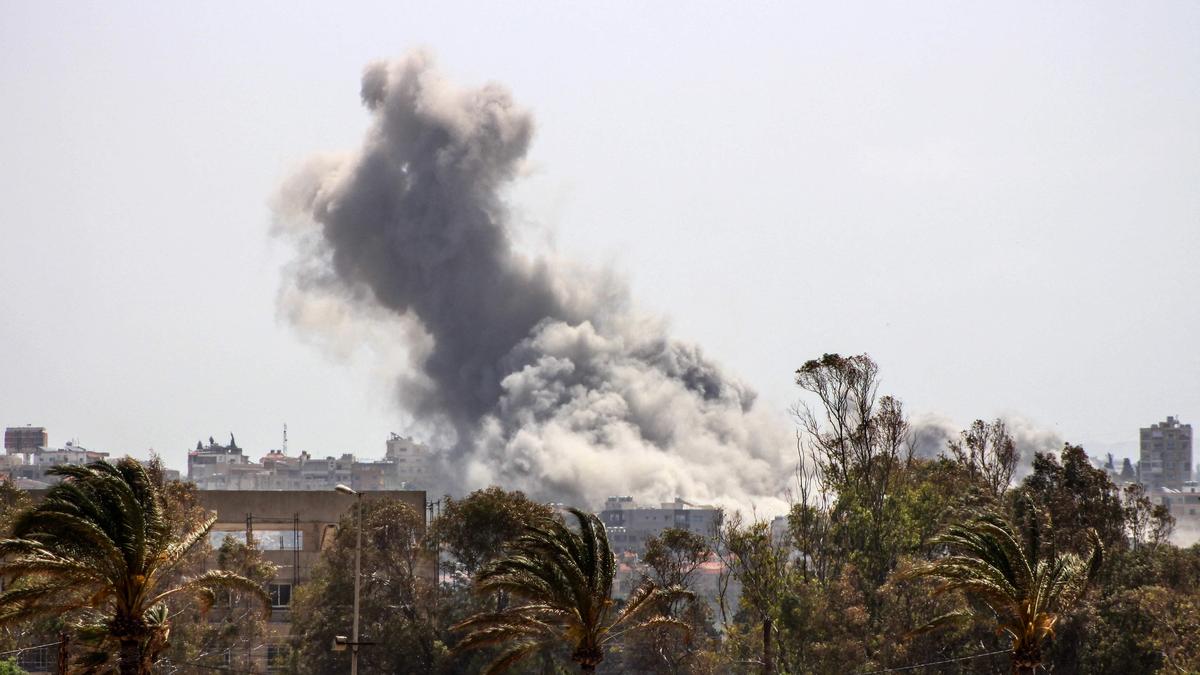
But let us turn to the West Asia war. Israel’s pretence of self-defence against the state of Iran is thin. Its responses in Gaza, Iran, Lebanon and Syria involve territorial aggression and are illegal and genocidal. Mr. Trump’s imperialism is guided by Israel. One recalls seeing a T-shirt in Jerusalem with the legend: “Don’t worry America, Israel is behind you”. It is difficult to understand how survivors of the Holocaust can inflict such inhumane violence.
At the root of the conflict are three important aspects. The first, the Gulf countries have never had the military prowess to defend their oil interests, property and the excessive lifestyle of governing elites. West Asia was broken into a number of nations whose military defence came from imperial nations — earlier from England, and now America. In this helpless situation, they are unlikely to give up their defence arrangements with the U.S. even though its leaders or even populace do not want adverse relations with neighbouring Iran. They are cautious. Eventually, they will side with the U.S. after Iran’s counterattack on their military and energy installations and on the opening of the Strait of Hormuz.
Second, the U.S. wants to control, with the Strait firmly under its control. This is the third phase objective of the ‘undeclared’ war after the first and second phases of the war targeted military and then energy recourses. Mr. Trump wants a negotiated unilateral surrender though his objectives change by the day. If the Strait is to be released from Iran’s control, a limited aerial and a ground attack on Kharg Island and southern Iran will alter the war irretrievably.
The third question concerns who will be responsible for the reconstruction of Iran after the conflict ends, and whether reparations will be provided by the U.S., or by China and Russia, to restore the country and the balance of power.
The talks in Islamabad/Pakistan were bound to fail. The conditionalities of both parties were incompatible. The only issue that should have been discussed was the limited logistics of ceasefire. Other issues did not have a ‘yes’ or ‘no’ answer. Each issue needed to be discussed, step by step in later meetings. Nuclear energy is resolvable by oversight. Iran was open to inspection but this was defeated in Mr. Trump’s first term. Giving up missiles altogether is unreasonable for either side.
Reducing America’s military presence in the Gulf and West Asia will take time and require a multi-lateral meeting of the Gulf states. The answer to the Strait of Hormuz is neither Mr. Trump’s impending war, nor a negotiation between America and Iran. It requires a multilateral discussion initiated by the United Nations or a consortium of nations, including all affected countries, including China, not just Pakistan as a proxy. They have to join the peace initiative anew. Otherwise it is Munich of 1938 all over again. Pakistan has played its part. A wider initiative is needed to look for a solution not thwarted by conditionalities, proxies, or Mr. Trump’s mood and zeal for war.
People and a moral voice
The UN has become meaningless as a peace keeper. Perhaps Mr. Trump wants to lead a U.S.-aligned international council that includes participation from some Gulf countries. We are also witnessing the WTO, which was created to defend America’s imperial economic interest, descending into chaos along with climate change treaties.
The post-World War II which envisaged a human rights-based democratic order has been exposed as a moral façade for global predation and has failed to protect people humanely, while providing moral excuses for imperial actors. Too many sins are created in the name of democracy and human rights.
But to return to the concept of a just war, unsupported by a balance of power to preserve world peace: the concept of a just war has become meaningless except as a much-needed moral voice. This moral voice rests with the people of the world — all of us, not our rulers.
Rajeev Dhavan is a Senior Advocate of the Supreme Court of India
Published – May 14, 2026 12:16 am IST