


India should have stepped into vacuum left by U.S. as guarantor of security in West Asia: Talmiz Ahmad
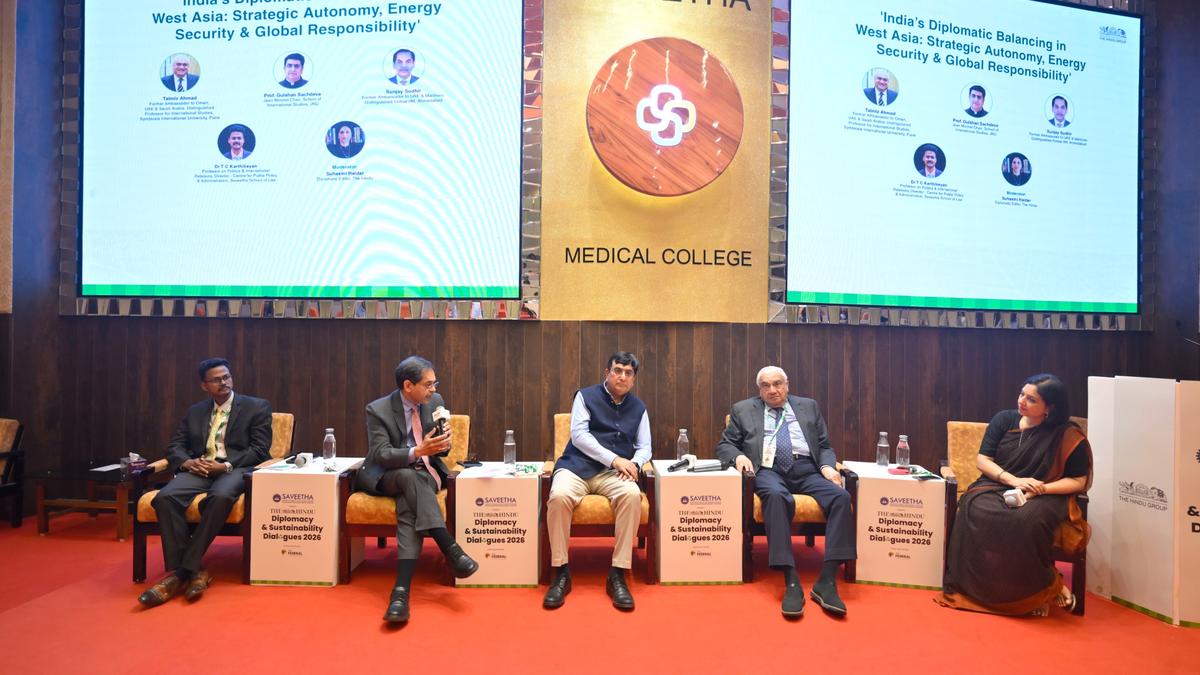
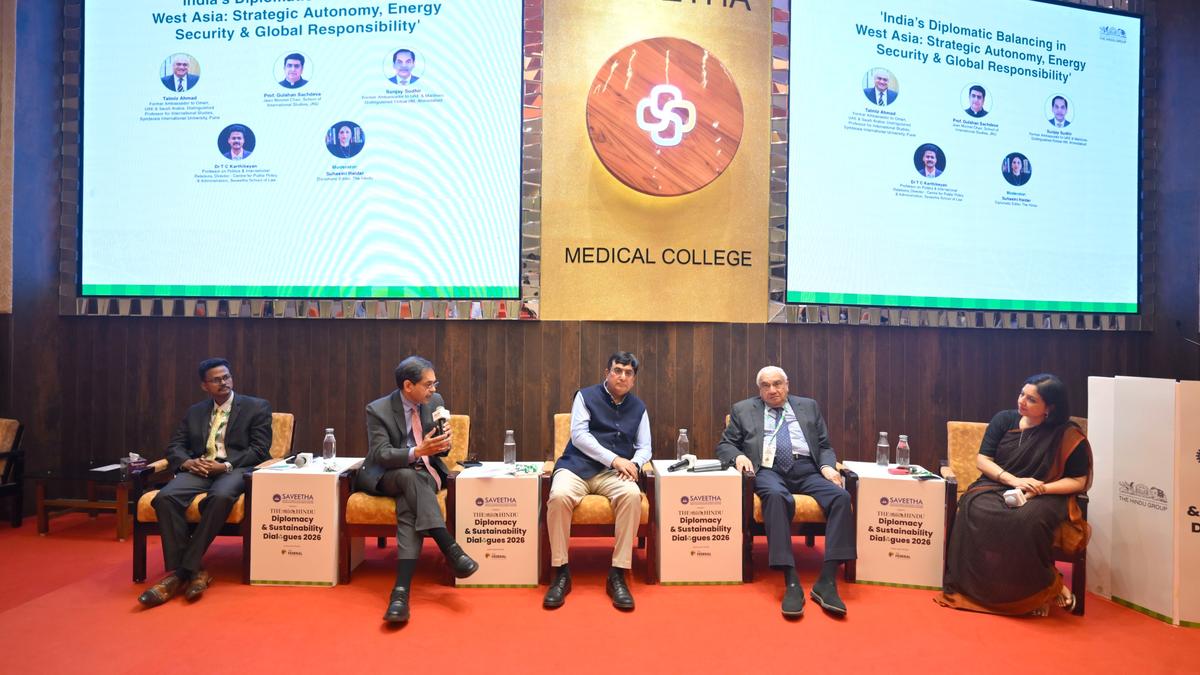
The discussion, titled ‘India’s Diplomatic Balancing in West Asia: Strategic Autonomy, Energy Security & Global Responsibility’, featured (from left) T.C. Karthikeyan, Professor of Politics and International Relations and Director, Centre for Public Policy & Administration, Saveetha School of Law. Sunjay Sudhir, former Ambassador to UAE and Maldives; Talmiz Ahmad, former Ambassador to Oman, UAE, and Saudi Arabia, and professor, International Studies at Symbiosis International University, Pune; and Prof. Gulshan Sachdeva, Jean Monnet Chair, School of International Studies, JNU. The discussion was moderated by Suhasini Haidar, Diplomatic Editor, The Hindu
| Photo Credit: J. Johan Sathyadas
India should have stepped into the vacuum when the United States, which played a dominant role in the West Asia region as the guarantor of security, lost its credibility in the region, said Talmiz Ahmad, former ambassador to Oman, UAE, and Saudi Arabia, and professor of International studies, Symbiosis International University, Pune. He was speaking at Saveetha Institute of Medical and Technical Sciences (SIMATS), which is hosting The Hindu Diplomacy and Sustainability Dialogues 2026.
Speaking on the topic ‘India’s Diplomatic Balancing in West Asia: Strategic Autonomy, Energy Security and Global Responsibility’ on Wednesday (May 13, 2026), the former Ambassador remarked that “India is not a serious role-player as far as West Asia and the crisis over the last two and a half years is concerned.”
Responding to the question posed by Suhasini Haidar, Diplomatic Editor, The Hindu, on how he evaluates India’s policy towards the region in the context of Prime Minister Narendra Modi’s visit to UAE, especially after his recent appeal to the public to deploy austerity measures, former ambassador Ahmad said: “Our approach, over the last several years, has been to have bilateral relations, which is transactional with the countries in the region. We do not have a collective view of the region, nor do we wish to play any role in promoting security and stability there.”
Answering a question over whether he felt India has followed a “balanced” West Asia policy, Sunjay Sudhir, former Ambassador to UAE and Maldives, Distinguished Fellow, IIM Ahmedabad, said that the policy has been rather “pragmatic”.
“It is because we have interests across the region – from Israel and the GCC to Iran. To balance out these interests, the approach has to be pragmatic. The visit to the UAE is a significant statement in itself. Half of our diaspora in the region is in that country and we have a huge amount of trade and Foreign Direct Investment,” he said.
Commenting on India’s role in the crisis in West Asia, Gulshan Sachdeva, Jean Monnet Chair, School of International Studies, JNU, said that India had taken a side in West Asia even before the war had begun.
“I would say that our assessment was not really correct. We thought that it was going to be a short and an easy war and they (U.S. and Israel) were going to win. We are trying to, perhaps, balance since then…” he said, adding, “Our one relationship with Israel should not become a liability, not only in West Asia, but in the entire global south. In the long run, things are going to settle.”
T.C. Karthikeyan, professor on Politics and International Relations, Director – Centre For Public policy and Administration, Saveetha School of Law, added, “Whenever nations face economic hardships, some people may emerge saying they can offer all the solutions. We have to be mindful of the emergence of dictatorships. India should play the role of a facilitator – principled and committed to international rules-based order.”
Published – May 13, 2026 03:25 pm IST