



India managed the West Asia crisis to reduce impact on fuel consumers
The West Asia conflict created enormous challenges for the oil and gas industry across the globe. The Strait of Hormuz, 21 miles wide at its narrowest point, is a thin water channel separating Iran from the Musandam Peninsula of Oman. Through it, roughly 20 million barrels of crude oil and equivalent products used to pass every day, along with about a fifth of the world’s traded liquefied natural gas (LNG). There is no alternative route. Therefore, it remains one of the busiest circulatory systems of global oil and gas trade.
Heightened tension, conflict, and a war situation engulfed the trade route with blockades, resulting in blockage of the flow of crude oil and LNG through this route. India’s exposure is extremely high due to overdependence on the Strait of Hormuz. This fact is clear from the trade statistics that India relies on Gulf states for 40% of its crude and over 80% of its LNG imports. Hence, the Strait is critical for India’s energy trade. The impasse on the single largest energy trade route created serious bottlenecks for the world’s third largest energy consumer.
On a war footing
India traditionally maintains a very strong diplomatic relationship with Iran, Israel, and the U.S. It is fair to argue that India stands to manage the emerging challenges more effectively. Under the leadership of Prime Minister Narendra Modi, multiple Ministries tirelessly worked to ensure that the domestic stakeholders, most importantly consumers of petroleum products, are least affected by the West Asia conflict. The government meticulously planned and executed strategies to keep the external shocks away from the domestic consumers. For example, the government anticipated a potential LPG crisis that could have a far-reaching effect on domestic households, commercial set-ups, and industrial consumers. Despite all possible challenges, the Ministry of Petroleum and Natural Gas acted in a timely way to resolve the challenges. Considerable efforts were made by the petroleum industry to increase domestic LPG production to minimise the impact of LPG import constraints. Despite all the bottlenecks, private and public sector companies worked collaboratively to maintain supply security of petroleum products. The government’s timely action to increase natural gas supply to the city gas distribution system avoided any possible crisis.
To avoid any supply shortage in the domestic market, the government imposed a temporary export levy on diesel and aviation turbine fuel. Such measures were necessary not only to meet domestic demand but also to reduce international price fluctuations, though to a less extent. Strategic measures such as reduction of excise duty on petrol and diesel resulted in maintaining the domestic price affordability. During the period of conflict, multiple countries across the globe increased the price of petroleum products. Since February 2026, gasoline prices have increased by 24-35% in countries such as Japan, Spain, South Korea, Israel, Germany, the U.K., Italy, and Singapore. Despite the insurmountable challenges, the Indian government maintained a steady petroleum products supply with price stability. Many may argue that the price hike was stalled in view of to elections in multiple States such as West Bengal, Assam, and Tamil Nadu. But the reality is that the government carefully assessed the limited ability of the middle class to bear the price escalation burden. It seems the government felt that the domestic consumers need sufficient protection from price escalation and subsequent consequences.
The government and the oil marketing companies (OMCs) readily absorbed the fiscal burden. It is estimated that these companies’ under-recoveries (mid-March to April-end) with excise cut stands at approximately ₹30,000 crore. Without excise duty cut, this figure rises to about ₹62,500 crore. Almost over 100 countries could not escape the cascading effect of West Asia crisis, which include supply disruptions, rationing of petroleum products, and price escalation. Till this point, India managed the situation better than others having similar resource constraints. However, rising crude oil prices, may force the refiners and marketing companies to increase petroleum product prices. It is evident that some point in time, the OMCs are likely to partly pass on the price escalation down the line and consumers may not be surprised with such decisions soon.
Strategic reserves
The government’s decision to build Strategic Petroleum Reserves (SPR) of 5.33 million tonnes (MMT) over the past 10-12 years, which offers a plenty of cushion. The West Asia crisis reaffirms that India must expand the SPR beyond 10 MMT. Focus on compressed biogas and 20% ethanol blending supports crude oil import reduction. More importantly, the government’s push for energy basket diversification with emphasis on renewable and sustainable energy will serve the national interest.
Further, to mitigate risk and facilitate trade, the government made numerous diplomatic and strategic efforts. For instance, creating a safe passage for Indian vessels through the Strait of Hormuz is a result of astute diplomatic outreach by the Ministry of External Affairs. Due to the West Asia conflict, the insurance (risk) premium for the petroleum importing companies through the Persian Gulf increased drastically, resulting in severe challenges for the importers. To facilitate the Indian companies’ trade, the Cabinet under Mr. Modi created a ₹12,980-crore Bharat Maritime Insurance Pool. This visionary strategic decision could mitigate the risk arising out of global volatility, geopolitical instability, and Indian vessels’ overdependence on foreign insurance. This offers timely support to the vessels operating between Indian and foreign ports.
Naya Bharat under Mr. Modi stands tall to mitigate risks and convert challenges into opportunities. The West Asia crisis is not the last but India’s readiness to deal with such shocks are better than before. Over 120 nations saw a surge in fuel prices as geopolitical tensions rattled global energy supply chains. Whether developed economies or emerging markets, governments worldwide transferred the weight of soaring crude costs onto consumers, hiking petrol, diesel, and aviation fuel rates.
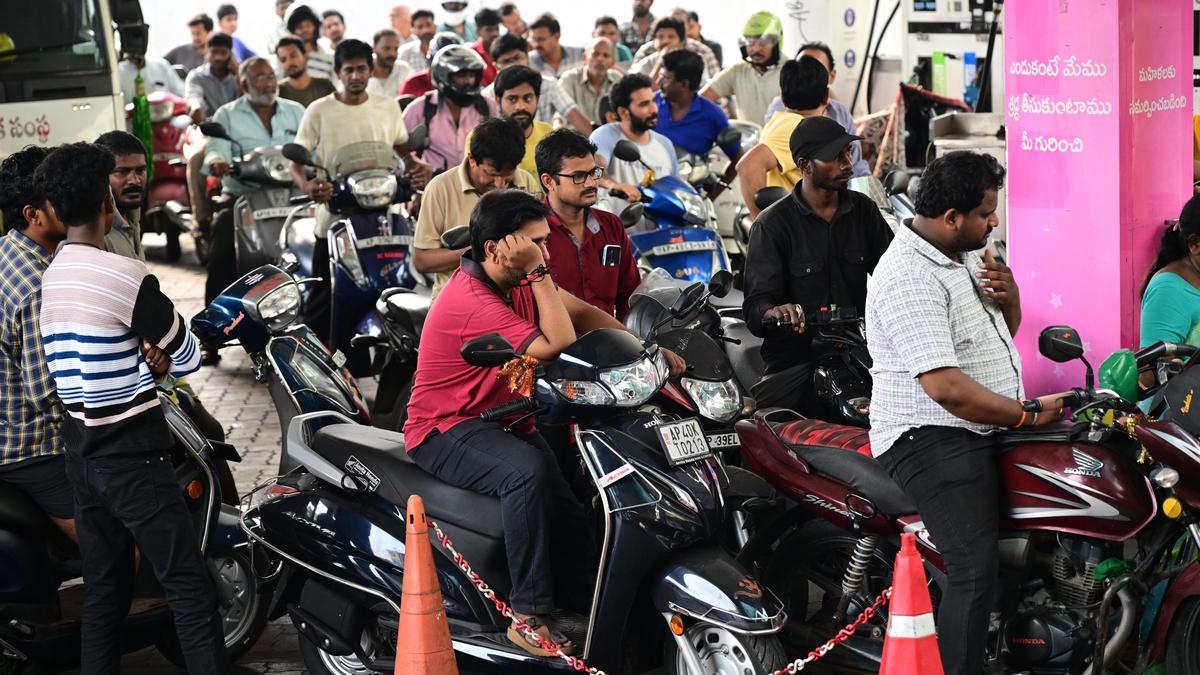
Some countries went as far as imposing rationing measures and rolling out emergency fiscal packages to keep their domestic markets afloat. India, however, charted its own course. Petrol and diesel rates stayed put, LPG supplies flowed uninterrupted to more than 33.5 crore households, and aviation turbine fuel prices held firm. The Indian government, working hand-in-hand with its public sector oil companies, deliberately shouldered immense pressure across the entire energy value chain.
That said, this cushion cannot last indefinitely. With global crude prices showing no signs of cooling and oil marketing companies bleeding under mounting under-recoveries, an upward revision in domestic fuel prices now appears inevitable. India has stretched its buffer as far as economically feasible, and the moment to recalibrate pump prices is fast approaching.
Sanjay Kumar Kar is a Professor at the Rajiv Gandhi Institute of Petroleum Technology. Views expressed are personal
Published – May 08, 2026 08:59 pm IST