



I Drove The ‘Old’ Zeekr 001. This Chinese EV Still Feels Like The Future
Zeekr is the newest brand from Chinese car conglomerate Geely. It was founded in 2021, and the 001, a large pure electric fastback, was its first model. While it’s been on sale in China for around five years, it has only just become available in Europe, where I got to live with it for a week. It’s no equal to the newer, China-only model, but this five-year-old Chinese EV still feels ahead of the pack in Europe.
The new 001 you can buy in China today is a refreshed model with an upgraded 800-volt architecture; it charges faster and has more performance. The European 001 is the older 400-volt version, lacking the improvements found in the Chinese version. That sounds like a reason to shrug and go back to looking at used Taycans.

Photo by: Andrei Nedelea
But if you drive it, you realize: this thing isn’t a “good for a Chinese car.” It’s just good, and better than a lot of more expensive EVs. It feels like a lot of high-quality car for the €58,500 starting price here in Romania.
Before driving it, I thought of the 001 as a budget alternative to the Porsche Taycan Sport Turismo, which it is in many ways. But after I spent some time with it, I realized it’s not trying to imitate Porsche or any other brand. It may be a premium brand built around precision engineering, but it’s more than just a Porsche rival. It’s not perfect, and there are a few things I’d change about it, but it should worry legacy luxury brands.
Zeekr
Base Price
€58,500
As-Tested Price
€68,000
EV Range
385 miles WLTP
Battery
100 kWh
Drive Type
Dual-motor all-wheel drive
Output
536 hp
Maximum torque
506 lb-ft
Speed 0-62 MPH
3.8 seconds
Charge Type
CCS @ 200 kW
Charge Time
10-80% in 30 minutes
It Looks Expensive
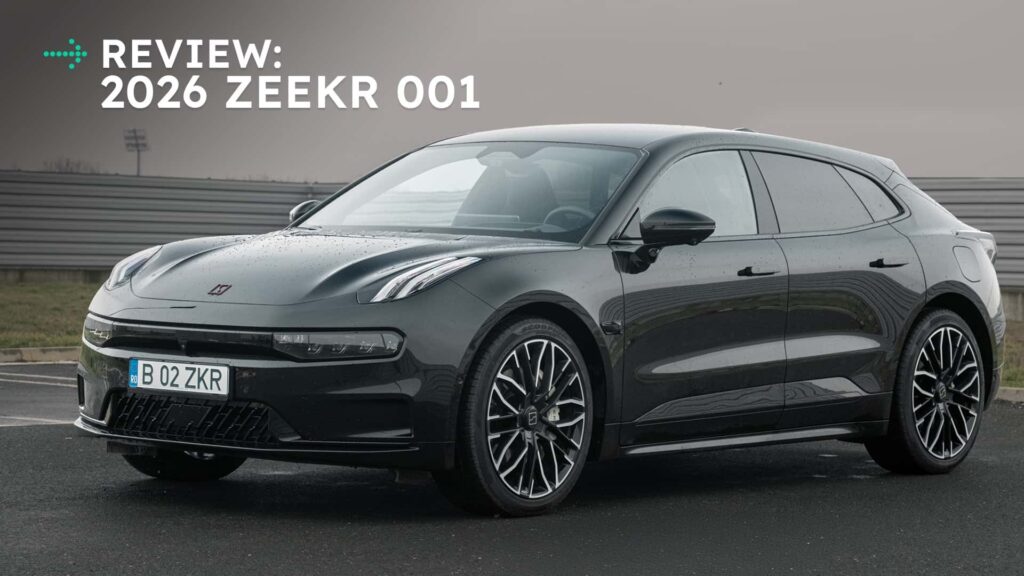
Even though the Zeekr 001 is a Chinese car built in China, very little about it feels Chinese. That’s because it was designed in Sweden, home of Geely brands Volvo and Polestar. The 001 has distinctive LED daytime running light strakes, with the headlights hidden behind a smoked panel below, making it look sporty and a bit sinister (especially if it’s all black, like my tester).
The car looks taller in person than it does in photos. It’s really surprising just how big it looks up close, making it seem like a vehicle a size class above the Taycan Sport Turismo, even though it’s almost the same size as the Porsche.
The Zeekr is 1.3 inches (3.3 cm) wider, 6.1 inches (15.6 cm) taller, and its 118.3-inch (3.005 m) wheelbase is 4.1 inches (10.5 cm) longer than the Porsche’s. These numbers explain why you sit so much higher in the Zeekr and why its back seat is so much more accommodating.
Photo by: Andrei Nedelea
It manages to hide its extra height well when viewed from the side, even though it’s nearly as tall as a Macan EV. My tester had optional height-adjustable air suspension, which transforms the car’s look when set to its lower setting.
But the best part of the design is its rear end. It has a sporty-looking, slanted fastback rear end with a full-width light bar featuring clusters of blade elements that light up individually, making it look quite sophisticated. Of course, it has an animation when you lock and unlock it, using the extensive rear illumination to full effect.
My top-of-the-range Privilege tester came with some striking-looking diamond-cut 22-inch wheels, which went really well with the Phantom Black exterior. I thought it made the car look a bit more understated than some of the lighter available hues, but people couldn’t take their eyes off it. I even got a couple of thumbs up from a few people on the sidewalk. When was the last time you drove something this attention-getting from an established premium brand?
It Feels Expensive
My Privilege trim tester had everything you could ask for. There is an even more expensive Sport Edition trim, but it doesn’t add any extra toys; it just brings some cosmetic changes, like orange brake calipers, unique 22-inch wheels, and an interior theme with lots of orange.
The car I drove had a black and grey interior with copper details, and I found little to criticize. The copper accents (including contrasting stitching) look and feel nice, giving the cabin a unique vibe and a lot of personality. Only the steering wheel has real leather, but the animal-friendly alternatives used throughout the cabin feel nice and don’t detract from its luxurious aspirations.
The steering wheel feels nice in the hand and looks pretty sporty, but the two touch pads on the prongs seem like a bad idea. Just touching an area on either pad brings up the function in the head-up display, and over time, you learn where to press, for instance, to raise or lower the media volume, but it just seems contrived. Zeeker has addressed this and given the facelifted 001 (available in China) physical buttons on the wheel. I can’t wait for that update to make it here.
Photo by: Andrei Nedelea
Adjusting the driving position to fit my six-foot frame with rather long legs, I found there wasn’t enough reach adjustment for the steering column. It just didn’t come as close to me as I would have wanted, so I had to bring the seat closer to the pedals than I felt comfortable with. I could have used an extending thigh support to feel even more comfortable.
But this wasn’t a deal-breaker, and after a while, I got used to the driving position. It’s just not as good as in a BMW or Porsche, where you sit much lower and can bring the steering wheel much closer, which is what you want if you are a keen driver. Overall, there is no getting around the fact that the driving position in the 001 was closer to a crossover than to a sports car.
I’m not a fan of big screens stuck to the middle of the dashboard. But you have to use one in the 001 for most car functions. The 15-inch unit looks and runs fine, with good graphics and minimal lag, though it sometimes hangs for a second when switching between menus. The car gets a slightly larger, better OLED screen in China, which has more processing power, so it should run smoother, too.
I have to give a shout-out to the back seat, which was fantastic. The Privilege allows you to electrically recline the rear backrests just enough to lean back and really relax on a long journey. The rear seats were also heated, and there’s a 7.7-inch touchscreen back there, allowing you to adjust climate and media settings or change the color of the ambient lighting.
Packs Plenty Of Punch
Photo by: Andrei Nedelea
You would expect an electric vehicle the size of a 001 to be heavy, and you would be absolutely right. With its big 100-kilowatt-hour (94 kWh usable) NMC battery and dual-motor setup, it weighs just over 5,300 lbs (2,410 kg), which is why its 544 hp and 506 lb-ft (686 Nm) output (courtesy of two identical 272 hp motors) only gets it to 62 mph (100 km/h) from a standstill in 3.8 seconds.
Dual-motor 001s are WLTP-rated at up to 363 miles (585 km), or if you can live with the single-motor 272 hp variant that sprints to 62 mph in 7.2 seconds, that jumps to 385 miles (620 km).
Unlike its newer stablemates, the 7X and 7GT, which run at 800 volts and have the highest charging power of any EV available in Europe, the 001 makes do with 400 volts and a peak charging speed of 200 kW. That’s not a bad number, and it’s still good for 10-80% in 30 minutes. There’s much better kit on the Zeekr shelf, though, and I hope the 800-volt upgrade for the 001 makes it here soon.
Photo by: Andrei Nedelea
Depending on how you drive, you may find yourself charging up the 001 fairly frequently, especially if you take it on the highway and to the speed limit. My average just driving around town before I took the car out on faster roads was around 2.37 miles/kWh (26.2 kWh/100 km), which means a full battery would take you maybe 220 miles (360 km). Keep in mind that my testing was done in winter, so you should expect better numbers in warmer weather.
That dropped to 2.15 miles/kWh (29 kWh/100 km) while doing a constant 80.7 mph (130 km/h), which is the national highway speed limit in Romani. At that pace, you’d be lucky to get 190 miles (305 km) on a full charge doing the speed limit on the highway during the winter.
After some highway time, I pulled into a 350 kW charger. I preconditioned the battery for about 10 minutes before I plugged it in at a 24% state of charge. It started charging at 110 kW and peaked at around 145 kW, about 40% before tapering off to below 70 kW by the time it reached 75%. Those are fairly average results, and below the rated figure. Again, that upgraded model would help here.
Comfort Meets Handling
Photo by: Andrei Nedelea
There’s something a bit weird about the power delivery in the 001. Unless you’re in sport mode, even if you floor the accelerator pedal, the power only feeds in gradually, making it feel even slower and less responsive than some combustion cars. Even in sport mode, you still get this gradual wind-up, although it’s much quicker, and it does feel every bit as powerful as the stats suggest. It’s definitely not meant to wow you with insane acceleration.
The suspension in the 001 was really impressive. My top-of-the-range tester had height-adjustable adaptive air suspension that ironed out road imperfections remarkably well, even with the 22-inch wheels that come as standard on the Privilege. The car was really good at soaking up bumps and even going over rough roads. The suspension went about its business in a very hushed manner. It was quieter than in most Mercedes-Benz cars with a similar setup that I’ve been in recently.
Photo by: Andrei Nedelea
Firming and lowering the suspension transforms how the car feels, and it becomes surprisingly sharp and sporty. You can carry a lot of speed through the corners in a 001, and it manages to feel smaller and lighter than it really is, giving you confidence to push it a bit on a bendy stretch of tarmac. It’s not quite as good as a BMW i5 Touring M60, but it’s sportier than any other Chinese car I’ve ever driven, and it has a character of its own.
The steering is quite light and is almost completely devoid of feedback, even in sport mode, but this is true of most new cars now. I really like the brake pedal calibration in the 001, which does a fantastic job of seamlessly blending the friction brakes with regen. The brakes in this car inspired more confidence than the steering, but that was still precise enough not to make taking corners fast feel like a gamble.
Soundproofing was remarkably good, too. Wind and road noise were minimal at highway speeds, and the latter should be even better with quieter summer tires and the smaller 21-inch wheels. Overall, this car felt unexpectedly dynamic yet very luxurious and comfort-oriented.
Fancy, Fast, And Fully-Featured
45
Source: Andrei Nedelea
Buying the 001 in Europe makes a lot of sense given how much it costs and how much (very premium-feeling) car you get for the money. The base car here in Romania starts at €58,500, and if you want the 544 hp all-wheel drive powertrain, that’s an extra €5,000. My Privilege tester cost €68,000, which sounds pretty reasonable for what you’re getting. The top trim, the Sport Edition, bumps the price to €70,500, and that’s worth it given its cosmetic changes that give the car a more aggressive demeanor.
It’s definitely a worthy rival for cars that cost €100,000 or more, and it leaves me wanting in very few areas. It’s also a much rarer sight on European roads than anything from Porsche or BMW, making it a unique choice. Already, it’s one of the few big, sporty electric fastbacks that you can buy today. Having previously experienced Zeekr vehicles and knowing the standards they aspire to, I had high expectations for the 001. Despite its age, the Zeeker still left me pretty impressed.
The strange part isn’t that Zeekr built something this good. The strange part is that it’s already been doing it for a few years, and Europe is only just noticing. Having now driven the 001 and 7X, and having seen how the latter has progressed, I’m more excited than ever for the company’s upcoming Euro-market electric wagon, the 7GT.