


2027 Mercedes C-Class EV vs. 2027 BMW i3: Which Is Better?
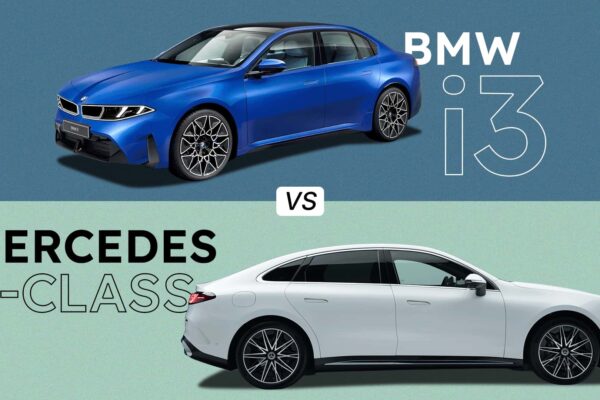
Mercedes has just revealed the electric C-Class, a direct rival to the BMW i3. These two long-range, charging-monster EVs are about as direct as rivals get, but they have diverging approaches to the electric compact executive sedan problem.
What they both have in common is 800-volt platforms with all the benefits they bring, as well as features that would have seemed far-fetched in older EVs from both manufacturers. Even though Mercedes says the new C-Class EV is “the sportiest C-Class ever,” it still leans much more toward cushy luxury than the BMW.
On paper, the BMW has the edge with better charging and range figures, but the launch version of the Mercedes has more power and torque. We don’t have the complete list of specs for both models, but the manufacturers have released enough for us to get a pretty good idea of how these two vehicles compare.
Same Segment, Different Size

Photo by: Mercedes-Benz
Photo by: BMW
The Mercedes is 192.2 in (4.88 m) long and rides on a 116.6 in (2.96 m) wheelbase, while the BMW is 187.4 in (4.76 m) long and has a 114.1 in (2.89 m) wheelbase. This makes the C-Class 4.8 in (12 centimeters) longer with a 2.5 in (6.5 cm) longer wheelbase. It’s also 1.1 in (2.7 cm) wider and 0.9 in (24 mm) taller.
The C-Class EV is actually closer in size to the gas-powered E-Class sedan, while the i3 is a more 3 Series-sized proposition. Even though it’s fairly big, the C-Class doesn’t offer that much space for rear occupants. Sitting in the back, my six-foot frame just about fit, but I had less room for my feet and knees than I would have thought. The i3 seems to have a bit more room, even though it’s marginally smaller on the outside.
With its 16.6 cubic-foot (470-liter) trunk complemented by a 3.6 cu-ft (101-liter) frunk, the C-Class EV should be pretty practical. BMW hasn’t released official cargo volume numbers for the i3 yet, though, so we can’t directly compare.
Power Play
Photo by: Mercedes-Benz
Photo by: BMW
The launch-spec C400 4Matic has a dual-motor powertrain that produces a combined 482 horsepower and 590 pound-feet (800 Nm) of torque, which allows it to accelerate from a standstill to 62 mph (100 km/h) in 3.9 seconds. The rear motor provides most of the motivation and is hooked up to a two-speed transmission that Mercedes says helps with both acceleration and efficiency, and the front motor can also mechanically decouple from the wheels to save electrons.
The i3 xDrive 50—its launch spec—has the same powertrain as the equivalent iX3 model we recently reviewed. This means it packs 469 hp and 476 lb-ft (645 Nm), putting it 13 hp and 114 lb-ft (155 Nm) behind the equivalent Mercedes in power and torque, respectively. BMW hasn’t published an official acceleration figure for the i3 yet, but given that the heavier iX3 with the same power needs 4.9 seconds, a safe estimate for the i3 is around 4.5 seconds.
Both Mercedes and BMW will launch additional model variants, including wagons. They will likely get more efficient single-motor variants, as well as performance models bearing AMG and M badges, respectively. The electric M3 equivalent is believed to feature a quad-motor setup with advanced torque vectoring and a lot more power than today’s combustion models. The AMG version of the electric C-Class is reportedly getting a three-motor setup.
BMW Wins Charging
Photo by: Mercedes-Benz
BMW Neue Klasse Gen6 High-Voltage Battery Pack Assembly
Photo by: BMW
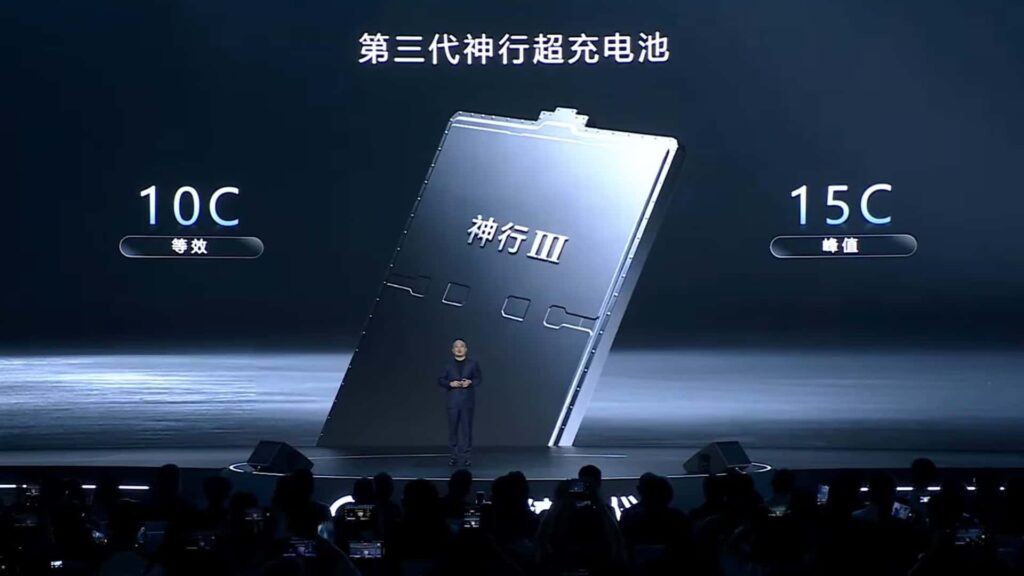
The BMW i3 easily beats the C-Class Electric in terms of range. It has a bigger 108.7 kWh pack than the C-Class’s 94.3 kWh, giving it a WLTP range of 559 miles (900 km) to its rival’s 473 miles (762 km) rating. (WLTP figures are generally more optimistic than EPA range figures, which have not been released.)
It also charges faster with a peak charging power rating of 400 kW, which can add 249 miles (400 km) of range in 10 minutes and take the battery from 10% to 80% in around 21 minutes. The Mercedes has a lower peak rating of 330 kW. It can replenish 202 miles (325 km) in 10 minutes and go from 10% to 80% in 22 minutes. If it’s like the GLC EV that I charged, it should exceed its maximum charging rating and reach over 350 kW in ideal conditions.
The specs for the single-motor, small-battery iX3 have already leaked, and it has an 82.6 kWh battery that can go 395 miles (620 km) WLTP. Its single rear motor delivers 315 horsepower, pushing it to 62 mph in 5.9 seconds. BMW will very likely mirror these specs in a future i3 variant, although it could also launch a single-motor version with the big battery, which could deliver a truly astounding range figure.
Both models support vehicle-to-load (V2L) bidirectional charging, and BMW has confirmed that the i3 also supports vehicle-to-home (V2H) and vehicle-to-grid (V2G) charging.
Two Kinds Of Tech
Photo by: Mercedes-Benz
Photo by: BMW
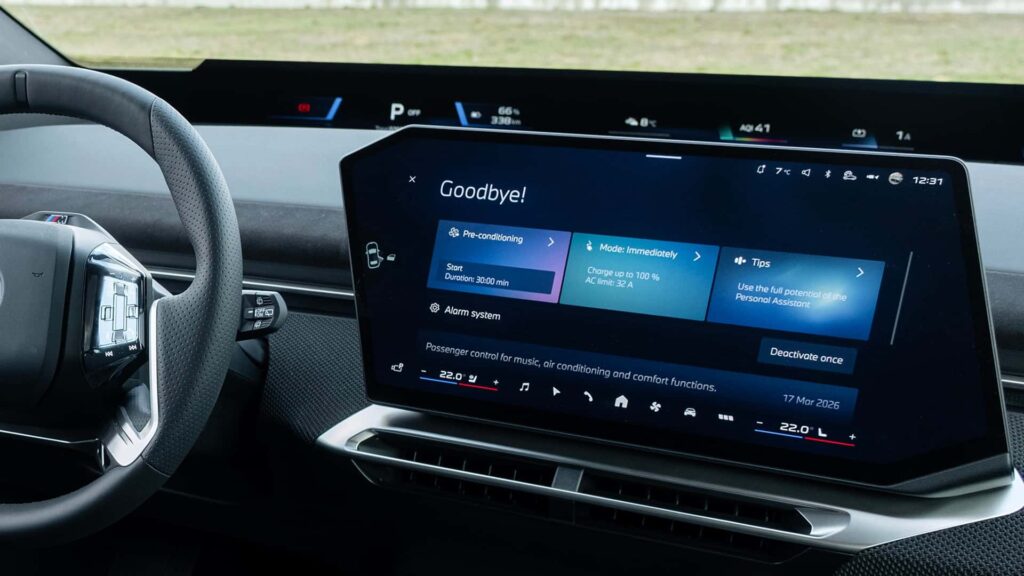
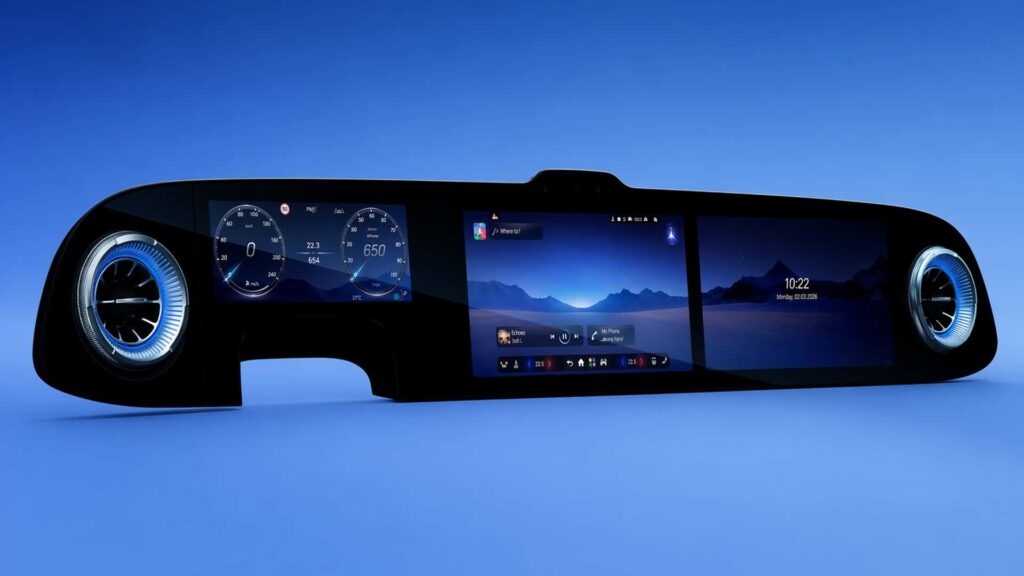
Both of these two electric sedans are very advanced, but they go about displaying their tech quite differently. The BMW adopts a ‘shy tech’ approach, hiding much of its integrated tech until it’s needed or interacted with, while the Mercedes flaunts its features more in-your-face.
Just take the huge 39.1-inch pillar-to-pillar dashboard display in the C-Class. It’s a single screen bigger than anything we’ve ever seen in a car, and it feels like a very brash way of shouting about how futuristic the car is. This setup is optional; the standard setup consists of three separate screens.
By contrast, the BMW is a lot more restrained. Sure, the 17.9-inch parallelogram-shaped center screen is a pretty bold decision, but aside from its shape (meant to remind you of how the center console was angled toward the driver in older BMWs), it’s a pretty ordinary infotainment display (albeit a good one).
The 43-inch panoramic display spanning the entire lower edge of the windshield in the i3 is a cross between a traditional screen and a head-up display. It displays all the important information right in front of the driver and has six additional slots to choose from a wide selection of widgets. I really enjoyed the setup in the iX3, so I’d give BMW the edge here.
The optional Comfort and Agility Package for the C-Class gives it adaptive air suspension and 4.5 degrees of rear-wheel steering. This pack gives the C-Class a broader range of personalities than the i3, which gets neither of these features. If these features are as good in the C-Class as they were in the GLC EV that I drove, and they probably are, it will give the Mercedes levels of comfort and adaptability that the BMW can’t match.
BMW, for its part, made a lot of noise about the Heart of Joy supercomputer that controls how the i3 drives. I’ve already experienced it in the iX3 SUV, and it delivers a very smooth, sharp, and controlled driving experience, making provoking oversteer fun and controllable. It also allows the vehicle to perform a limo stop, which gracefully brings the car to a halt without jolting your head against the headrest. The Mercedes stops smoothly, too, but it’s not as smooth as the BMW.
Same Fight, New Rules
Photo by: Mercedes-Benz
Photo by: BMW
This feels like the return of an old rivalry under very different terms. Mercedes and BMW are once again chasing the same buyers, but their views on what makes a good electric sedan seem to have diverged. Mercedes seems more interested in translating its existing brand values into the EV age, while the other is leaning on electrification as justification to break with tradition, even if it remains heavily inspired by heritage.
It’s more than just a simple spec sheet showdown (which the BMW clearly wins). It’s really about two very different visions of what buyers will want next.
The i3 looks like the more advanced, more futuristic electric car, while the C-Class wants to be more of a well-rounded luxury sedan that just happens to be electric. We’ll have to drive these cars back to back to pick our favorite, but we’re happy that this age-old rivalry lives on in the electric age.