




Charged EVs | Korean researchers solve the thick-magnet coercivity problem with a sandwich-structured grain boundary diffusion process
Nd-Fe-B magnets have a scaling problem that limits high-power EV motor design: the grain boundary diffusion process that gives them high-temperature coercivity only works well near the surface. As magnets get thicker to handle higher torque and power, the core degrades while the exterior performs, meaning the interior of a thick magnet is working against you. Researchers at Korea Institute of Materials Science (KIMS) have developed a process that puts the diffusion source inside the magnet rather than just on it.
The method stacks multiple magnet layers, applying a praseodymium-based light rare earth alloy at both the outer surface and the interlayer interfaces before bonding the stack together. Because diffusion initiates at internal boundaries as well as the surface, coercivity builds up uniformly through the full cross-section. Coercivity is what allows a magnet to hold its magnetization under the heat and opposing magnetic fields generated during high-speed motor operation—lose it in the core, and the whole magnet underperforms.
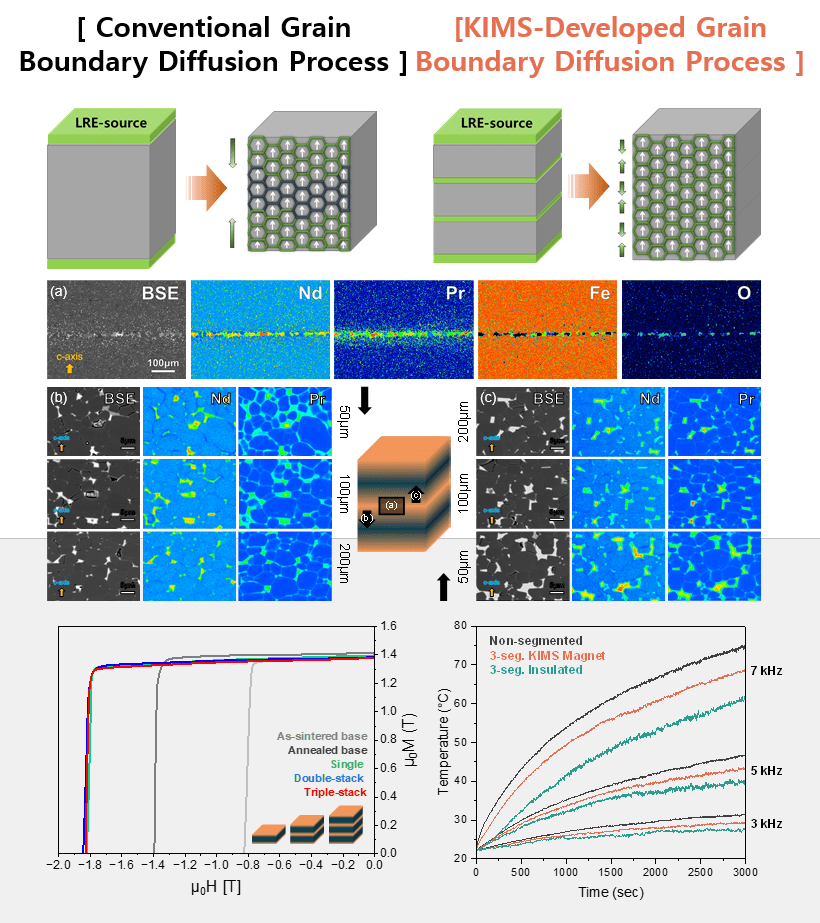
The approach also handles a second problem in a single step. High-speed operation drives eddy currents through the magnet, generating heat that further degrades performance. The layer boundaries formed during the diffusion process create a high-resistivity structure that suppresses eddy current formation. Three conventional operations—segmentation, grain boundary diffusion, and insulating bonding—collapse into one.
Heavy rare earth elements like dysprosium and terbium are the standard fix for high-temperature coercivity, but they’re expensive and almost entirely sourced from China. Using praseodymium, a light rare earth, as the diffusion medium reduces that dependence.
Specific coercivity and resistivity values weren’t disclosed in the announcement. The team says the technology is applicable to EV traction motors, industrial motors, wind generators, and large-format applications like electric ship propulsion. Follow-up work for practical motor integration is underway.
The study was published in Scripta Materialia on March 18, 2026. Lead researchers are Su-Min Kim and Jung-Goo Lee at KIMS.
Source: Korea Institute of Materials Science