



Charged EVs | Inside Henkel’s Battery Application Center, where adhesive formulations meet production-line robots
Most adhesive and materials companies ship samples. Henkel built a factory inside its lab.
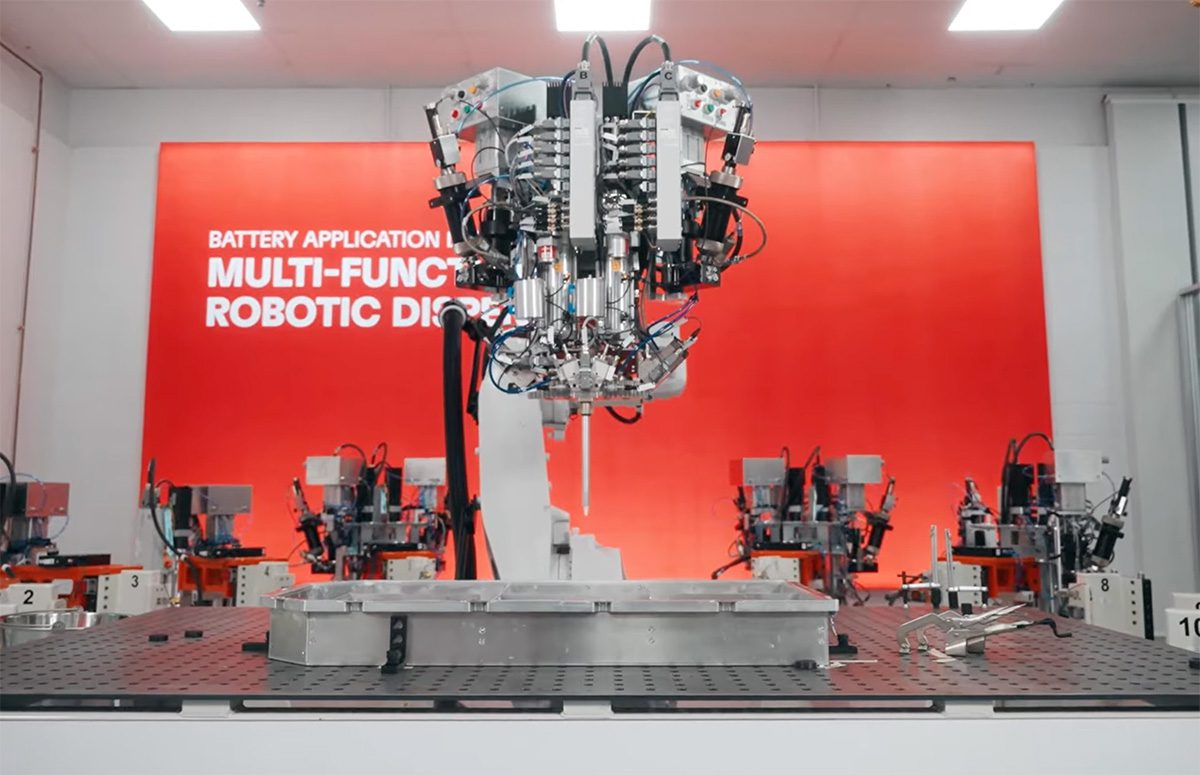
The Battery Application Center in Madison Heights, Michigan, is set up with production-intent dispensing equipment, a six-axis ABB robot and pump systems sized for full-scale EV battery housings. OEMs and battery manufacturers can bring their actual components in, run them through real dispensing processes and walk out with data on bead application, flow rates, temperatures and material behavior at production speeds.
“It takes the conversation very quickly from just focused on samples to more of a co-system based co-engineering with our partners and customers,” said Pankaj Arora, Vice President of Henkel’s electronics, eMobility and automotive components business for North America. The facility, he said, combines application capabilities, technology expertise and advanced modeling and simulation under one roof.
Charged recently visited the Battery Application Center to see what’s inside and talk to the engineers running it.
Production equipment in a prototyping lab
Chloe Jindra, a senior application engineer at the center, walked us through the dispensing setup. The robot cell handles both one-component and two-component cartridge and bulk dispensing across polyurethanes, epoxies, thermals and silicones. Multiple dispense heads allow the team to switch between material types without rebuilding the cell.
“These HMI tools allow us to control certain factors like our flow rates and our pre-pressures as well as our bead size,” Jindra said. “So that way we make sure we get the perfect bead size for our customer every time.”
The pump systems accommodate German-sized pails (Hobocks), standard pails and drums. All of them are heated to manage viscosity, which matters when you’re dispensing materials that behave differently at room temperature than they do at the 40–60 °C range where production lines typically run. Operators can call and sequence dispensing programs from the HMI without entering the robot cell, and the safety system switches between automatic and teach modes depending on whether customers are present on the floor.
De-bonding on demand
Gluing a battery pack together is one engineering challenge. Taking it apart is another.
Matt Boback, who is the senior manager of the Battery Application Center, said a growing share of the work now focuses on de-bonding: making adhesive joints that can be reversed on purpose. The target applications include in-plant rework, field service repairs and end-of-life recycling.
“We focused in on two main triggers,” Boback said. “These are both either electrical or thermal de-bonding triggers to safely remove and de-bond the assemblies.”
The idea is to design adhesive systems that hold up under the thermal and mechanical loads of normal battery operation but release cleanly when hit with the right stimulus. Boback said the work is done collaboratively with customers, aiming at “a de-bond on demand type of environment” that delivers consistent and safe de-bonding whether it’s for a production-line fix or a pack headed for recycling.
That’s a harder engineering problem than it sounds. An adhesive that lets go too easily is a reliability risk. One that won’t let go at all makes the battery pack a single-use assembly, which creates problems with repairability requirements and recycling regulations that are tightening in both Europe and North America.
Lab to line
The other challenge Boback described is making sure what works in the lab still works at volume. “We want to take something that’s in the lab environment and it’s going to go through pilot lines, through production intent volume,” he said. “We want to have that consistency throughout the process.”
That means matching dispensing parameters (temperatures, speeds, bead geometry, pressures) across scales so that a material qualified in Madison Heights performs the same way when it’s being applied at rate on a customer’s production floor. The center’s quality controls are built around that handoff.
Arora said the facility also feeds back into Henkel’s own product development. Working with OEMs early in the design phase surfaces requirements that the materials team wouldn’t see from a datasheet request alone, from new cell chemistries to evolving pack architectures. “We are able to dial those learnings back into our development cycles and produce a better product,” Arora said. The center also uses digital twin modeling to reduce physical iteration cycles.