



BYD surpasses Tesla as world’s top energy storage deployer
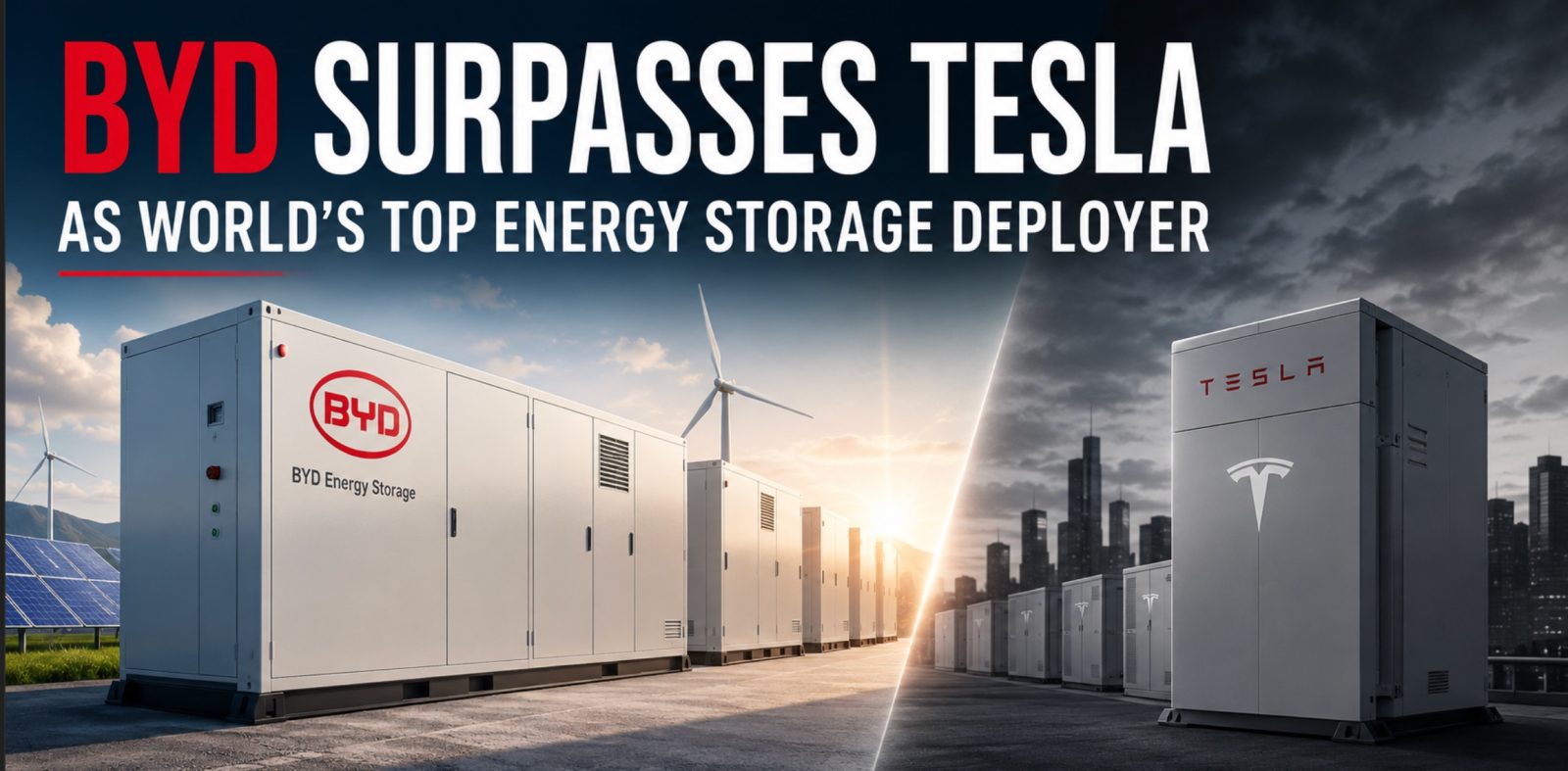
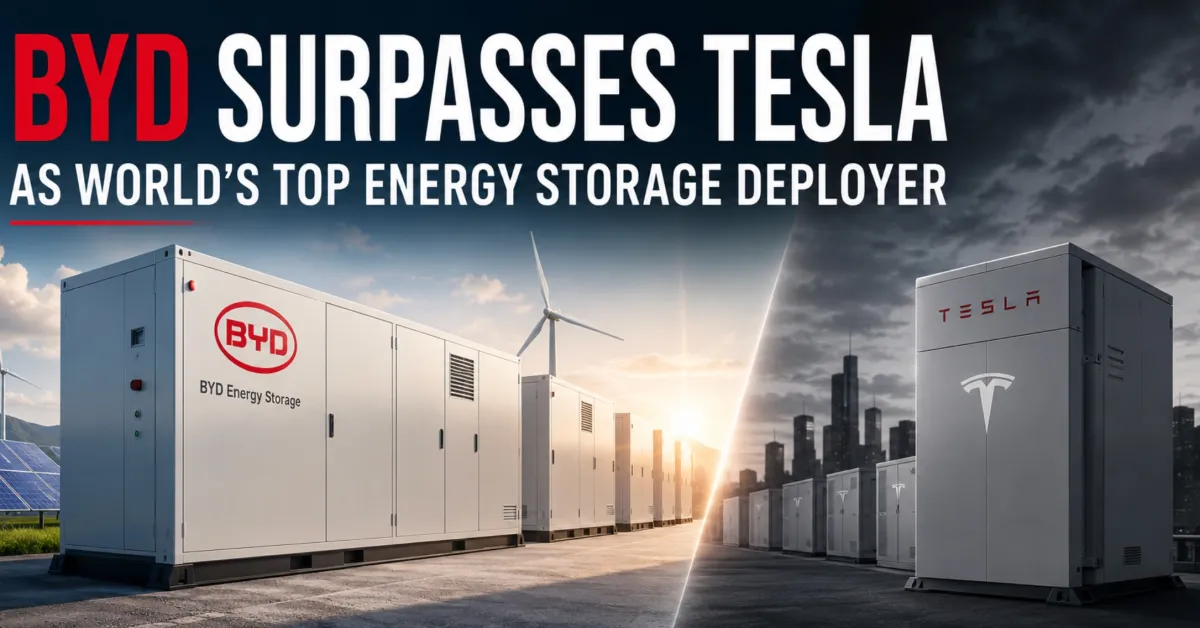
BYD has overtaken Tesla to become the world’s largest battery energy storage system (BESS) integrator, capturing 13% of the global market in 2025 compared to Tesla’s 10%, according to new data from Benchmark Mineral Intelligence.
The shift marks the end of Tesla’s reign as the top energy storage deployer — a position it held in 2023 and 2024 — as Chinese manufacturers now dominate the rapidly growing stationary storage market.
BYD shipped over 60 GWh versus Tesla’s 46.7 GWh
According to Benchmark’s Battery Energy Stationary Storage Service, BYD shipped over 60 GWh of energy storage systems globally in 2025, ranking first among all BESS system integrators. Tesla deployed 46.7 GWh during the same period — a 49% year-over-year increase that was still not enough to keep pace with BYD’s aggressive expansion.
Sungrow claimed the third spot with 9% market share, followed by three Chinese companies tied at 6% each: CRRC Zhuzhou, CATL, and Hyper Strong. Huawei (5%), Envision (5%), Fluence (4%), and Sunwoda (4%) rounded out the top 10.
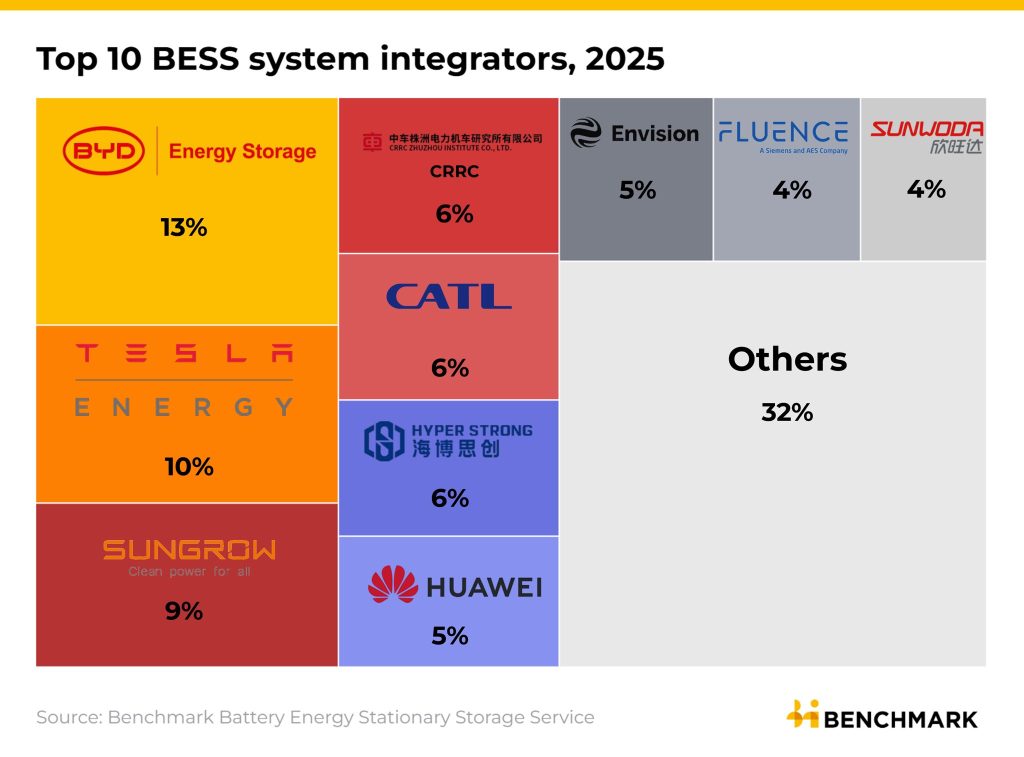
The numbers paint a clear picture of Chinese dominance: eight of the top 10 BESS system integrators are Chinese companies. Fluence, a Siemens and AES joint venture, is the only Western company besides Tesla to crack the list.
Tesla is also expanding its BESS production in China to capitalize on the growing market.
A market that nearly doubled in a single year
The broader context makes BYD’s ascent even more significant. Global BESS installations jumped 51% in 2025 to approximately 315 GWh, while cell shipments for stationary storage nearly doubled to over 600 GWh, according to Benchmark and InfoLink data.
China drove much of that growth. In December 2025 alone, China installed 65 GWh of large-scale battery storage — more than the entire United States deployed over the full year.
BYD’s rise in energy storage mirrors its trajectory in electric vehicles, where it surpassed Tesla in global BEV market share. The company’s vertically integrated model — manufacturing its own battery cells, including the Blade LFP platform — gives it a structural cost advantage that Tesla cannot easily replicate.
BYD’s HaoHan takes aim at Megapack
BYD’s push to the top was supported by aggressive product launches. In September 2025, BYD unveiled its HaoHan energy storage system with a capacity of 14.5 MWh in its standard configuration — nearly three times Tesla’s Megapack capacity. A 20-foot container variant offers 10 MWh.
The HaoHan system is already powering major projects, including a massive 12.5 GWh deployment in Saudi Arabia with the Saudi Electricity Company — one of the largest grid-scale battery storage projects in the world.
Tesla responded by unveiling Megapack 3 and Megablock the same month, featuring 2.8-liter battery cells that deliver roughly 5 MWh per unit, up from 3.9 MWh in Megapack 2. Tesla is also building out its Houston Megafactory with a target of 50 GWh annual production capacity by late 2026, and it recently confirmed a $4.3 billion LFP battery deal with LG Energy Solution to supply cells for Megapack 3 starting in August 2027.
The vertically integrated advantage
One of the most important trends highlighted by the Benchmark data is the shifting balance between vertically integrated manufacturers — companies that make both the battery cells and the storage systems — and pure system integrators that source cells from third parties.
Benchmark notes that vertically integrated cell-BESS companies have actually been losing market share since 2023, as falling battery prices and an expansion of the cell manufacturing industry have broadened the range of options available to system builders. Pure integrators like Sungrow, CRRC, and Hyper Strong saw their combined market share grow from 20% in 2023 to 30% in the first half of 2025.
But BYD is the exception. As a vertically integrated manufacturer, BYD still managed to take the top spot, suggesting its cost structure and manufacturing scale are simply too formidable. The company’s battery division crossed 113 GWh of production in the first three quarters of 2025 alone, supplying both its EV business and its growing BESS operations.
Tesla, by contrast, sources its Megapack cells from CATL, BYD, and soon LG — meaning it is competing in energy storage while literally buying batteries from its top competitor.
Electrek’s Take
This was inevitable. We’ve been tracking BYD’s energy storage ambitions for a while, and the writing was on the wall when BYD launched the HaoHan system with nearly three times the capacity of a Megapack in the same footprint. When you combine that kind of product advantage with vertically integrated battery manufacturing, the outcome is predictable.
Tesla’s energy storage business is still growing rapidly — 46.7 GWh in 2025 is nothing to scoff at, and the Megapack 3 is a genuinely impressive product. But the fundamental challenge for Tesla is that it doesn’t make its own stationary storage cells at scale, or at least at BYD’s scale. It buys them from CATL and BYD, two of its direct competitors in the BESS market. That’s a structural vulnerability that no amount of Megafactory capacity can fully overcome.
The bigger story here is the sheer Chinese dominance of this market. Eight of the top 10 BESS integrators are Chinese, and China’s domestic deployment alone dwarfs the rest of the world combined. For Tesla to compete long-term, the Houston Megafactory and the LG battery deal need to deliver on cost and scale — fast. The market is not going to wait.
Now is a great time to begin your solar journey. If you want to make sure you’re finding a trusted, reliable solar installer near you that offers competitive pricing, check out EnergySage. EnergySage is a free service that makes it easy for you to go solar – whether you’re a homeowner or renter. They have hundreds of pre-vetted solar installers competing for your business, ensuring you get high quality solutions and save 20 to 30% compared to going it alone. Plus, it’s free to use and you won’t get sales calls until you select an installer and you share your phone number with them.
Your personalized solar quotes are easy to compare online and you’ll get access to unbiased Energy Advisors to help you every step of the way. Get started here.


FTC: We use income earning auto affiliate links. More.