



A survival guide for pronoun protocols
I first encountered pronoun protocols at the start of one of those one-week training programmes — the kind where the coffee is lukewarm, the air conditioning is set to “Arctic Tundra”, and the icebreakers are designed to make even the extreme extrovert consider a career in lighthouse keeping. We went around the room for introductions. “Name, designation, and pronouns,” the facilitator said cheerfully, as though this were as routine as stating one’s mother tongue.
I was flustered. My brain, usually a reasonably efficient filing cabinet, suddenly felt like someone had tossed a flashbang into the “Identity” drawer. When my turn came, I smiled with what I hoped was calm competence but likely looked more like a man realising he had left the stove on at home.
“I’m… well… I’m me,” I said. While philosophically sound and arguably the most honest thing I had said all year, it did not answer the question. A polite, heavy silence filled the room. Someone helpfully whispered, “He/him?” I seized it with the desperation of a drowning man. “Yes! That. He/him.” I sat down, feeling as though I had narrowly passed an exam I had not studied for.
That moment — equal parts amusing and mildly disorienting — was my official introduction to pronoun protocols. Since then, I have come to see them less as a terrifying test of ideological purity and more as a basic social skill, akin to remembering names, or suppressing the auto response, “you too”, when a waiter tells you to enjoy your meal. At its simplest, it is just about referring to people in ways that align with how they see themselves.
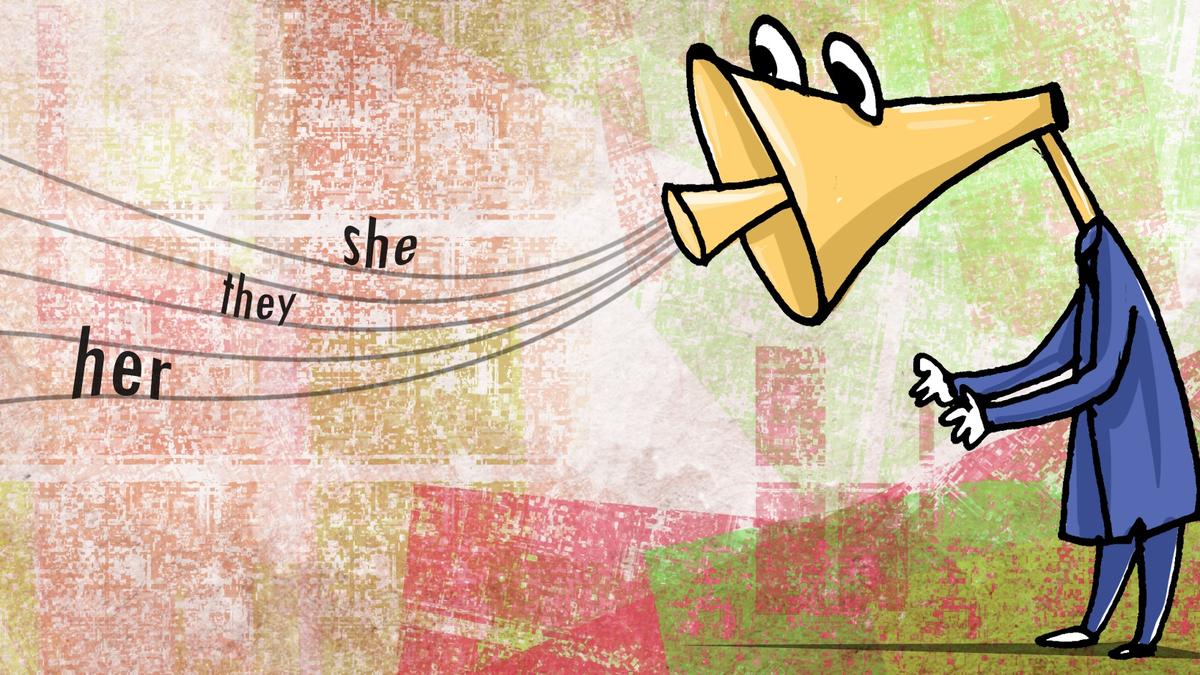
Pronoun protocols sound straightforward, yet like many “simple” things — such as assembling IKEA furniture or “resting” for five minutes — it has acquired layers of complexity. Some view pronoun protocols as a vital sign of gender sensitivity, a small but meaningful way of acknowledging diversity. Others, in contrast, see it as a form of unwelcome “virtue signalling” — an accessory worn to show off one’s sensitivity rather than a functional necessity.
But language has never been static or simple. It evolves — awkwardly, often unevenly. That there is a pushback is itself a sign that something fundamental is shifting. Whether you see these protocols as progress, overreach, or just another item on the long list of irritating etiquettes, they have undeniably moved from the margins to the mainstream.
Rewiring of habits
A large part of the adjustment lies in the subtle rewiring of habits we didn’t even know we had. Consider the sentence: “The actor rehearsed his part before coming on stage.” For decades, that “his” rolled off the tongue automatically. Now, we are more likely to say, “The actor rehearsed their part.” The meaning remains identical, but the language has widened its embrace.
At first, pronoun protocol can feel like trying to write with your non-dominant hand — a tad unnatural, a bit slower, occasionally leading to odd-looking results. But with practice, it becomes easier. And in some cases, more precise. After all, not every actor is a “he”, and “they” has quietly been doing double duty in English for centuries anyway.
Of course, the real comedy lies in the everyday practice. We have all seen the “overcorrection phase”, where a speaker becomes so determined to be inclusive that their sentence becomes a linguistic obstacle course: “They — sorry, I mean she — well, I mean, as they mentioned — oh dear.” By the time they finish the sentence, everyone has forgotten what the original point was, and we are all just staring at the floor in sympathetic secondary embarrassment.
Then there are the “enthusiastic adopters” who introduce their pronouns with such dramatic flourish — “Hello, I’m Neha, she/her, delighted to be here!” — that you half expect a round of applause to break out. And, of course, there are the “quietly bewildered”, nodding along while mentally filing away new information, hoping it will come in handy later.
Through the confusion, it helps to remember that the English language has survived far more dramatic transformations than this. We have retired “thou”, embraced “you” for both singular and plural, and somehow managed to live with the absolute chaos of English spelling. Compared to the silent ‘p’ in ‘psychology’, adjusting a few pronouns seems entirely manageable.
If the whole thing still feels daunting, there is always the time-tested, foolproof fallback: use names. Names are wonderfully dependable. They don’t change with context, they don’t require agreement, and they rarely spark a heated debate in the break room. “Krishna said Krishna will send the report” might sound slightly awkward, but it’s an effective way to navigate the terrain without fear of a misstep. As for me, I have made my peace with the protocol. If I ever find myself in another workshop circle, I have a plan. I’ll smile, introduce myself, state my pronouns with quiet confidence, and perhaps add, “Still learning, but improving daily.”
And, I have half a mind to sign off on this piece as Duvvuri Subbarao (he/him).
subbarao@gmail.com
The author is a former Governor of the Reserve Bank of India.
Published – May 17, 2026 05:34 am IST