




2027 Mercedes-AMG GT EV Revealed With 1,153 HP, 600 kW Charging
The new Mercedes-AMG GT 4-Door Coupe may be the most technologically advanced electric vehicle any Western automaker has put into production yet.
It uses a new kind of EV motor to reduce weight and improve performance. It’s powered by a bespoke battery pack infused with lessons from the automaker’s Formula 1 program. And it flaunts a peak charging power of 600 kilowatts, the most we’ve seen in an electric car from a non-Chinese company.

48
Source: Mercedes-AMG
The German automaker struggled with its early EV efforts, which hinged on jellybean-shaped EQ models that had limited appeal and poor sales. The brand then spent the last two years course-correcting, with solid results. The new GLC EV and CLA sport more conventional designs, along with faster charging, more range, and improved software.
The new AMG GT takes that reset to a whole new level. It’s the first vehicle on the company’s new AMG.EA performance EV platform, and it aims to put Mercedes at the forefront of EV technology, at least outside of China. It will take on rival high-performance sedans like the Porsche Taycan and the Lucid Air Sapphire.
Polarizing Design
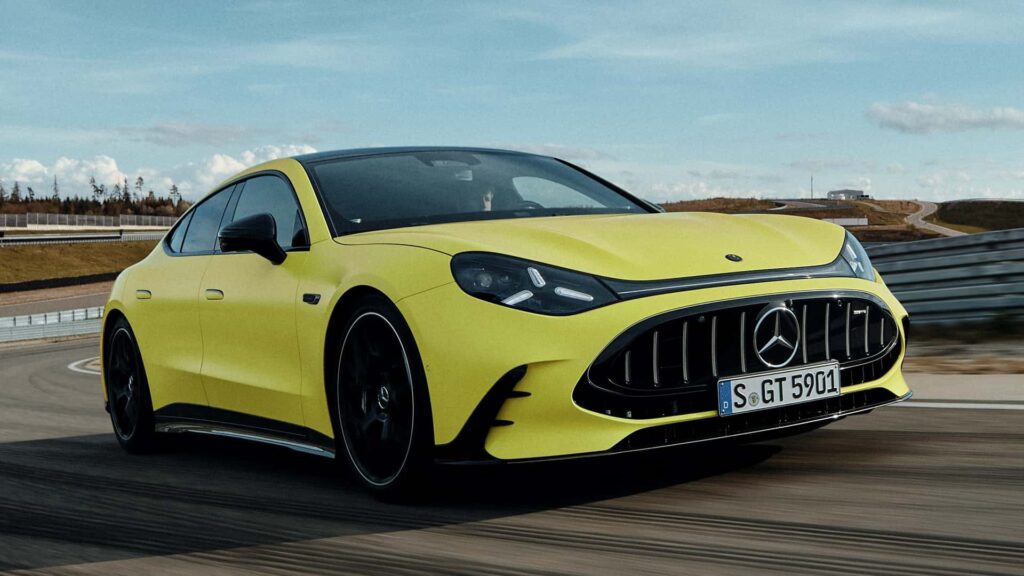
Design is highly subjective, but at least to this pair of eyes, the sedan looks like it may be a tough sell. Gone are the sleek headlamps and smooth bodywork of last year’s AMG GT XX Concept, and in comes one of the most excessive exterior designs of recent times.
The AMG GT gets gaudy daytime running lights with Mercedes star graphics, all located in unusually large headlamp housings. There’s also a huge grille with vertical illuminated slats and an lit-up logo.
Photo by: Mercedes-AMG
The rear looks equally over the top. There you’ll find circular taillights and more star graphics, all set into an oversized and glossy black panel. None of it is what you’d call understated. But then again, its fastback silhouette provides a sporty look. And this is a pricey tech flagship; it doesn’t need to appeal to everybody.
The AMG GT generates extra downforce at high speeds using an active aerodynamics system that the company calls “Aerokinetics.” A panel near the front automatically extends from the underbody at 75 miles per hour, while one in the center activates at 87 mph. There’s also an optional active rear diffuser, standard retractable spoiler, and active cooling flaps in the front. In addition to the aerodynamics, the tech underneath also seems genuinely cutting-edge.
Photo by: Mercedes-AMG
Axial Flux Motors
Mercedes claims the AMG GT is the first production EV to use what are known as axial flux motors. The technology comes from YASA, the British electric motor specialist Mercedes-Benz acquired in 2021. Hybrid Lamborghini Temerario and McLaren Artura also use these kinds of motors, so the technology isn’t entirely new to performance cars. But while those models are hybrids, the AMG GT is the first to use the technology in a fully electric production car.
Before we dive deep, here’s what the motors allow the sedan to do: On the GT 63 trim, three motors—two at the rear and one upfront—deliver a whopping 1,153 horsepower and 1,475 pound-feet of torque. It can accelerate from a standstill to 60 miles per hour in 2.3 seconds and reach 124 mph in 6.4 seconds. The top speed is limited to 186 mph. There’s also a GT 55 trim with 805 hp and 1,328 lb-ft.
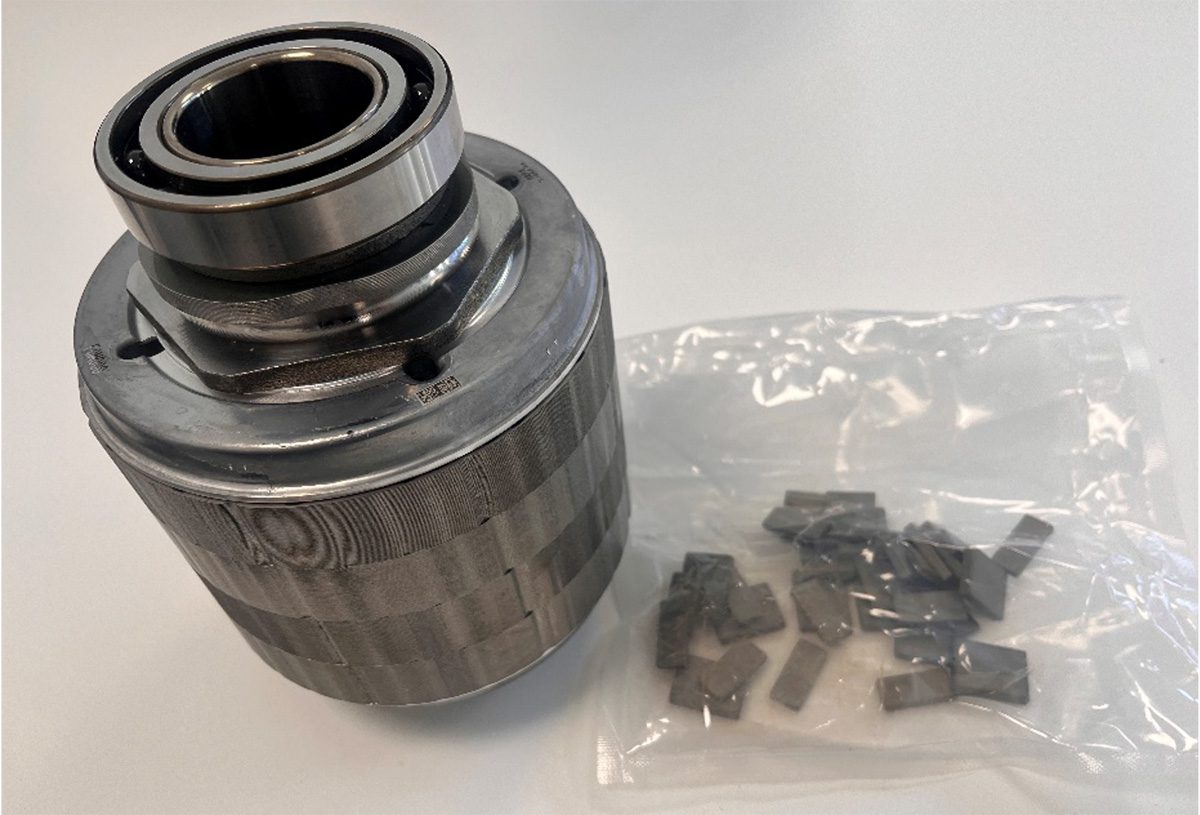
Here’s how axial flux motors differ from the radial flux motors EVs typically use. Conventional motors are shaped like a soup can. A shaft running down the middle (the rotor) spins when an electromagnetic force is applied by the outer part (the stator). Yasa’s axial flux motor is shaped more like a pancake, with two disc-shaped rotors sandwiching the stator. The result is a boost in torque, better packaging efficiency, and, ultimately, a much more power-dense design.
Mercedes says the AMG GT’s power unit is 67% lighter and 67% shorter than conventional motors.

Owners also get a simulated manual gearbox with fake V8 sounds. Mercedes said it’s using 1,600 audio files to “sonically interpret” different driving situations. It will even make “exhaust burbles,” the pop and bang sounds that happen when drivers let off the accelerator.
Silicon Anode Batteries
Mercedes engineers applied battery lessons from the AMG One supercar and its F1 team. The 106 kWh battery uses 2,660 cylindrical cells grouped into 18 modules. The driving range on both trims is roughly 700 kilometers on the more optimistic European WLTP cycle, which translates to roughly 315 miles on the U.S EPA cycle.
The cells are tall and slim—4.1 inches high, one inch in diameter—a format the automaker picked specifically for better cooling. Mercedes said the narrow diameter minimizes the distance heat has to travel from the cell core to the surface.
Photo by: Mercedes-AMG
Each cell is immersed in a coolant and also cooled via a plate. It also features something called “on-demand cooling,” where the battery management system (BMS) cools individual modules based on their temperatures.
In terms of chemistry, the automaker is using a nickel, cobalt, manganese, and aluminum (NCMA) cathode, paired with a silicon-containing anode. Automakers have been exploring silicon anodes for years to improve EV range, and they finally seem to be entering production.
Anodes are the energy-storing part of the cell, and they were historically made with graphite. But a graphite-silicon mix improves energy density, according to battery makers, which explains the AMG GT’s cell-level energy density of 298 watt-hours per kilogram. That’s at the high end of current nickel-based batteries, which typically have an energy density between 200-300 Wh/kg.
600-kilowatt Charging
While Chinese cars from the likes of BYD and Geely are already capable of megawatt charging speeds, the AMG GT’s 600 kW fast-charging speed is the highest yet from a Western automaker. The Mercedes can go from 10% to 80% in just 11 minutes, which is incredibly quick. Mercedes also says the AMG GT can add 285 miles of WLTP range in just 10 minutes of charging when plugged into a 600 kW charger. That would translate to somewhere near 250 miles on the EPA cycle.
For comparison, the Tesla Cybertruck is America’s only EV that can do 500 kW. Several of the latest and greatest luxury EVs are now pushing 400 kW.The Lucid Gravity, with its 400 kW peak charging speed, can add up to 200 miles of range in under 11 minutes of charging. That’s why charging stations in the U.S. that can deliver over 500 kW barely exist. But charging companies are working on that.
Still, BYD remains the world’s charging champion. Its latest EVs using the second-generation Blade battery and Flash charging can go from 10-97% in an astonishing nine minutes. But on this side of the planet, the new AMG GT is the best you’re going to get.
Photo by: Mercedes-AMG
When Can I Buy One?
The GT 55 trim will arrive at U.S. dealerships later this year, with the GT 63 following in early 2027. Pricing will be announced at a later date. But with the amount of technology and performance on offer, expect this super sedan to cost a fortune.
Contact the author: suvrat.kothari@insideevs.com