

Trade, supply chains and economic statecraft
The past decade has collapsed the old boundary between economics and geopolitics, creating a world in which supply chains, trade routes, energy corridors and technology ecosystems have become the real battlegrounds of power. What once belonged to corporate strategy decks is now the daily fare of national security briefings. Tariffs behave like sanctions, semiconductor alliances resemble defence pacts, and the flow of critical minerals can tilt influence as decisively as troop deployments once did. In this new order, states compete not only with armies or ideologies but with regulatory regimes, infrastructure networks and the capacity to anchor global production. The fusion of markets and statecraft is no longer a trend; it is the organising principle of 21st century geopolitics.
Trade as strategic leverage
This shift has also exposed the fragility of the older globalisation consensus — the belief that trade naturally fosters cooperation and shared prosperity. Increasingly, economic ties are being repurposed as instruments of strategic leverage. Tariffs, export controls, supply-chain restrictions and energy dependencies have become tools through which states attempt to shape the behaviour of others. The scramble over critical minerals, the weaponisation of interdependence (with China’s curbs on the export of rare earths allowing it to flex its muscles against the United States and India), and the resurgence of tariff politics (used by U.S. President Donald Trump to punitive effect) all underscore how easily commerce can be turned into coercion. In such an environment, economic diplomacy is inseparable from national security, and countries must navigate a world where prosperity and power are intertwined.
For India, this shift has encouraged a more pragmatic approach to foreign policy, one that places greater emphasis on economic resilience and diversification. This fusion of economics and geopolitics has created a rare moment in which India’s structural strengths align with the world’s strategic needs. As companies and governments rethink their exposure to concentrated supply chains, India’s scale, stability and reform trajectory have moved it from the periphery of globalisation to the centre of boardroom strategies and diplomatic calculations. A country once viewed in the West as a promising but difficult market is now seen as an indispensable node in a diversified global economy — large enough to matter, stable enough to trust, and open enough to absorb investment at scale.
Three shifts underpin this new positioning. First, India’s domestic reforms — digitisation, infrastructure expansion, and targeted deregulation — have lowered transaction costs and improved predictability, making it easier for global firms to build long-term capacity.
Second, the geopolitical recalibration around China has created a structural demand for alternative production ecosystems, and India is one of the few economies with the labour force, political stability and market depth to meet that demand.
Third, India’s own strategic imagination has expanded: it now sees trade agreements, technology partnerships and supply-chain diplomacy not as peripheral to national strategy but as central instruments of statecraft.
The new order and India
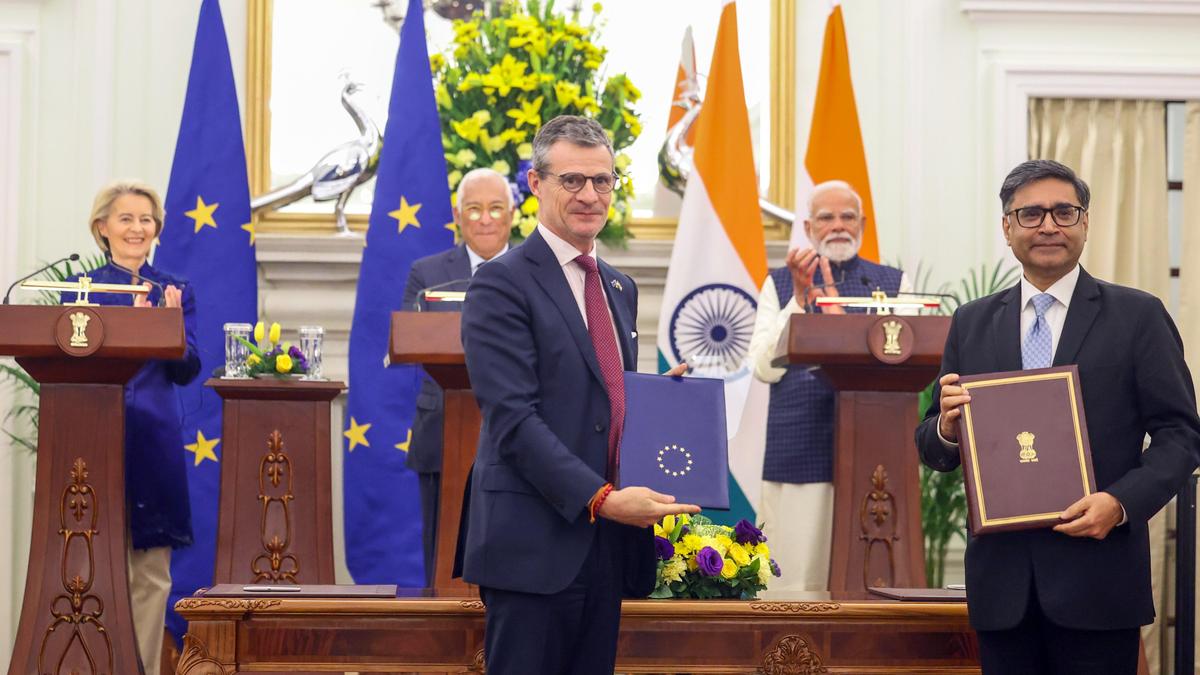
In this environment, India’s relationships with major powers are increasingly shaped by economic security rather than traditional geopolitics alone. Semiconductor collaborations, critical-mineral partnerships, defence-industrial co-production and digital-public-infrastructure exports are all examples of how India is weaving economic resilience into its foreign policy. These are not merely commercial arrangements; they are strategic bets on a world where influence flows through production networks as much as through military alliances. It is a world where Pax Silica complements Pax Americana, but unlike the latter, does not require a military partnership.
At the same time, India must navigate the risks of this new order. Interdependence can empower, but it can also expose. Over-reliance on any single partner — whether for technology, minerals, or markets — creates vulnerabilities that can be exploited. The challenge is to build a diversified portfolio of economic relationships that enhances India’s autonomy rather than constraining it. Promiscuity is not a virtue in inter-personal relationships, but in the trade world of the third decade of the 21st century, it may be the only viable “default mode” for India’s conduct. Of course, like the other kind, trade promiscuity also requires precautions. Even as it pursues multiple partners, India must strike a careful balance: deepening integration without surrendering strategic space, attracting investment without becoming dependent on it, and embracing globalisation without repeating the mistakes of earlier eras. This global shift also places new demands on India’s internal economic strategy. To anchor global supply chains, India must continue improving logistics, regulatory clarity and workforce skills. To lead in emerging technologies, it must invest in research, intellectual property and trusted digital infrastructure. To secure critical minerals, it must build resilient partnerships abroad and sustainable extraction policies at home. And to maintain credibility as a democratic alternative in a world of authoritarian efficiency, it must ensure that economic growth is matched by institutional strength and social cohesion.
The stakes are high because the opportunity is historic. For the first time since liberalisation, the global economy is not merely inviting India to participate — it is actively seeking India’s presence. The question is whether India can convert this moment of geopolitical demand into long-term economic capability.
As the global trading system fragments into overlapping coalitions and custom-tailored economic arrangements, India’s task is not to retreat behind new walls but to remain confidently open on its own terms. The goal is neither complete individualism nor naive globalism, but a calibrated integration that avoids excessive dependence on any single partner. Serial dating works best when each partner is aware of your other relationships, knows multiple options exist but is not threatened by any of them. This is why energy security, technology partnerships and resilient supply chains have become central to India’s external engagement: they are the arenas in which the next phase of global competition will be decided.
Economic diplomacy is no longer an adjunct to foreign policy; it is one of its organising principles. Countries that can align their economic strategy with their diplomatic posture will shape the emerging order rather than be shaped by it.
This moment also coincides with a profound transition in the architecture of global trade. The multilateralism that defined the late 20th century — rooted in universal rules and broad consensus — has lost momentum under the weight of geopolitical rivalry and domestic political pressures. In its place, nations are turning to flexible bilateral and regional arrangements that allow them to tailor partnerships to strategic priorities. For India, this shift is not a setback but an opening. It creates space for a more agile, interest-driven diplomacy that can leverage India’s scale, stability, and reform trajectory to build coalitions across geographies and sectors.
India at global crossroads
The convergence of these trends places India at a pivotal juncture. The world is searching for diversified production bases, trusted digital ecosystems and stable democratic partners. India can meet that demand — but only if it continues to invest in competitiveness at home and credibility abroad. The choices made now will determine whether India becomes a central anchor of the new global economy or remains merely one of its many participants. The opportunity is historic, but it is not automatic. It requires clarity of purpose, institutional steadiness and the confidence to engage the world without fear or favour.
In a world where prosperity and power now move through supply chains rather than shipping lanes, India’s future will be shaped not by choosing between globalisation and self-reliance, but by mastering the art of engaging the world on terms that protect its autonomy while amplifying its ambition.
Shashi Tharoor is the fourth-term Member of Parliament (Congress party, Lok Sabha) for Thiruvananthapuram, the Chairman of the Parliamentary Standing Committee on External Affairs and the Sahitya Akademi Award-winning author of 29 books, including Pax Indica (2012) and The New World Disorder (2020)
Published – May 16, 2026 12:16 am IST