



The World’s First Solid-State Electric Bike Has Tiny PC Fans For Cooling
- Donut Lab has released additional details about the world’s first solid-state electric bike, the Verge TS Pro Gen2.
- The startup claims to have cracked the code to production-ready solid-state batteries, but it has so far failed to show proof of the chemistry.
- The latest video details the electric motorcycle’s battery configuration.
Donut Lab, the Finnish startup that claims to have developed the world’s first production-ready solid-state battery, is back with new details.
In a new video published on the company’s YouTube channel, Ville Piippo, the battery startup’s co-founder and CTO, dives a little deeper into the solid-state pack that powers the Verge TS Pro Gen2 motorcycle, which is touted as the world’s first solid-state-powered electric bike, as well as the fastest-charging one.

The details don’t include proof of the chemistry used in the mysterious and controversial cells, which have so far attracted a lot of attention. The company has made some wild claims, including an energy density of 400 watt-hours/kilogram, zero use of rare-earth materials, and a lifespan of 100,000 charge cycles.
So far, the startup has failed to substantiate its claims with patents, relevant validation results, or a chemistry breakup that would prove it is, in fact, a solid-state cell, and experts are skeptical about the firm’s figures.
With all of this out of the way, let’s talk details. The new Verge TS Pro, shown here in its Standard Range version, uses 192 of Donut Lab’s 94 Wh cells, resulting in a nominal capacity of around 18 kilowatt-hours and a maximum capacity of approximately 20 kWh. There’s also a Long Range version with roughly 30 kWh of nominal capacity, but the battery enclosure is the same size as the smaller pack.
In the 18 kWh model, each module has a 2P 96S configuration (2 cells in parallel and 96 cells in series), resulting in a maximum system voltage of around 400V. There are four modules in total, layered on top of each other, and there are heat transfer plates mounted between each cell layer, which conduct the heat to the outside of the pack.
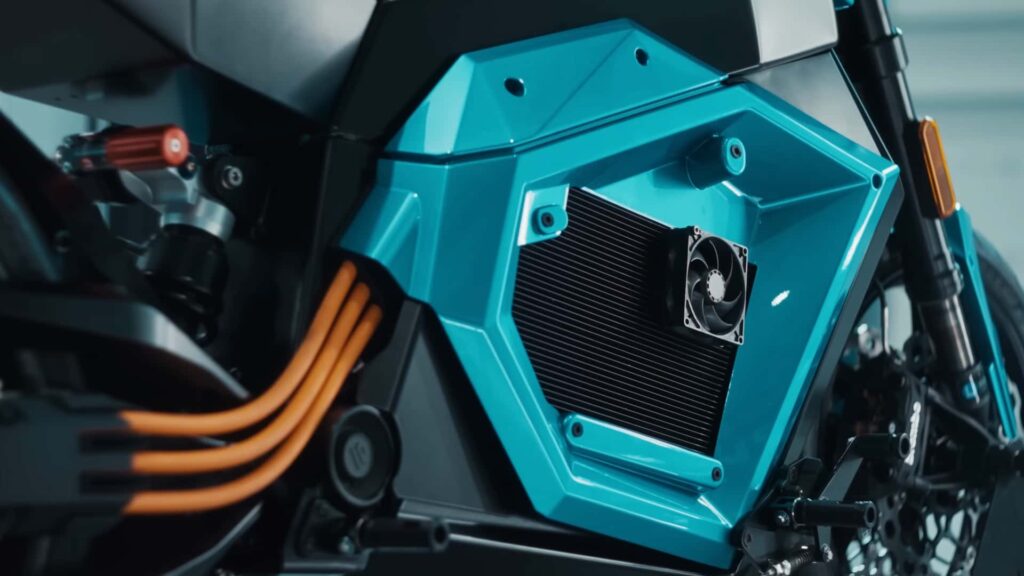
On each side of the pack, there is a heat sink and a small fan that looks like something you’d find on top of a PC processor. In any case, it helps dissipate the heat into the ambient air, making this an air-cooled battery pack.
Charging-wise, the solid-state Verge TS Pro Gen 2 peaks at around 100 kW when using a DC fast charger, and needs about 11 minutes to go from 10% to 80%. A 10-to-90% top-up takes a little under 15 minutes.
The peak charging power is about half of the 200 kW figure touted by Donut Lab in the past, but the company claims that the bike’s compact design, which doesn’t allow for liquid cooling, is the main differentiator. In a car that has enough space for a liquid-cooled pack, Donut Lab claims its 94 Wh cell can hit much higher charging speeds.
Even with a maximum 103 kW input, we’re still looking at a C-rate of a little over 5C, which is quite impressive. The C-rate refers to the rate at which a battery can charge or discharge relative to its maximum capacity. In the case of the Verge TS Pro Gen 2 Standard Range, its maximum capacity is 20 kWh, so a 1C rate would mean it could charge at 20 kW. Most modern EV batteries have a C-rate of under 4C.
All things considered, the Verge TS Pro with Donut Lab’s solid-state battery is now the world’s fastest-charging motorcycle, according to the battery maker. In the real world, this translates to about 12 miles of range added for each minute of charging, considering that the new TS Pro has a total estimated range of 217 miles.
Production of the upgraded electric bike reportedly started last month, but we have yet to see an independent test of the solid-state TS Pro Gen2.