




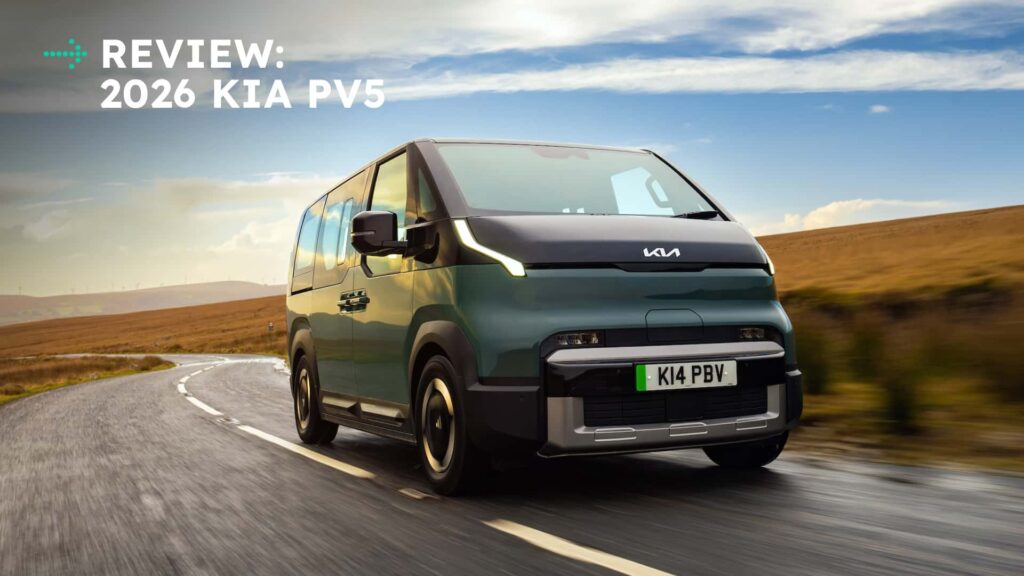
The Kia PV5 Is The Best Electric Van Value: Review
You could almost hear the collective happy noises of both commercial vehicle fans and car enthusiasts when Kia revealed the PV5. The first Platform Beyond Vehicle… vehicle, the PV5 can be a van, a people mover, a camper, or anything you want it to be given enough time and money. The Passenger model is perhaps the most interesting in the line up, purely because it’s the sort of thing you can imagine real people buying and using on the day to day.
Importantly, it’s not another Ford, Mercedes, Stellantis, or Renault van-with-seats. The PV5, and later on its smaller and bigger siblings, is indeed a van, but it doesn’t look too much like one. Nor does it feel like one. It’s also a Kia, and with the firm being on an EV roll, that’s a good thing.
Kia hopes that over time the PV family will become mainstay on roads all over the world. Its distinctive looks should help, but so will the people who helped make it what it is. During development, Kia didn’t decide that it knew best and plough on with things. It spoke to the people who’d use it, or who made software that would be used with it. It’s an oft mentioned fact that Uber and Samsung played a part in making it happen, and for good reason.

19
Source: Kia
If you don’t know how to do something, simply chancing it out and hoping everything pays off is a really dumb idea. Adult supervision is recommended. Kia wanted to make a car that can be used for ride sharing. It could have made an old school MPV and called it a day, or it could ask the best known ride sharing platform in the world what works. Of course, what works for ride share drivers will also work for people with large families. Win-win.
In the U.K., Kia hopes to shift 1,250 PV5s in 2026, most of them being the 71.2kWh Passenger Plus mode—with a lot of range and a lot of room for people. Globally, by 2030, the plan is to have 250,000 PV vehicles on the road.
Kia’s offering an alternative to what’s otherwise a broadly drab segment, and it feels like a good one.
[Full disclosure: Kia loaned me a PV5 for the purposes of this review.]
Spec and features
Kia’s got a pretty good base to build the PV5 on: The E-GMP platform that underpins various EV models has been tweaked for commercial business. Here it’s the E-GMP.S (Electric-Global Modular Platform for Service), and it’s suited for dropping different tops on board depending on user spec.
You can have your PV5 in a number of ways. As a van (for things), as a crew cab (for some things and some people), as a Wheelchair Accessible Vehicle, or in Passenger spec (for people and fewer things).
Kia PV5 Essential Specs
Base Price
£32,995 ($44,700)
As-Tested Price
£35,995 ($53,825)
EV Range
256 miles (WLTP)
Battery
71.2 kWh Lithium-ion
Drive Type
Front-wheel drive
Output
160 hp / 184 lb-ft
Speed 0-62 MPH
10.6 seconds
Charge Time
10-80% in 30 minutes, 150 kW max
The Passenger, the planned big seller, comes in three trims: Essential with a 51.5kWh battery, Essential with a 71.2kWh battery, and Plus with the same chunky slab. The base car with the small battery comes with 120 horsepower, and clips 62 mph (100 km/h) from rest in a leisurely 13 seconds. It will get you 183 miles on a charge. PV5s with the bigger battery on board will get you 256 miles on a charge, and thanks to a more powerful 160 hp, 184 lb-ft motor can get from 0-62mph in 10.6 seconds. Top speed is capped at 84mph for all. Not brisk in any dimension.
In the UK, no matter which battery size you go for, your PV5 Passenger will take 150kW DC fast charging, and will net you a 30 minute-ish 10-80% top-up time.
The Essential trim is pretty generous. Folding seats, tinted glass, OTA updates, Apple CarPlay/Android Auto, 16-inch steel wheels, a 12.9-inch infotainment screen, a 7-inch instrument binnacle, and as much active safety kit as Kia can throw at it all come standard. For a bit more cash, the Plus trim gets alloy wheels, heated seats, V2L functionality, a powered tailgate, a few more advanced ADAS functions, and more toys.
Photo by: Kia
At its core, the PV5 is a van, which means its hard and soft points need to be hard wearing, and take miles/abuse well. The result is a slightly less than perky interior design. It’s function over form, here, and it works well.
In Passenger form, the PV5’s function is to take people around. Initially, the PV5 comes with five seats, though a seven seater is on the way. Now, in most EVs, the people in the rear can feel a little like their knees are up by their ears, as a result of the thick floor-mounted battery. But because the PV5 is so tall and long, you can sit out without feeling like you’re hiding in a cupboard. Average height people have an impressive amount of space to put their legs.
It’s in touches like that you realize what Kia’s been learning from industry partners. The PV5 was made with this sort of thing in mind, and it makes being driven around feel… normal. Yes, it’s still a big box, so it’s not a salubrious exec express, but it’s more than comfy enough to be driven around town in for a decent spell. For the job of moving people, it’s leagues above the various SUV options kicking around. The ample glass lets in plenty of natural light as well, letting the interior feel bright and airy. Honestly, it’s pretty great.
Photo by: Kia
Driving Experience
The PV5 is a bit big for European roads.. Or at least it should feel that way. Because it’s a big ‘ol box, though, you can easily place it anywhere you want to on the road. Its mirrors are huge, and its sides slabby, meaning seeing down the side is easy. As such, spotting errant cyclists, massive kerbs, and anything that might scrape paint is easy as pie. Its high driving position, twinned with a massive windshield, and huge side windows give an incredible view out, and let lots of light in. That might sound like a simplistic win, but most new passenger cars keep you low, and ensconced behind thick doors with tiny windows letting in dribbles of sunlight if you’re lucky.
There are a handful of drive modes—Normal, Eco, and Snow—but to be honest unless you’re worried about running out of range for a day, just leave it in Normal and be done with it. The controls feel ‘car like,’ which in real terms mean ‘it doesn’t feel like a massive airy cavern on wheels.’ The steering is light, but you can feel what the front’s doing in a pinch. There was plenty of get up from the 160 hp motor in my tester, so overtaking wasn’t an issue. I didn’t get to try the 120-hp version, but it may require a bit more planning for such moves.
The PV5’s slabby boxiness does come with a small issue. Crosswinds on the highway can make things a little more mobile than you’d hope. Thankfully, if some lateral wind-assisted movement looks like it’s going to happen a stability control warning pops up and lets you know the Kia is looking out for you.
Photo by: Kia
As you’d expect from Kia, there are a handful of brake regen settings, as well as the i-Pedal mode for one-pedal driving. It’s a system that works well, and makes grabbing a bit of extra charge here and there a doddle.
While it’s a broadly pleasing drive, those big windows come with an annoyance. The window ledge is low, and the seat doesn’t sink as close to the floor as you’d hope, so you can’t easily rest your arm on it as you go. It’s a small thing, but worth noting.
Tech and Charging
Kia’s in house infotainment is as good here as it is elsewhere. Slick and easy to use, it’s got a lot going for it. Most people will probably bypass it and go straight for ‘ol faithfu, CarPlay. So be it.
There’s plenty of ADAS on board to keep you safe, though during testing (bar the cross wind assist) none of it was necessary.
When it comes time to top up the battery, the 150 kW fast charging speed feels like it should be a winner when you’re out and about. Frustratingly, the PV5 didn’t quite manage to get quite those speeds on a usually reliable charger, topping out at just under 100kW.
When it comes to WLTP figures, a pinch of salt is always needed. Kia reckons it’ll get 3.6 miles per kWh peak efficiency, but a mix of grotty British weather and atypical driving netted an average of 3.2. That still gives a range of just shy of 230 miles on a charge, which ain’t bad at all considering it’s shaped like a brick.
Photo by: Kia
Much as with the EV5, and other Kia EV cars, the twisty gear selector can be cause for confusion. It’s not a world ending thing, but may cause some unintentional swearing when nudged the wrong way.
Pricing and Verdict
Kia has a lot resting on the PV5 in general. If it can corner the EV end of the commercial vehicle market it’ll unlock an infinite money glitch, sure, but it’s hedging its bets by building a vehicle that can do both commercial and personal jobs. While the Cargo models do load lugging really well, the Passenger handle people incredibly well.
People movers have slowly but surely been superseded by SUVs and other such fashionable cars, and this moves to address that with a package that’s more than just a big ‘ol box. The only other vehicle in that space you could consider as a close competitor is the VW ID. Buzz; it’s made for people, looks great, and has a bit more ‘fun’ about it. But it’s also vastly more expensive than the PV5.
What you lose in ‘fun’ with the PV5, you gain in value. For a big battery Passenger Essential, its sub-£40,000 price point appeals hugely. No, you can’t have it in lurid yellow from the factory, but it doesn’t pretend to be honoring some sort of legacy. It’s a tool to do a job. It just happens to be a good one. It won’t melt your face, but you get the impression that it won’t let you down either. It’s a swing, and a strong hit.
Alex Goy is a freelance journalist based in London. He likes British sports cars, tea, and the feeling of the mild peril that only owning a British sports car can bring to your day.