
Shrinking shared spaces in a growing cityscape
Four years ago, Halley Kalyan moved from Moti Nagar to a gated community in Manikonda for a reason that had little to do with luxury or status. In a rapidly changing Hyderabad, the 40-year-old product manager simply wanted his seven-year-old daughter to have a safe place to ride a bicycle.
Back in Moti Nagar, learning to cycle was proving to be a task. Their apartment block had little space beyond a cramped parking area packed with vehicles. Outside, speeding traffic left no safe stretch for a child to wobble through her first cycling lessons.
“For days, I struggled to take her out. There was no safe stretch, no open space. Something as basic as cycling became difficult,” he recalls.
Today, those worries feel distant. Every evening, his daughter cycles through parks and paved tracks within the residential complex before walking to her Kuchipudi class held in the compound itself. Families gather near the clubhouse, children spill into open spaces and residents move about without stepping onto a busy road.
But for Kalyan, the move also came with an unsettling realisation. “In the colonies we grew up in, we met people from everywhere. Here, everything exists within a boundary. You mostly interact with people who live in the same community, so exposure to different social groups and cultures is limited. These are not truly open spaces; they are enclosed,” he says with a sigh.
That contradiction increasingly defines Hyderabad’s changing urban landscape: a city where private comfort is expanding even as shared public life is slowly but surely shrinking.
Across Hyderabad, particularly in its western stretches, a new urban pattern has taken hold, one that is defined by gated communities, IT campuses and self-contained developments that function like private islands within the city.
Within these spaces, parks, walking tracks, clubhouses and cultural spaces are well curated, well designed and easily accessible. But beyond those boundaries truly shared public spaces are becoming harder to find and the consequences are beginning to surface in everyday life.
Families are increasingly moving in search of safer neighbourhoods and open spaces for children. Youngsters gather on flyovers, outside cafes and along arterial roads because there are few places left where they can spend time freely. Even catching up with friends often revolves around cafes, food courts and commercial spaces now.
Earlier this month, one such gathering outside Gowra Palladium near Knowledge City drew attention after large groups of youngsters assembled late at night, dancing, making videos and performing bike stunts before police arrived and dispersed the crowds. Videos from the spot soon spread across social media, with many users calling it Hyderabad’s newest “hangout place” or “Reels adda”.
According to urban planners, the episode reflected something bigger than a law-and-order concern. “When a city does not design spaces for the people, people start creating their own,” says architect and urban planner Shankar Narayan.
Describing Hyderabad’s evolving landscape as a “city of islands”, he says, “Each development creates its own internal open spaces. But these are isolated and do not connect with each other.”
Looking for space and finding none
For 27-year-old private school teacher Chris Adams, even meeting friends has become an exercise in logistics and spending: “I stay in Sun City. Catching up with a friend from Alwal starts with scrolling through apps like Swiggy or District to pick a cafe with good discounts. But after a point, every place starts feeling the same with the same menus and the same setup. And you are always spending money just to sit and talk.”
What bothers him more is the disappearance of what urban planners call the “third space”, places that are neither home nor workplace. “You begin to wonder if there is any place left where you can just exist… somewhere to sit, talk and exchange ideas without having to pay for it,” he says.
For adolescents, the lack of an accessible public space shapes everyday expression. Keerthana Rao, a 15-year-old from KPHB Colony who creates dance videos for social media, says finding space to practise or record often proves a challenge.
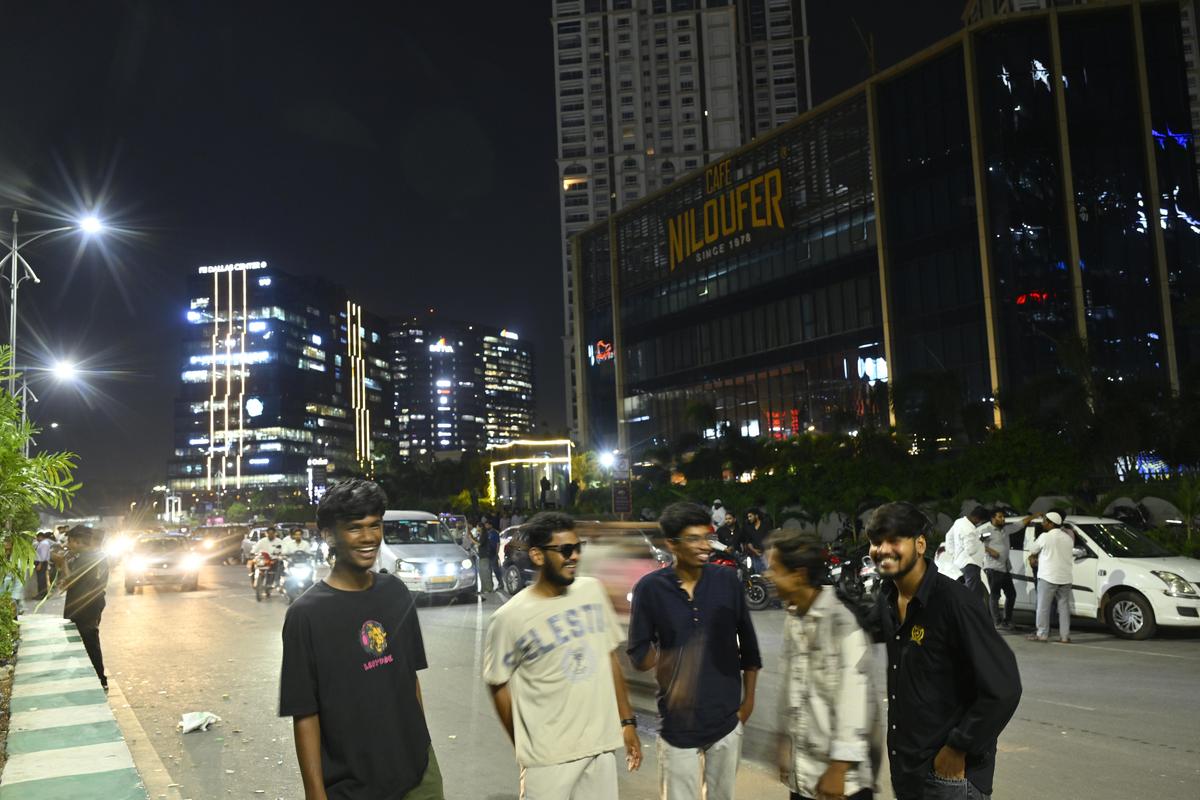
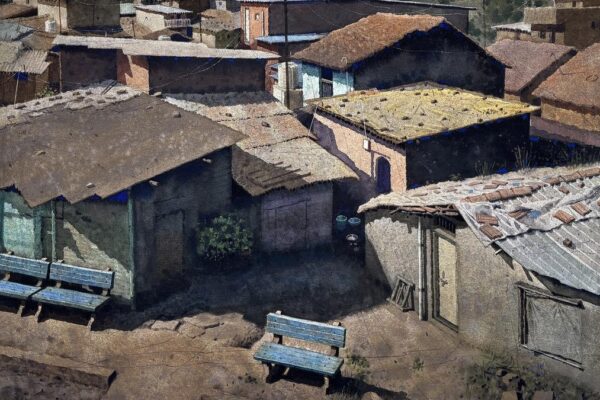
Public spaces shrink and privileged private spaces grow in Hyderabad as the city expands.
| Photo Credit:
NAGARA GOPAL
“There isn’t enough space at home. So I go to parks or empty roads. But in some places, you are not allowed, especially near office areas. And even where I find space, people stare or pass comments. It becomes uncomfortable,” she points out and adds, “With so many young people trying to express themselves now, we need spaces where we can do that freely.”
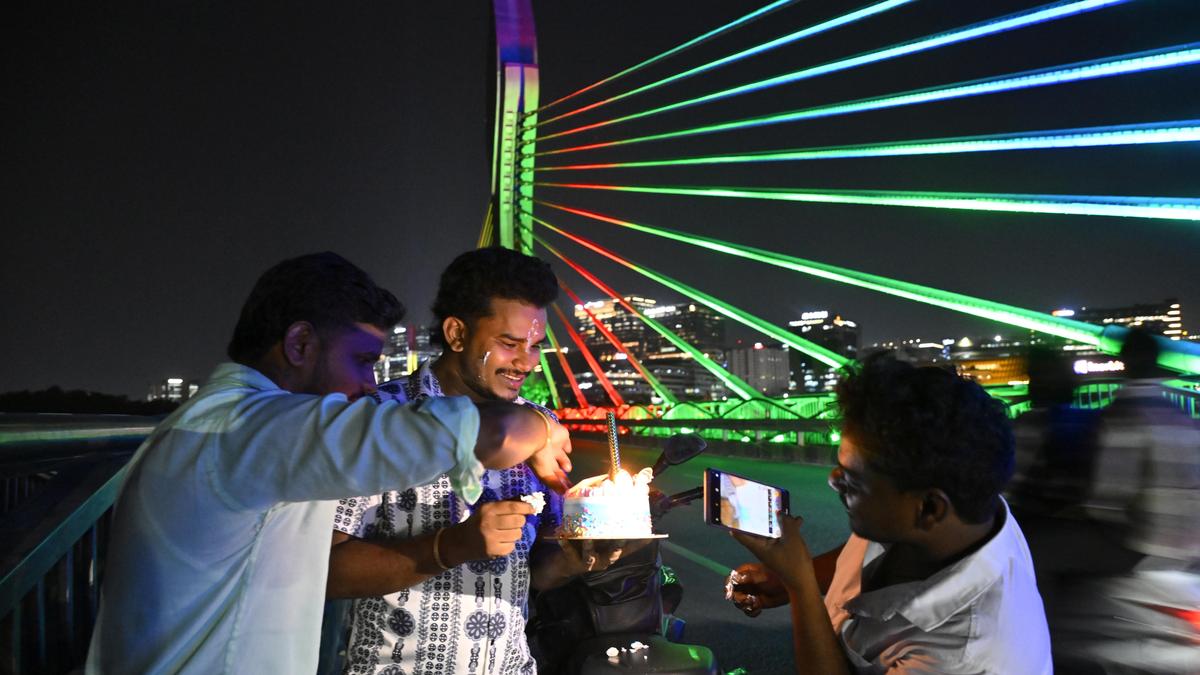
The shortage of such spaces is perhaps most visible on Hyderabad’s roads and flyovers. Crowding on the Durgam Cheruvu cable bridge has repeatedly drawn attention, with people stopping to take photos, spend time or simply take in the view despite traffic and safety concerns.
Similar scenes play out across other arterial roads and commercial districts, where stretches outside cafes, food streets and office hubs temporarily transform into informal gathering spaces after dark.
Even Cyberabad Police Commissioner M. Ramesh recently acknowledged the growing demand for such spaces while addressing concerns around unsafe public gatherings. “There is a clear need for spaces where young people can gather, socialise and express themselves,” he says, while stressing that activities endangering public safety would not be tolerated.
Urban researcher T. Pavan Kumar, who has lived in Saidabad for over 27 years, says older parts of Hyderabad once offered far more organic public interaction. He recalls playing cricket in an open ground and badminton at a local park in Subramanyam Nagar Colony during his childhood. Those spaces no longer exist in the same form.
“The ground has been converted into a congested multi-generation park while the badminton court has made way for a two-storey building,” he says.
According to him, older neighbourhoods today face multiple pressures such as shrinking land availability, poor maintenance of existing grounds, safety concerns and changing perceptions around public spaces.
As traditional recreational spaces disappear, commercial alternatives have begun filling the vacuum. “People are opening up or leasing out their land for rooftop ‘box-cricket’ and pickleball courts offerings, which are fast becoming the new social spaces,” he explains.
Even established public spaces such as Tank Bund and People’s Plaza have seen fluctuating public engagement, shaped by maintenance issues and usability concerns. Attempts to revive these areas, from traffic-free Sundays to designated food streets, have faded over time. “The problem is not just creating space. It is understanding how people actually use it,” Kumar says.
For some others, accessibility alone does not guarantee comfort or safety. M. Rachana, an IT employee from Basheerbagh, says she now avoids Tank Bund despite its appeal. “It is a beautiful place, but the stench near the water is too strong,” she shares. “As a woman, I have also seen groups gathering in ways that feel intimidating. I avoid going there, especially on weekends.”
Model built for growth, not for life
Urban experts trace this disconnect back to a broader shift in planning priorities over the past two decades. Hyderabad, like many Indian cities, has pursued a growth-first model after the 2000s, focussed on IT corridors, Special Economic Zones, commercial real estate and large-scale infrastructure projects.
In this process, localised social spaces such as parks, playgrounds, bazaars and public squares have slipped into the background. Entire urban zones emerged with limited room for informal interaction or large community gatherings. In many newer areas, commercial spaces have effectively become the default social infrastructure.
What followed was an impromptu response from residents themselves.
As office zones and residential hubs expanded, informal gathering points began emerging around chai stalls, roadside eateries, food trucks and snack vendors occupying footpaths and vacant corners. Food streets across Hyderabad, from DLF in Gachibowli and the stretch near ITC Kohenur in Knowledge City to Masab Tank, Tank Bund and Parade Ground, evolved into some of the city’s most active social spaces.
“This is what is now being called placemaking,” says Narayan. “Globally, it is structured and intentional. In India, we are rediscovering something older cities already had.”
Across the world, cities have long invested in such public environments — from Central Park in New York and the Chicago riverfront to the Tsim Sha Tsui Promenade in Hong Kong and Old Town Square in Prague. In India, major social anchors include Marine Drive, Bandra Reclamation and Bandra Bandstand in Mumbai, Cubbon Park in Bengaluru, and Dilli Haat and Central Park in Connaught Place, New Delhi.
Hyderabad’s own planning frameworks had once recognised the importance of such shared spaces. “The mandate exists, but it is confined within project boundaries. Each development provides for itself. These spaces do not come together as shared public environments,” he adds.
Urban planner and development expert Maheep Singh says the intent itself has shifted over time. “Open spaces have become a compliance requirement rather than a planning priority,” he says.
Despite multiple development norms, observers say that Hyderabad still lacks a city-wide benchmark for accessible open space. The result is a city where parks and recreational areas do exist, but often as fragmented, privatised or inaccessible pockets disconnected from the larger urban fabric.
Private spaces filling a public void
Inside Knowledge City in Raidurgam, amid glass office towers and restaurants, a small stepped plaza with a patch of lawn draws couples, families and groups of youngsters every evening.
“This is one of the few places where we can just sit,” says a young woman and regular visitor.
But access comes with conditions. “It is not fully open for anyone at any time. There have been occasions when I have been asked why I am here. But that is the trade-off if you want a place to spend time,” she says.
In the absence of strong public infrastructure, private developments have increasingly stepped in to fill the gap. IT campuses and commercial hubs now incorporate food courts, performance spaces and open plazas, creating vibrant internal ecosystems.
But planners caution against seeing them as substitutes for public space, arguing that the private sector is doing this from a business perspective. Stating that recreational infrastructure must be decentralised across the city, Singh says, “Each part of the city or each corporation should have multiple large, accessible public spaces. That would also reduce travel distances and congestion.”
Owing to the growing demand for such spaces, Telangana government in 2024 proposed the development of a ‘T-Square’ in Raidurgam, a 24×7 public plaza inspired by New York’s Times Square. Envisioned as a multi-functional urban hub in Hitec City, the project proposed digital billboards along with designated spaces for events, performances and public gatherings.
The initiative, led by the Telangana State Industrial Infrastructure Corporation, saw a Request for Proposal the same year, but there has been little visible progress since.
For planners, the larger concern remains unchanged. As Hyderabad continues expanding and undergoing administrative restructuring, they say accessible, safe and inclusive public spaces must become a central priority. “The government does not necessarily have to fund everything, but it has to act as an enabler. It should work with private players to plan and build spaces that are truly open and usable,” says Narayan.