




‘One Piece’ Season 2 review: Swashbuckling sophomore season is a Gum-Gum good time across the Grand Line
The sheer scale of One Piece remains difficult to articulate without sounding demented. The story has stretched across nearly three decades of manga chapters, with an anime that long ago crossed the thousand-episode threshold, and a fictional ocean so densely populated with islands, conspiracies, and improbable friendships that the mere thought of catching up often feels like staring out at the open ocean from the edge of a dock while a frenzied diehard insists the other side is well worth the swim. Yet once you take that leap of faith and the voyage begins in earnest, the world unfolds with a generosity that keeps rewarding curiosity.

The Netflix adaptation of Eiichiro Oda’s epic seafaring saga, understands that sensation of boundless exploration with remarkable clarity. Its sophomore run extends the journey from the comparatively grounded East Blue into the delirious unpredictability of the Grand Line, and in doing so it recaptures the exhilaration of discovery that defines Oda’s unruly imagination while holding firm to the spirit that made the original beloved. Watching newcomers begin the voyage, regardless of whether they arrive by manga, anime or Netflix algorithm, really does feel like watching rookie pirates crest Reverse Mountain for the first time, while the rest of us (with bounties in the billions) wait somewhere farther along the route, waving from distant islands and smiling knowingly at just how much ocean this story still has left to give them.
One Piece Season 2 (English)
Creators: Matt Owens and Joseph E. Tracz
Cast: Iñaki Godoy, Emily Rudd, Mackenyu, Jacob Romero Gibson, Taz Skylar, Charithra Chandran, Lera Abova and Mikaela Hoover
Episodes: 8
Runtime: 50-60 minutes
Storyline: The Straw Hat Pirates enter the dangerous Grand Line, facing the criminal syndicate Baroque Works
For the uninitiated, the premise of One Piece remains simple. Monkey D. Luffy, played with open-hearted enthusiasm by Iñaki Godoy, is a young pirate whose body stretches like rubber thanks to a supernatural Devil Fruit. His dream is to locate the legendary treasure left behind by the Pirate King Gol D. Roger and claim the title himself. Over the course of the first season he assembles the Straw Hat crew aboard the ship Going Merry: swordsman Roronoa Zoro, navigator Nami, sharpshooter Usopp, and chef Sanji. The first season chronicled how these misfits found each other across the East Blue, acquired the ship Going Merry, and discovered that loyalty forms faster than any ocean current when a captain refuses to abandon his friends. Season two begins as the crew finally reaches the Grand Line, where each island has a separate civilisation with its own climate, political crisis, and supernatural eccentricities, while a secret organisation called Baroque Works begins circling the Straw Hats menacingly.

The new season adapts a modest stretch of Oda’s manga that spans the Loguetown epilogue of the East Blue saga through the Drum Island arc. The anime adaptation frequently expanded small narrative beats into multi-episode sequences to avoid overtaking the weekly manga serialisation, and that strategy gradually produced the reputation for glacial storytelling that veteran fans know well. The live-action format approaches the material with a surgical economy that retains emotional landmarks while removing the repetition that television animation often relied upon. Each island therefore is now a discrete narrative chamber where character motivations that feed into the larger journey surface quickly and conflicts resolve with decisive momentum.

A still from ‘One Piece’ Season 2
| Photo Credit:
Netflix
Loguetown serves as the first stop, a coastal settlement haunted by history because it marks the place where the Pirate King was executed, and in his final moments, triggered the global treasure hunt that defines this saga. Production designer Richard Bridgland fills the streets with a carnivalesque energy, boasting late-Age-of-Sail aesthetics layered with theatrical eccentricity. Here the Straw Hats encounter some familiar foes, but also Marine Captain Smoker (Calum Kerr), whose smoke-based Devil Fruit abilities immediately complicate Luffy’s rubber-limbed bravado. The opener re-establishes the story’s central tension between pirates chasing freedom and authorities determined to rein them in.
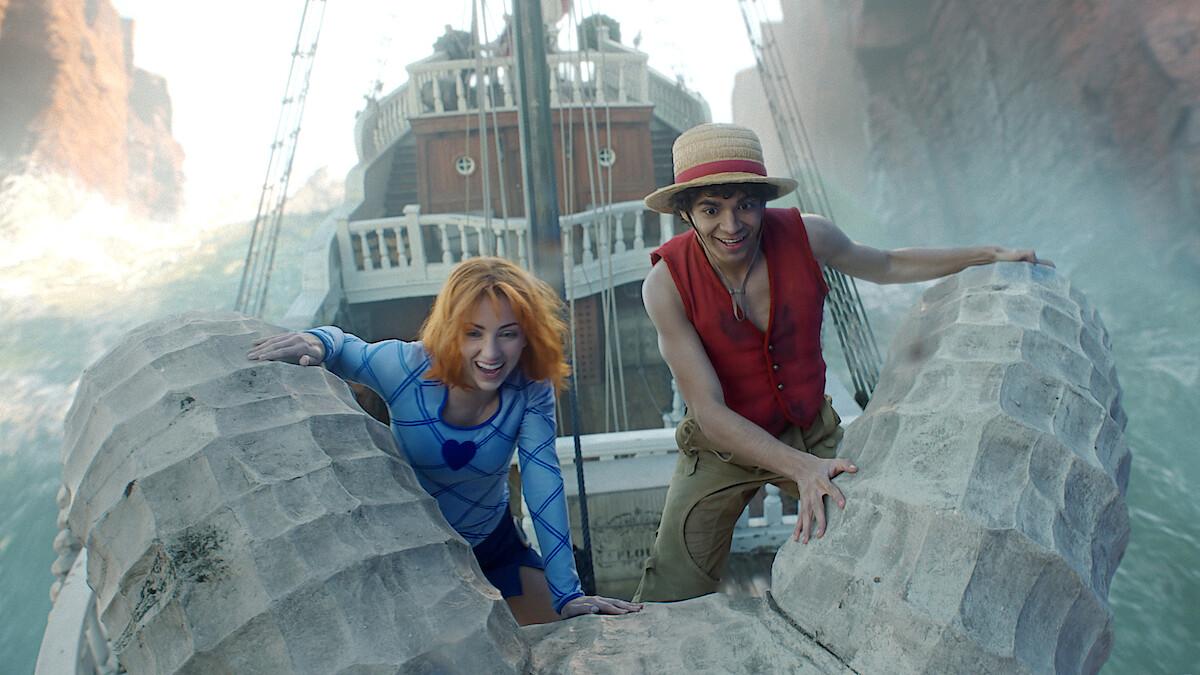
The passage across Reverse Mountain introduces one of the season’s most audacious visual gambles. The gateway into the Grand Line is a towering summit where four seas converge and where a river flows upward against gravity toward the mountain’s peak. The production recreated the ascent on an enormous inclined set that forced actors to perform scenes while physically climbing a tilted deck. But once the crew crests the summit the narrative immediately confronts them with Laboon, a whale so large it swallows the Going Merry whole. Luffy’s decision to soothe the creature with song rather than violence captures the show’s gentle streak of absurd compassion with grace.

Whiskey Peak arrives next and is initially a cheerful pirate sanctuary built on exaggerated frontier imagery. Towering cactus formations dominate the horizon while lantern-lit saloons overflow with music, alcohol, and suspiciously enthusiastic hosts. The episode evokes Sergio Leone-westerns filtered through anime surrealism, while a midnight ambush allows the season to stage one of its most kinetic action sequences when Zoro fights a hundred assassins in a sprawling saloon brawl. Mackenyu performs much of the choreography with grounded martial discipline, which contrasts sharply with the quirky costumes and ridiculous hairstyles of his opponents and grounds the sequence in a physical realism that many live-action anime adaptations struggle to achieve.
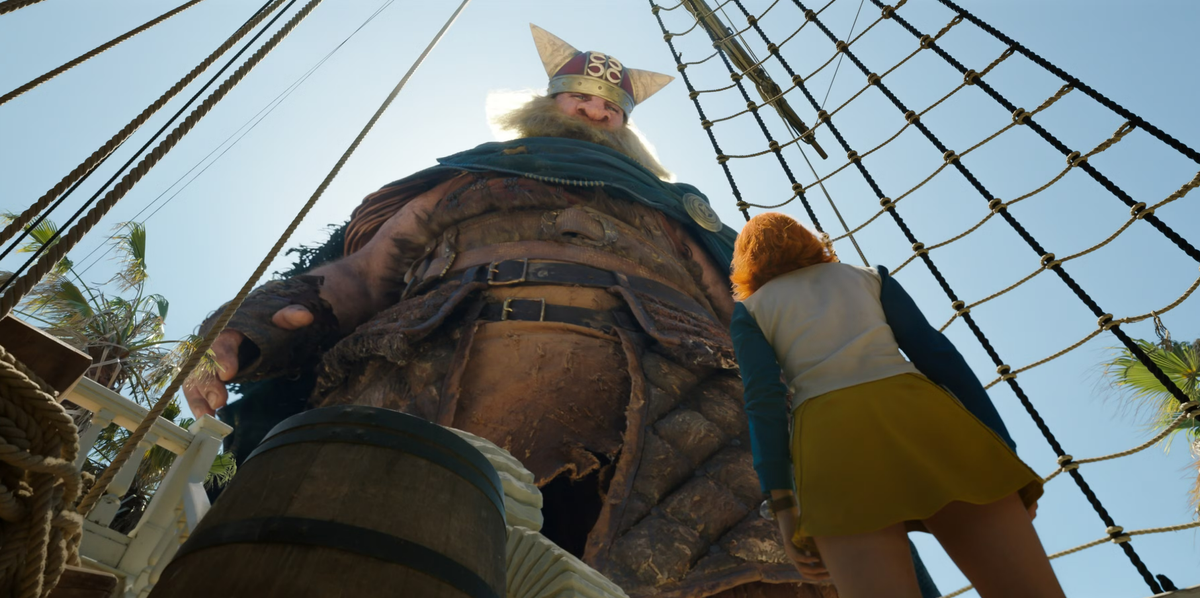
Little Garden expands the world’s imaginative bandwidth even further by transporting the crew to an island frozen in a prehistoric epoch. Dinosaurs roam through humid jungles while two giants named Dorry and Brogy continue a duel that began more than a century earlier. This ancient stalemate becomes a surprisingly reflective meditation on honour and the warriors code, echoing themes found in classical heroic epics while maintaining the whimsy that defines One Piece. Production teams lean heavily on oversized physical sets and practical prosthetics to portray the giants, which has prevented the environment from collapsing into weightless digital imagery.
A still from ‘One Piece’ Season 2
| Photo Credit:
Netflix
Drum Island concludes the seasonal arc with a tonal pivot toward tragedy and healing. The island’s geography consists of towering cylindrical mountains capped with snow, surrounding the ruined Drum Kingdom where a despotic monarch named Wapol once monopolised the country’s medical resources before abandoning it. When Nami contracts a life-threatening illness the Straw Hats must scale those frozen peaks to reach the eccentric physician Dr. Kureha, whose cynical humour masks a deeply compassionate worldview shaped by her late peer Dr. Hiruluk. The narrative transforms the island into a kind of medical parable in which Hiruluk’s belief that a nation can be cured through compassion becomes the philosophical backbone for the introduction of the crew’s future doctor.
The Straw Hats themselves remain the core that prevents this parade of eccentric islands from drifting into incoherence. Godoy continues to portray Luffy with an earnesty that borders on reckless optimism, embodying the character’s odd mixture of innocence and stubborn resolve. Emily Rudd sharpens Nami’s intelligence and moral pragmatism, turning her into the crew’s unofficial strategist whenever danger escalates. Jacob Romero Gibson shapes Usopp’s cowardice into something emotionally recognisable rather than purely comedic, while Taz Skylar’s Sanji radiates an easy charisma, whose martial-arts kicks and flirtatious bravado hide a surprising emotional sensitivity. And Mackenyu’s Zoro anchors the ensemble with dry stoicism and disciplined swordplay, which provides a crucial tonal counterweight whenever the story threatens to spin too far into farce. The group’s infectious chemistry already carries the goofy, relaxed rhythms of friends who have shared too many near-death experiences to remain strangers.

The expanding supporting cast too, enriches the narrative. Lera Abova glides through scenes as Miss All Sunday with a bewitching threat that hints at deeper ambitions. Charithra Chandran also injects warmth and urgency into Princess Vivi, whose alliance with the Straw Hats slowly reshapes the season’s stakes. And David Dastmalchian chews scenery delightfully as the wax-wielding Mr. 3.
The season’s most daunting technical challenge was clearly the iconic Tony Tony Chopper, voiced by Mikaela Hoover. Rendering a talking reindeer who walks upright, cries convincingly, and interacts with human actors carries the same peril that once plagued the adaptation of Sonic the Hedgehog. The visual effects team seems to have found that delicate balance between cartoon charm and believable texture. Chopper’s expressive eyes and hesitant voice carry the weight of his tragic backstory that transforms the seeming mascot into a fully realised character.
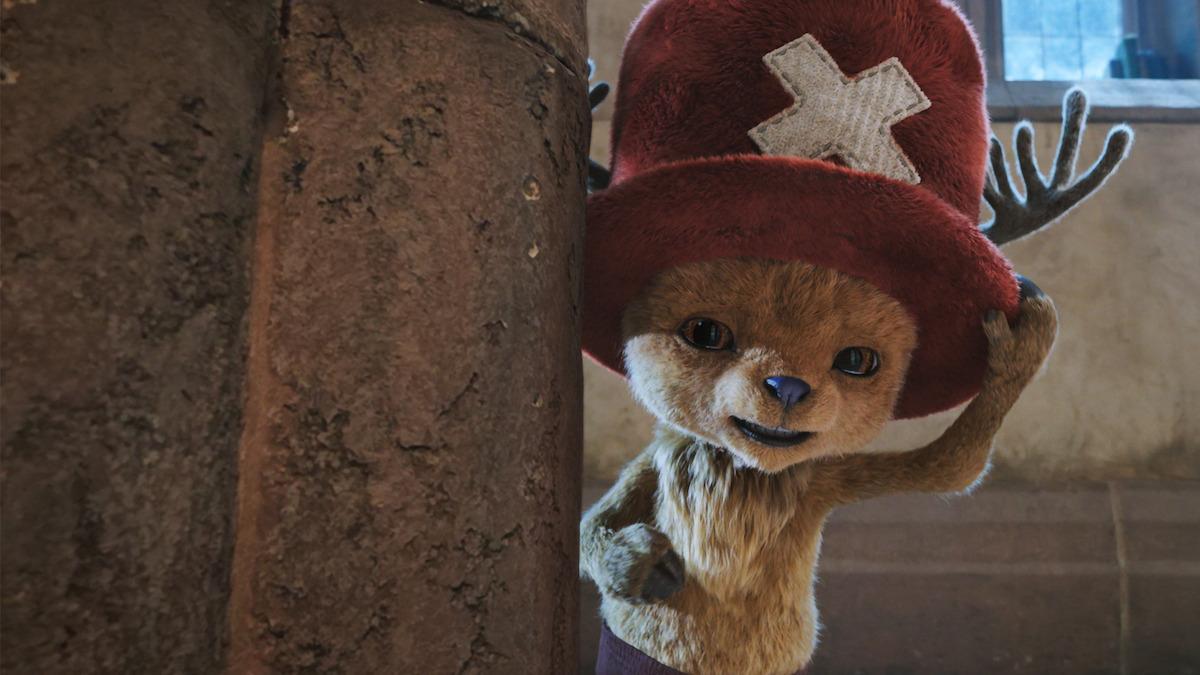
A still from ‘One Piece’ Season 2
| Photo Credit:
Netflix
Long-time readers will of course find additional pleasures hidden in the margins. The series makes some surprising narrative choices that hint at events far beyond this season’s scope. Conversations reference the mysterious battle of God Valley and the elusive Will of D. A fleeting pose echoes legends surrounding the Sun God Nika. Wooden carvings nod toward the distant land of Elbaph. A flashback to the Reverie expands the political tensions shaping the world. Subtle lines about Sanji’s childhood suggest a backstory still waiting in the wings. But the most charming surprise came during the Laboon flashback when a familiar violinist appears briefly among the Rumbar Pirates, performing the beloved sea shanty “Binks’ Brew” (or “Binks no Sake”). None of these details disrupt the story, yet the writers have quietly planted seeds for stories that will not properly blossom until far later in the narrative.

The greatest triumph of the live-action is how faithfully it captures the spirit that keeps fans returning to Oda’s universe year after year. The story finally moves beyond introductions and embraces the rhythm of island-hopping escapades, flamboyant villains, and emotional climaxes that have defined the saga. Across the past year the Straw Hat flag has appeared on revolutionary banners around the world as a symbol of resistance against oppression and tyranny, and the live-action series understands why that symbol resonates. In his own silly ways, Luffy continually frames piracy as a metaphor for freedom and a refusal to accept rigid hierarchies that restrict imagination, dignity or dreams. Season two proves that this philosophy can survive the transition from manga panels to live-action spectacle with surprising grace. With the horizon now pointing toward the political turmoil of Alabasta, the voyage appears only to be gathering momentum.
One Piece Season 2 is currently streaming on Netflix
Published – March 11, 2026 06:49 pm IST