



India’s trade strategy in a multipolar world
India’s recent global trade strategy aims to boost exports and strengthen its position as a leading global trade partner. This has resulted in ambitious free trade agreements and a stronger presence in key international economic forums. In 2023, India updated its Foreign Trade Policy (FTP) with the goal of increasing exports to $2 trillion by 2030, reinforcing a framework of strategic autonomy that supports sovereign decision-making while engaging major global powers. According to the Department of Commerce’s 2025 Year-End Review, India recorded a 6.05% annual increase in total exports — merchandise and services combined — reaching $825.25 billion.
A shift in approach
For many years, India adopted a cautious approach to free trade agreements (FTA), engaging primarily with economies that were similar in structure and stages of development. In recent years, however, New Delhi has shifted to a more proactive trade strategy, pursuing intensive negotiations and concluding comprehensive FTAs with major developed economies that were previously beyond reach. According to recent estimates, India’s network of FTAs is projected to cover nearly 71% of its total export basket by 2026 — an extraordinary increase from approximately 22% in 2019. This rapid expansion reflects a decisive shift away from primarily regional trade arrangements toward deeper integration with advanced economies such as Australia, the the European Union (EU), the United Arab Emirates (UAE), the United Kingdom (U.K.) and the United States, signalling India’s broader strategic ambition to integrate into global value chains and high-value markets.
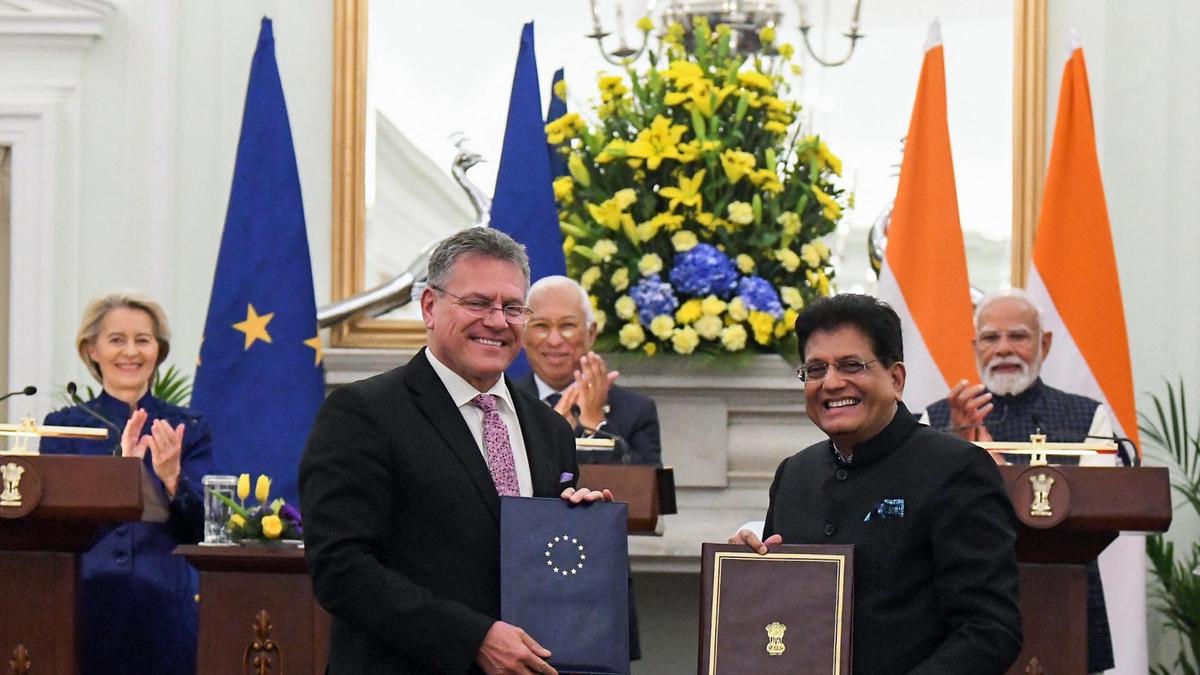
A major development in India’s trade diplomacy is the India-EU Free Trade Agreement, signed on January 27, 2026 after nearly two decades of negotiations. Described as “historic” by European Commission President Ursula von der Leyen, it creates a vast free trade zone covering nearly two billion people.
The agreement reduces or eliminates tariffs on over 90% of traded goods, boosting market access for Indian exporters, especially in textiles, leather, pharmaceuticals, chemicals, and marine products. It enhances India’s competitiveness against exporters such as Bangladesh and Vietnam. The FTA also removes tariffs on many pharmaceutical exports, strengthens regulatory cooperation, and lowers production costs by easing access to advanced European machinery and inputs. It is also expected to foster digital trade, boost investor confidence, and strengthen long-term economic resilience. Widely regarded as the “mother of all deals”, the agreement represents a transformative boost to India’s export ecosystem and marks a decisive shift in India’s broader global trade strategy.
The deal with the U.S.
Early in February 2026, India and the U.S. signed a framework for an interim agreement on reciprocal trade, restating their commitment to advancing negotiations on a broader U.S.-India Bilateral Trade Agreement (BTA). The interim framework is designed to progressively reduce tariffs across a range of products, thereby facilitating greater Indian exports to the U.S. market and enhancing overall market access.
The agreement also prioritises strategic collaboration in critical sectors such as rare earths and semiconductors. This cooperation is expected to support India’s ambitions in high-technology manufacturing, reinforce its electronics export capacity, and strengthen its emergence as a reliable global hub for electronics and semiconductor-related production. By diversifying export destinations and reducing overdependence on specific markets, the pact enhances India’s strategic and economic flexibility. Strategically, India’s recent global trade agreements collectively signal a major shift toward enhancing its role as a leading player in the global trading system. This shift is visible across four key dimensions. First, deeper engagement with advanced economies such as the EU and the U.S. provides India with preferential access to some of the world’s most lucrative and high-demand markets. Such access is expected to significantly strengthen India’s export potential and global market presence with benefits flowing to labour intensive sectors integrating the Micro, Small, and Medium Enterprises into the Global Value Chains. The agreements are across continents that reinforces India’s strategic attempt to diversify and not become overly dependent on any single geography.
Second, FTAs reduce barriers on both exports and imports of intermediate goods, enabling Indian firms to integrate more effectively into global supply chains and improve their global competitiveness. This integration is especially beneficial for high-growth sectors such as technology, electronics, pharmaceuticals and services, all of which depend heavily on seamless cross-border movement of inputs and components.
Third, trade agreements serve as strategic instruments for enhancing India’s diplomatic influence. By establishing deeper economic interdependence with major powers, India strengthens its role in global economic governance and positions itself as a more influential voice in shaping trade norms and standards.
At the core
India’s evolving global trade strategy is central to its ambition of becoming an economic superpower and achieving Viksit Bharat. After opting out of the Regional Comprehensive Economic Partnership, India adopted a calibrated approach — boosting domestic manufacturing through production-linked incentives and infrastructure expansion while deepening global integration. Trade agreements with Australia, the EU, the UAE, and the U.K. aim to expand market access, attract investment, and diversify exports. By strengthening supply chains, promoting digital and services trade, and integrating into global value chains, India seeks to scale high-value exports and position itself as a leading force in global commerce.
Chandrajit Banerjee is Director General, The Confederation of Indian Industry (CII)
Published – February 25, 2026 12:08 am IST