



I Went To Toyota’s City Of The Future. It’s A Work In Progress.
Once, a traffic light that was supposed to turn green whenever a vehicle approached stayed red for half an hour. In the middle of the night, all the lights in the city turned on for no apparent reason. A robot got stuck, forcing three people to team up and brute-force it out of the way. About six months since the first residents moved in, Toyota’s city of the future is still very much a work in progress.
And the company is transparent about that; I heard all these examples of what’s gone wrong straight from Daisuke Toyoda, a senior vice president at Woven by Toyota (the carmaker’s mobility technology division) and the son of Toyota Chairman Akio Toyoda.
But six years after Akio Toyoda announced that the carmaker would erect a living laboratory for new mobility technologies, the place exists. A small group of people are living and working there, testing and tweaking the technologies that could define Toyota’s future—along with a few that probably won’t.
Last month, Toyota opened up Woven City to non-Japanese journalists for the first time, and I got a peek inside. Here’s what I saw.
Woven City: Population 100
Woven City looks about how you’d expect: sparkly clean, cookie-cutter, and a little futuristic. What I didn’t anticipate was how eerily empty it would feel. There was virtually nobody walking around. There were no cars coming and going and few signs of life in general. The sprinkly weather during my tour may have had something to do with it. But the reality is that not too many people live there yet. Again—work in progress.

Photo by: Tim Levin/InsideEVs
Toyota says that an initial group of 100 “Weavers” inhabit the city, and all 50 households are Toyota-affiliated. Situated in the shadow of Mount Fuji about a 90-minute drive from Tokyo, the city’s first phase comprises a handful of buildings on a plot the size of a few city blocks. A phase two expansion is under construction now. And over time, Woven City’s footprint will grow by more than tenfold and its population should hit around 2,000, Toyota says.
The city is part proving ground and part idea-incubator. At one corner of the site lies the “Inventor Garage,” a former Toyota factory building converted into a maker space where companies working on projects at Woven City can tinker with their products. As I learned perusing the booths participants had set up for the media, some “Inventors” are obviously related to moving people and things. Others have nothing at all to do with cars or transportation.
Toyota supplier Denso is working on wireless EV charging and plans to test a road with embedded induction charging at Woven City. A Toyota subsidiary has developed a sidewalk delivery robot called Cocomo, which is learning how to navigate the world at Woven and elsewhere. Another company is working on compact hydrogen fuel cells and hopes Weavers will test out a hydrogen-powered e-bike that it developed as a proof of concept. Joby Aviation the electric vertical take-off and landing firm that counts Toyota as a major backer, recently signed on.
One “Inventor” company at Woven City is working on small hydrogen fuel cells, including the one featured in this prototype electric bike.
Photo by: Tim Levin/InsideEVs
Then there’s a vending-machine company. (As I learned during my time in Japan, these are a very big deal.) The ramen giant Nissin Foods is working on new food concepts it wants to test on the Weavers. One company hopes to help pick your perfect karaoke song using AI.
A ‘Proving Ground For Mobility’
At its core, as Daisuke Toyoda and other executives explained, Woven City is a “proving ground for mobility.” All carmakers have facilities where they push vehicles to their limits in the mud, rain, and snow. Woven City will help Toyota prove out other technologies. During my trip, I wanted to get a better sense of what that means.
Part of it has to do with infrastructure. Toyota doesn’t believe its goal of a world with “zero accidents” is feasible with better vehicle technology alone. While Toyota is testing self-driving technology on public roads too, Woven by Toyota CTO John Absmeier told reporters, at Woven City, it can experiment with solutions that fold in the street infrastructure too.
The entrance and welcome center at Toyota Woven City.
Photo by: Tim Levin/InsideEVs
“In the city, in particular, the infrastructure is what we can get access to,” he said. “We can control, we can test, we can develop new ideas around it. And that’s the biggest difference or opportunity that we have here in the city.”
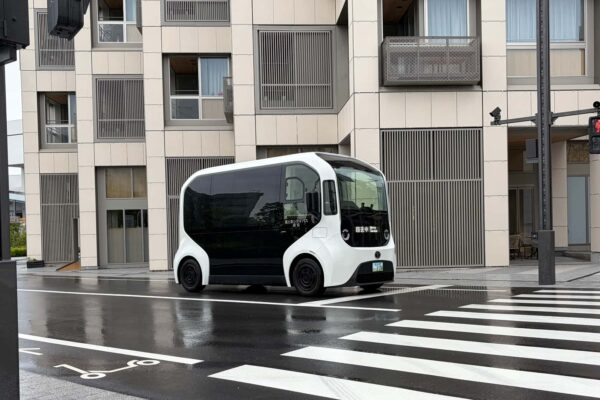
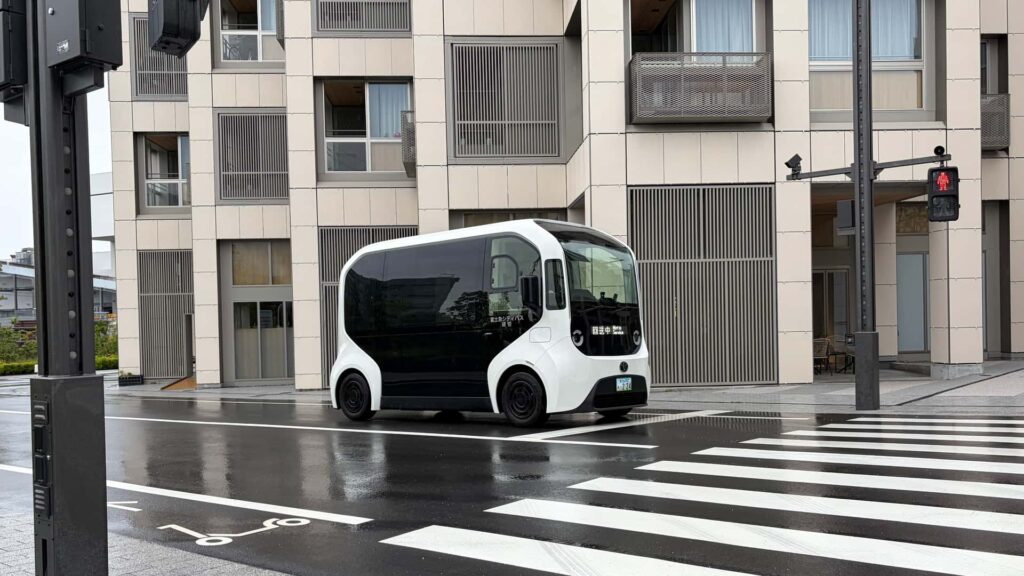
Every intersection at Woven City has several cameras that feed into something called the Woven City AI Vision Engine. That lets Toyota test, for example, systems that pick up on a person running through an intersection and alert an approaching driver before the worst happens. Those kinds of tests are happening right now. Today, the bubbly e-Palette buses that comprise Woven City’s tiny transit system are driven by humans, but the plan is to make those autonomous down the line. The traffic signals are also designed to prioritize pedestrians until they sense a car approaching, but that feature isn’t working yet.
Delivery Robots, A VPP, And The Swake
So what other mobility tech is Toyota proving out at Woven City? I didn’t catch a glimpse of any Cocomos on account of the rain, which was disappointing. But I did see other bots, like Toyota’s Guide Mobi.
During a demonstration, a Guide Mobi guided a Toyota bZ4X out of a parking garage and onto the streets of Woven City.
Photo by: Tim Levin/InsideEVs
It’s a stout, three-wheeled robot, with a comprehensive sensor array, that’s designed to make any car driverless. At Woven City, Guide Mobi robots effectively tow Toyota bZ4X crossovers out of a parking garage as part of a car-sharing service. Weavers can order a vehicle via an app, and a Guide Mobi will deliver it to the curb, wirelessly tapping into the braking, steering, and acceleration from about 10 feet ahead. The demonstration we saw involved a human monitor sitting in the bZ4X’s driver’s seat, and the driving wasn’t exactly smooth. But the concept makes a lot of sense for robo-valets and the like.
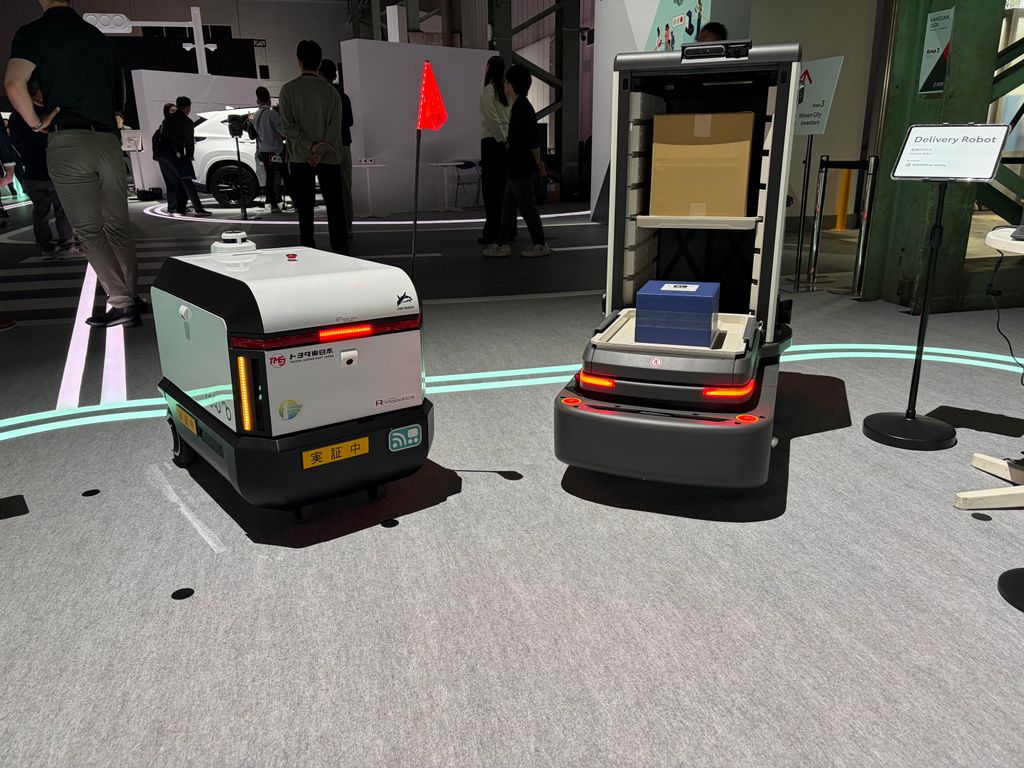
Toyota’s Cocomo (right) and package delivery robots that are being tested at Woven City.
Photo by: Tim Levin/InsideEVs
Weavers get their packages via robot too. Delivery trucks don’t enter the city and instead deposit packages at an underground logistics center. From there, wheeled robots pick them up and bring them to centralized lockers in each building via tunnels beneath the city. Toyota also plans to bring helper robots into Weavers’ homes, where they can learn how to do dishes and fold laundry in a real-world environment.
The Swake is a three-wheeled scooter developed by Toyota and being tested as part of a shared micromobility service at Woven City.
Photo by: Tim Levin/InsideEVs
At the street level, residents can grab a ride on a Swake, another Toyota invention. The scooters feature three wheels instead of two, a large platform for both of a rider’s feet, and a butt pad for leaning. The Swake service was out of commission due to the weather and, unfortunately, I didn’t get to try one. But based on an indoor demonstration, they look like a good micromobility solution. They seem more stable and nimble than a typical scooter-share vehicle and could get people who feel wobbly on a bike or scooter to try a non-car solution.
Woven City also has an EV-powered virtual power plant (VPP). A parking garage on site houses 50 city-owned vehicles that can feed power back to the city via bidirectional charging. Woven City reps said the setup can shave off 5-10% of the city’s peak power needs. Right now, the VPP tech that Toyota has built is in the proof-of-concept stage, but Toyota reps said that this could be a solution for industrial sites with large company-owned fleets.
Woven City staff are working on virtual power plant technology, and a proof of concept project is underway at the city featuring 50 EVs in a parking garage.
Photo by: Tim Levin/InsideEVs
Will It Work?
Like the rest of the automotive establishment, Toyota is trying to remake itself for the future. Going forward, this Japanese giant needs to contend not only with relentlessly fast-moving Chinese carmakers and with Silicon Valley-inspired startups like Tesla and Rivian, but also with self-driving technologies that may obviate the need for personal cars altogether.
Toyota started out making looms at the turn of the last century—hence all the “woven” lingo—then became the world’s biggest car manufacturer. Now it’s figuring out how to be a mobility company, and, based on the sheer breadth of ideas I witnessed, what that even means. It won’t be easy, but a controlled playground for technology like Woven City could certainly help Toyota come up with some answers—especially once some of the teething issues get ironed out.
Contact the author: Tim.Levin@InsideEVs.com