


Governor should be convinced that single largest party can win a majority
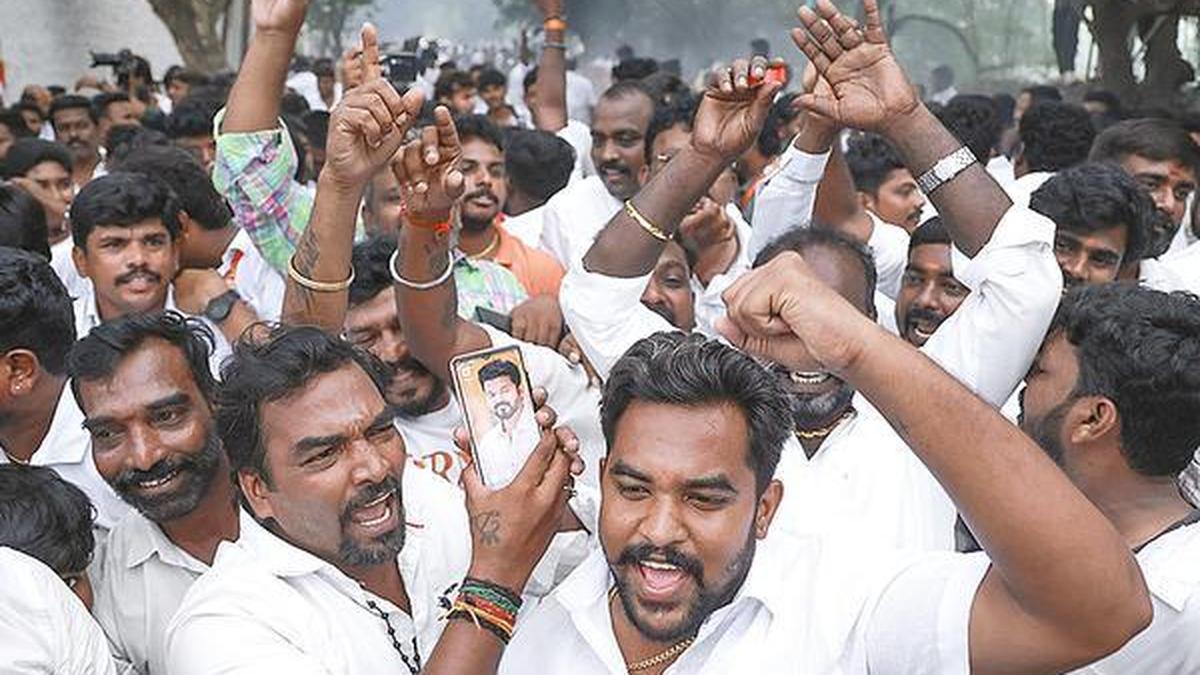
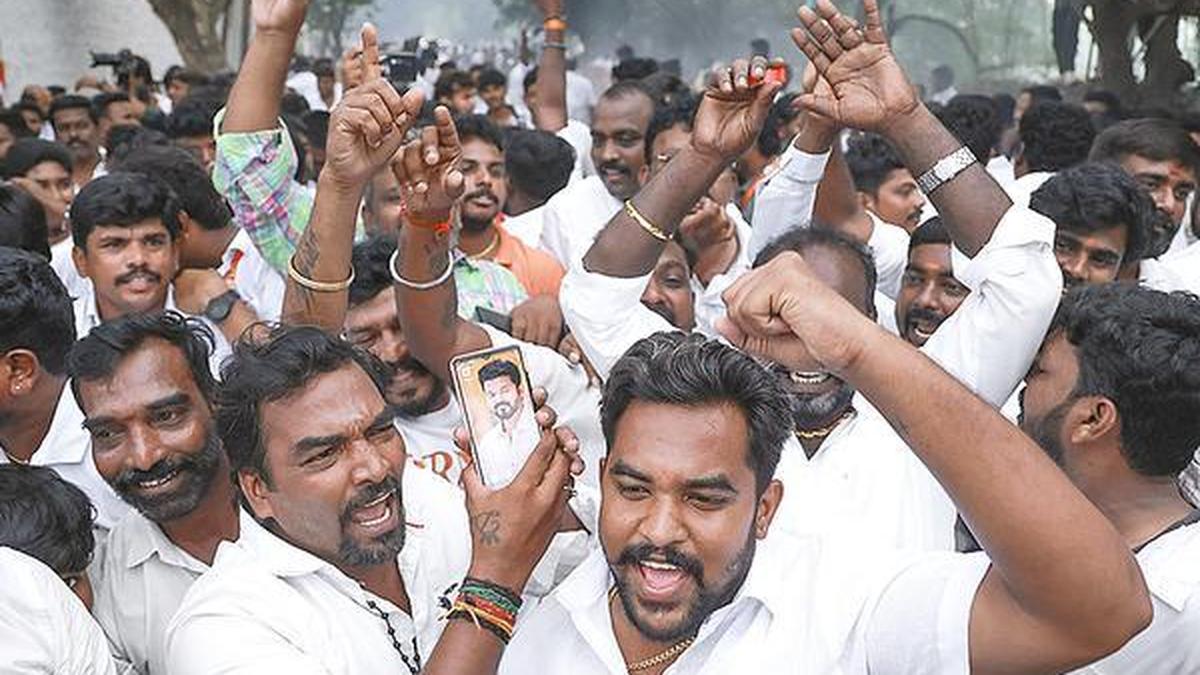
TVK supporters celebrate in Chennai on Friday after party chief Vijay received support from the Left parties to form the government.
| Photo Credit: PTI
The Tamil Nadu Legislative Assembly election has turned out to be a nail-biter befitting Tamilaga Vettri Kazhagam chief C. Joseph Vijay’s cinematic background, keeping the audience on the edge of their seats as everyone waits to see whether he will become Chief Minister or President’s Rule will be invoked.
Every person across the State and country, be it a legal luminary or the common man, has an opinion. Some say the Governor must compulsorily invite Mr. Vijay to form the government since his party emerged as the single largest party, whereas others say he can only invite the party which has the support of the majority of the Assembly.
What is relevant to consider are the factors which determine the Governor’s exercise of his discretion in a manner he may deem fit. The Supreme Court in S.R. Bommai case reported in (1994) 3 SCC 1 dealt with a situation where six State legislatures were dissolved by the President acting on their respective Governors’ reports issued under Article 356(1) that those States could not function as per the Constitution. The court struck down the dissolution of the Assemblies of Karnataka, Meghalaya, and Nagaland and upheld the dissolution of Madhya Pradesh, Himachal Pradesh, and Rajasthan Houses. The conclusion of the court in short was that the President has to act on credible and verifiable information that the constitutional machinery of the State had broken down rather than on the ipse dixit of the Governor.
Nominal head, significant role
The above was a case of a government already in power; however the rationale therein has been held to be equally applicable to the formation of a government as well by the Supreme Court in the case of Rameshwar Prasad reported in (2006) 2 SCC 1. Before referring to what was stated in Rameshwar Prasad, it would be apt to understand where the Governor stands in the larger constitutional scheme. The Governor is only a nominal head; however, the Constitution has in certain situations given this position significant importance in the functioning of the State, and one such role is the appointment of the Chief Minister.
Article 164(1) is silent on who ought to be appointed the Chief Minister; it simply states that the “Chief Minister shall be appointed by the Governor…” This does not mean that there are no limitations on who can be appointed. The Supreme Court in Harasharan Verma reported in (1971) 1 SC 616 has held that even a person who is not a member of the Assembly can be appointed Chief Minister, but he has six months to get elected failing which his appointment would cease as laid out in Article 164(4). This decision of appointing the Chief Minister who commands the majority is exclusively within the Governor’s discretionary power as held by the Supreme Court in Samsher Singh vs State of Punjab reported in (1974) 2 SCC 831. As to the amenability of such discretion to judicial review, the personal immunity granted by Article 361 does not bar a challenge to the actions of the Governor; it merely prohibits the court from issuing notice or making the President or Governor personally answerable. It is, therefore, implicit that the Governor exercises his circumstantial discretion in accordance with constitutional principles.
Bihar case
Now going back to Rameshwar Prasad’s case, the Governor of Bihar had kept the state in suspended animation as no party emerged as the majority and the Governor submitted a report to the President and sought for President’s Rule under Article 356(1), to give time for a party to emerge with a majority. Thereafter, amid reports of horse-trading by the National Democratic Alliance, the Governor submitted another report to the President that there is large-scale poaching of MLAs and that the constitutional machinery of the State had broken down. The President, acting on the report, dissolved the Assembly and called for President’s rule. This proclamation was struck down by the Supreme Court as the Governor’s report was not based on any credible data applying the principles from S.R. Bommai.
How is any of this relevant today? In Rameshwar Prasad, the Supreme Court considered the Sarkaria Report with regard to the appointment of a Chief Minister when a party lacks a clear majority. The report set out a step-by-step process to be followed in the event no single party emerges with a clear majority. The Governor is vested with the discretion to invite the single largest party who in his opinion commands the majority to form the government and if there are multiple claims, to settle the issue by a floor test. The dissolution of the Assembly and proclamation of President’s Rule is the very last resort. If the President were to act on a report of the Governor and dissolve the Assembly, it ought to be based on some credible information that the State’s constitutional machinery has broken down; in the absence of such data, any proclamation by the President based on such a report will be struck down.
Now with multiple plot twists, the TVK is teetering on the precipice. The Governor cannot be said to be acting unconstitutionally by not immediately inviting the single largest party to form the government, especially when the TVK has not yet laid claim to the magic number of 117 . What is clear from the Report of the Sarkaria Commission, and the judgment of the top court in Nabam Rebia (2016 (11) SCC 673) is that the Governor should be of the opinion that the single largest party commands or is at least expected to command the support of the majority of the Assembly before appointing the Chief Minister. The Supreme Court in Rameshwar Prasad emphasised that an opportunity ought to be given to the single largest party to stake their claim with the support of other parties and that any drastic steps envisaged under Article 356(1) should be a last resort.
Gautam S. Raman is a practising advocate in the Madras High Court; Views expressed are personal
Published – May 09, 2026 12:48 pm IST