



Build Them 30 At A Time
- General Motors revealed one of the manufacturing techniques that lowers the Chevy Bolt EV’s costs.
- The automaker ditched the old way of assembling cars, where different trims and configurations converged on the line.
- For the Bolt EV, GM is making identical cars in batches; a pair of “clones” is also on standby to keep the line rolling.
The 2027 Chevrolet Bolt is marketed as “America’s most affordable EV,” but to get that title, General Motors had to find some clever solutions. One of those was to fit modern components under a body that shares a lot of components with the previous-generation Bolt EUV.
But that’s what people can see. To make a 262-mile EV with decent charging specs, hands-free driving capabilities, and a sub-$30,000 price tag, GM was forced to get creative on the assembly line, too.

20
Source: Mack Hogan/InsideEVs
Usually, cars go on the manufacturing line in VIN order, which means multiple trims, colors, and options have to be fitted by workers in a short amount of time. This increases the risk of something going wrong—and if the line has to stop, the money stops flowing.
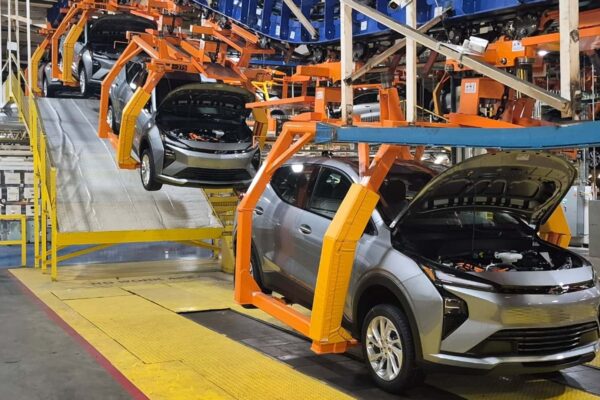
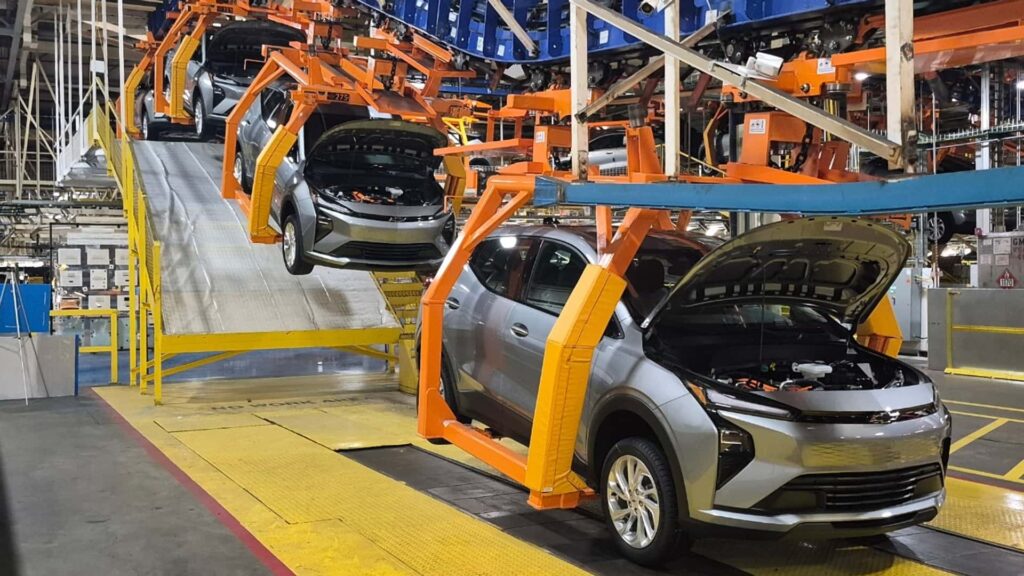
To get around this issue, the 2027 Bolt is assembled in batches of 30 identical cars at the Fairfax plant in Kansas City. According to General Motors, this “Winning with Simplicity” approach has so far managed to reduce complexity and costs, and, at the same time, boost productivity and quality.
Workers know they no longer have to reach for different parts trays from one car to another, ensuring that vehicles don’t have to be pulled off the line to repair mistakes. Even if that happens, though, the automaker has another ace up its sleeve—the “clone” process. For every configuration, the plant holds back two bodies, so that if a vehicle is removed from the assembly line for a quality issue, its matching “clone” can take its place on the line, and manufacturing can keep moving forward.
In the Chevy Bolt’s case, we’re talking about 21 “clones,” seeing how the EV is available with three roof configurations and seven colors.
Assembling cars in batches saves quite a bit of floor space, because there are fewer racks and storage equipment. Switching between paint colors can also be done less frequently, which saves time. Additionally, suppliers can plan deliveries to GM’s Fairfax plant on a fixed seven-day schedule, leading to greater consistency in deliveries.
All of this has led to the 2027 Bolt’s assembly team consistently meeting its monthly quality targets, three months after the car’s launch. That’s great news for future Bolt owners, but the party won’t last very long. Next year, the lovable American electric hatchback will be retired, making room for the gas-powered Chevrolet Equinox and a new Buick SUV, both of which will be assembled using the batch technique.