



As calculations catch up, muon anomaly nearly vanishes
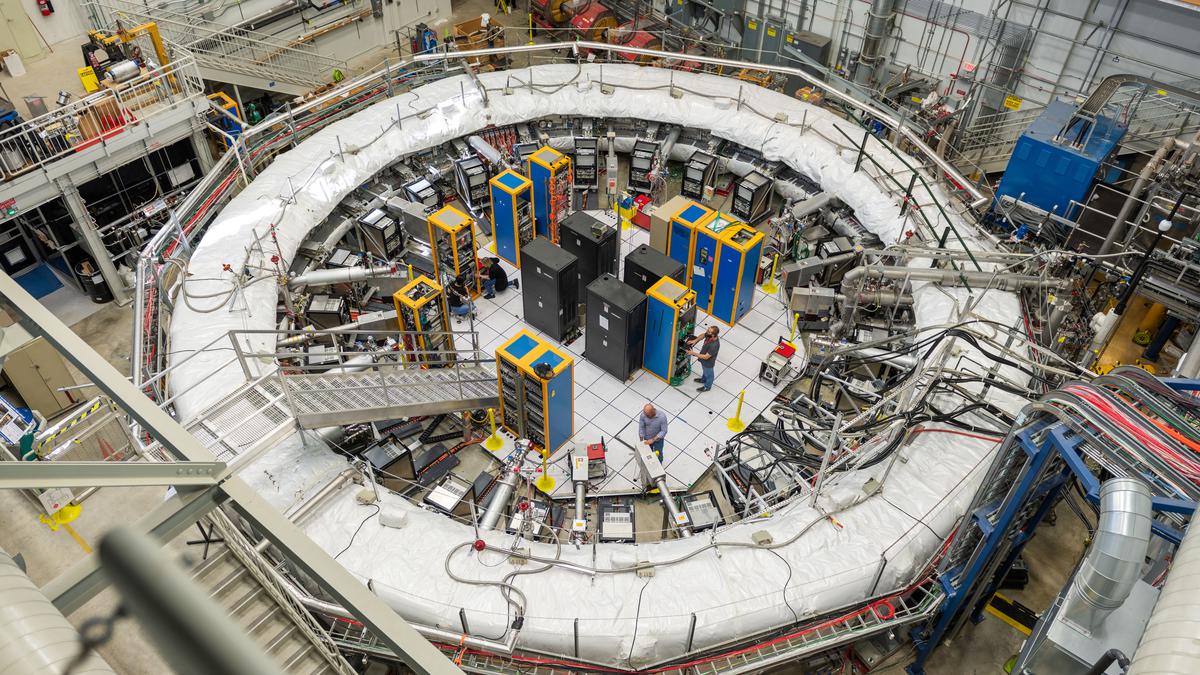
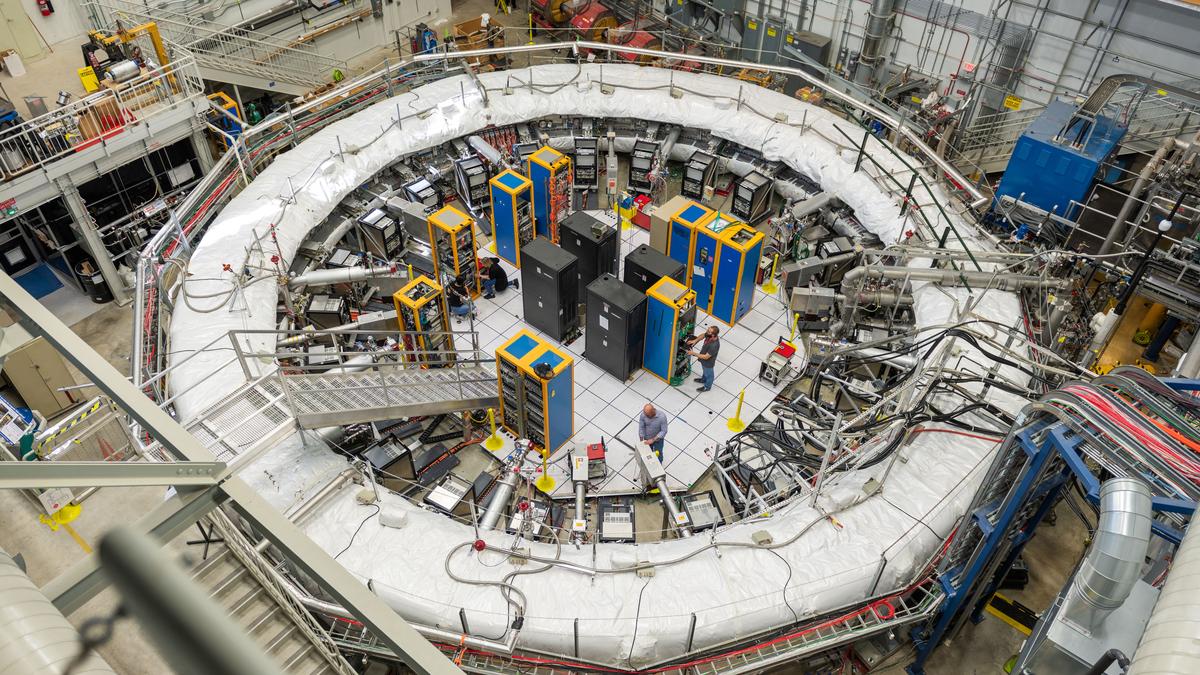
The Muon g-2 ring sits in its detector hall at the U.S. Department of Energy’s Fermi National Accelerator Laboratory (Fermilab) in Illinois. The setup studies the wobble of muons in a magnetic field.
| Photo Credit: REUTERS
The particle physics rulebook, called the Standard Model, predicts the properties of most subatomic particles with such precision that those few properties found to differ in experiments have frustrated physicists. This is why they’re keenly looking for cracks in the Model — parts where it can be updated — that could cover the anomalous findings as well.
One such crack is the g-2 anomaly. A muon is a subatomic particle that behaves like a spinning magnet, so when placed in a magnetic field, it wobbles. A figure, g, denotes the strength of this wobble. The model says it should be just above 2 but many experiments have found a higher value.
However, a new study published by an international team in Nature suggests the Model might be fine. Reasoning that previous calculations were just less accurate, the team published an updated set according to which the Model’s prediction is roughly 0.000015% from the value measured in experiments.
Published – April 30, 2026 08:00 am IST