



Want An Electric Outback? The Subaru Trailseeker Is Your Answer
I have been avoiding something for years. I am a twenty-something guy who lives in San Diego, has a dog, hikes a lot, and loves to camp inside his SUV. Everyone on Earth knows what I should be driving: a Subaru Outback. I know it, too, but truth be told I’ve always found the modern Subie wagons to be quite boring.
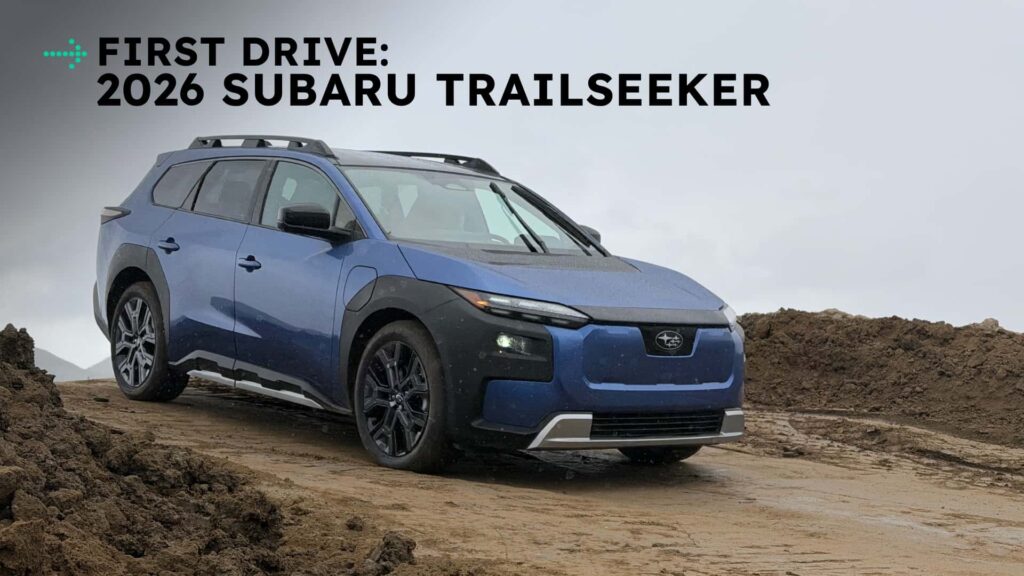
Enter the Trailseeker, an electric Outback-sized SUV with plenty of ground clearance, a massive cargo hold, excellent driving dynamics, and a whopping 375 horsepower.
It’s fantastic. In fact, with two small changes, it could become one of my favorite EVs on sale.
(Full Disclosure: Subaru put journalists up in a nice hotel in Laguna Beach for the Trailseeker and Uncharted drive. The company provided meals and test cars.)

20
Source: Mack Hogan/InsideEVs
2026 Subaru Trailseeker: Specs & Features
All Trailseekers come with the same basic setup: a dual-motor all-wheel-drive powertrain fed by a 74.7 kWh battery. That’s small for the segment, as the Chevy Blazer EV has an 85-kWh pack, and the Jeep Wagoneer S has 100.5 kWh of onboard energy. But Subaru still manages to get close on range. The Trailseeker offers 281 miles of range in its base spec, or 274 miles on the loaded Limited and Touring models.
Given that the Blazer manages only 283 miles with its larger battery and the Wagoneer S, with its whopper of a pack, only goes 294 miles, you can already see Subaru’s efficiency lead shining through. It’s not due to aerodynamic tricks alone, either, as the Subaru offers more cargo space and ground clearance than either option.
2026 Subaru Trailseeker Specs
Base Price
$41,445
EV Range
Up to 281 miles (274 on Limited/Touring)
Battery
74.7 kWh
Drive Type
Dual-motor all-wheel drive
Output
375 horsepower
Ground clearance
8.5 inches
Cargo Volume
31.3 cubic feet (seats up); 74.0 cubic feet (seats folded).
With 8.5 inches of clearance, it actually offers more room to maneuver than a base Ford F-150, with a shorter wheelbase and overhangs to boot. Oh, and it goes zero to 60 in 4.4 seconds. Man, EVs are neat.
All of this starts at just $41,445 with destination fees, making it $8,000 cheaper than any all-wheel-drive Blazer EV, and a good $25,000 cheaper than the Wagoneer S.
It may therefore seem foolish to compare them. But if you want an electric SUV that’s larger than something like a Tesla Model Y, Hyundai Ioniq 5, or Ford Mustang Mach-E without jumping to a gargantuan three-row SUV or a luxury marque, the Blazer EV and Wagoneer have until now been your only options. And because the Blazer is packaged so poorly, it doesn’t actually offer more cargo space than the smaller Hyundai and Tesla. Now you have the Trailseeker and the nearly identical Toyota bZ Woodland as options, too.
Photo by: Mack Hogan/InsideEVs
Since the Toyota is built by Subaru, anyway, and comes only in a more loaded-up guise with a $5,000 higher starting price, the Trailseeker fills some important white space in the market. Many people have big dogs, bulky camping gear, or two kids, but don’t want to jump to a $55,000 Kia EV9 to squeeze them all in. Even loaded up to its Touring trim with an extra-cost color, the Trailseeker comes in under $50,000, making it cheaper than the average new car in America.
That’s a great place to sit for a car that’s faster, more spacious, and more capable than the vast majority of SUVs on the road.
How Does It Drive?
Phenomenally. The Trailseeker weighs 4,465 lbs in its base configuration, about 700 lbs less than my Blazer EV. Weight is the enemy of a good driving experience, as it makes turning, accelerating, shock absorption, and braking all more sluggish, so a 700-pound advantage manifests in a holistically better driving experience. The fact that it also has 75 extra horses to let loose certainly helps, too.
The Trailseeker has quick, accurate steering and an extremely balanced chassis. Unlike most of its competitors, it has a symmetrical AWD system. So while a Blazer EV drives like a front-wheel-drive car with a small assistant working on the rear axle, and the AWD Ioniq 5 feels heavily rear-biased, the Trailseeker feels neutral and balanced. I did pick up more road noise than I’d like, but otherwise it’s a refined experience.
Photo by: Mack Hogan/InsideEVs
One other benefit of a lighter design: You don’t have to trade ride quality for precision. That means the Trailseeker isn’t just more engaging to drive than my Blazer, it also rides better, with a velvety suspension that makes everyday driving a treat.
Then you take it off-road and the lead widens. Despite its Jeep badge, the Wagoneer S’s limited clearance makes it a liability on dirt. And while Hyundai may have targeted the Subie demo with its Ioniq 5 XRT, that model’s seven inches of clearance just isn’t enough; I was white-knuckling it when I drove down a relatively tame fire road.
The Trailseeker is a cut above, with off-road software modes like X-Mode and Grip Control to help you make the best use of your traction. On a short and tame off-road course Subaru set up, I could feel X-Mode nipping brakes to stop wheelspin and send power to the tire with grip. It’s totally idiot proof; keep your foot in it and the car will just sort itself out. It was far more confident than my Blazer on a loose surface. Like most EVs, though, it doesn’t offer a spare tire, which is a big miss for one of the few companies that still includes spares on its gas SUVs.
The one limiting factor for those gas Subarus on dirt, historically, has been torque. 4WD gas trucks and off-roaders have low-range gearboxes to help them crawl, but AWD SUVs don’t. That means they don’t have as much oomph for crawling, and if you work them hard, you’ll often find that the transmission is the first part to fail, or send the car into limp mode. That’s not something you have to worry about in a Trailseeker: Subaru doesn’t claim a torque figure, but with an overpowered motor and instant all-electric torque, this thing loves to climb.
Photo by: Mack Hogan/InsideEVs
How’s The Tech?
Not as good. Subaru has upgraded the infotainment setup to a 14-inch unit with Toyota-derived software. That means it’s large and responsive, but still fairly limited. There are only a few screens, and the level of customization and visualization is behind what you get in other EVs. There’s not a lot of EV specific data, no useful utility or camp mode, no built-in apps, nada. There’s not even a quick-tap option to find nearby chargers.
For Subaru buyers that value simplicity, the stripped-down system may sound like a good thing. But the real miss is that—five full years after we first lodged this complaint against the Subaru Solterra and Toyota bZ4X—the brands’ EVs still can’t plan your road-trip route for you. It won’t find charging stops along the way for you or live route you based on your state of charge, throwing you to the wolves and forcing you to rely on external apps, which can’t read the car’s state of charge. Even outside of planning a road trip, I think people underestimate how reassuring it is to have a car tell you “you’ll be at 36% when you arrive, and 12% on your return,” as my car does when I input a destination.
Not having that is an unacceptable miss. It’s an essential tool for combatting range anxiety and for, you know, taking your car to far-away destinations, as one does with an automobile.
Photo by: Mack Hogan/InsideEVs
Also, as many EV fans will attest, one-pedal driving is one of the most fun parts of the EV experience. It’s not for everyone, but it should at least be available. Here, you don’t get it, with Subaru instead offering variable regen settings selected via the steering wheel paddles.
I find these systems to be the worst of both worlds: In high-regen mode it’s as herky-jerky and aggressive as a poorly calibrated one-pedal driving mode, but then once you slow to 5 mph or so, the car releases you back into coasting. Turn the car off and it resets to the default setting, anyway, which means I really can’t imagine ever using it.
The Trailseeker also creeps when you let off the brake regardless of what mode you’re in, imitating the dumbest part of a gas car. You can use an auto-hold function to prevent this, but then, why are we coding cars to behave unnaturally and then forcing you to use a separate, less smooth feature to overcome it every time you turn the car off? Choices like these make me wonder if Subaru engineers are excited about EV possibilities and differences, or just want to make gas cars, but with batteries.
I’ll give them some credit, though, for including plug-and-charge support on Tesla Superchargers with a native North American Charging System (NACS) port. This means that you should have the same sort of seamless experience as a Tesla owner, in theory. I’ll have to wait until I can do a charge test to confirm. Subaru says it should charge from 10-80% in about 28 minutes, besting the Blazer’s 40-ish-minute figure but behind the Wagoneer’s 24-minute sprint.
The Trailseeker also supports battery preconditioning, long a missing feature in Subarota/Toyobaru EVs. But it only automatically engages if you use the car’s native maps to find a charger, something I’d be unlikely to do given the middling native software, the lack of route planning, and the standard Wireless CarPlay/Android Auto. You can still enable preconditioning manually, though.
There are two things I love about this interior: First, it is huge and well-packaged. Second, it is available in blue.
Photo by: Mack Hogan/InsideEVs
Early Verdict: Close To Perfect
This thing is a slam dunk. It’s cheaper, faster, and more spacious than its only direct rival, in a segment that the company has historically dominated in the gas-car realm. Subaru knows what its buyers want—like the ability to fit a full-size dog crate in the trunk—and delivers.
I still feel like the company has a long way to go to understand EV buyers, though. Things like route planning and a fully fleshed out native software experience aren’t optional extras, they are core to selling people on why these cars are different, and worth more than their gas counterparts.
Photo by: Mack Hogan/InsideEVs
But developing that muscle takes time. For now, Subaru is a brand with a lot of EV-curious owners, and merely offering electric alternatives to its three main nameplates—the Crosstrek, Forester, and Outback—is a major coup. Of the three, I think the Trailseeker is clearly the best, with only a $4,000 premium over a base gas Outback, the same awesome practicality, and a far more exciting, refined driving experience.
It’s an excellent package. Add a spare tire and route-planning and I’d call it my favorite EV on sale. Had this been available when I leased my Blazer EV, I probably would have bought it instead. It sucks that it wasn’t, but the slow roll paid off. The Trailseeker isn’t the first car in its segment, but it is by far the best one. If you want a large two-row electric crossover, this is the one you should get.
Contact the author: Mack.Hogan@insideevs.com.