



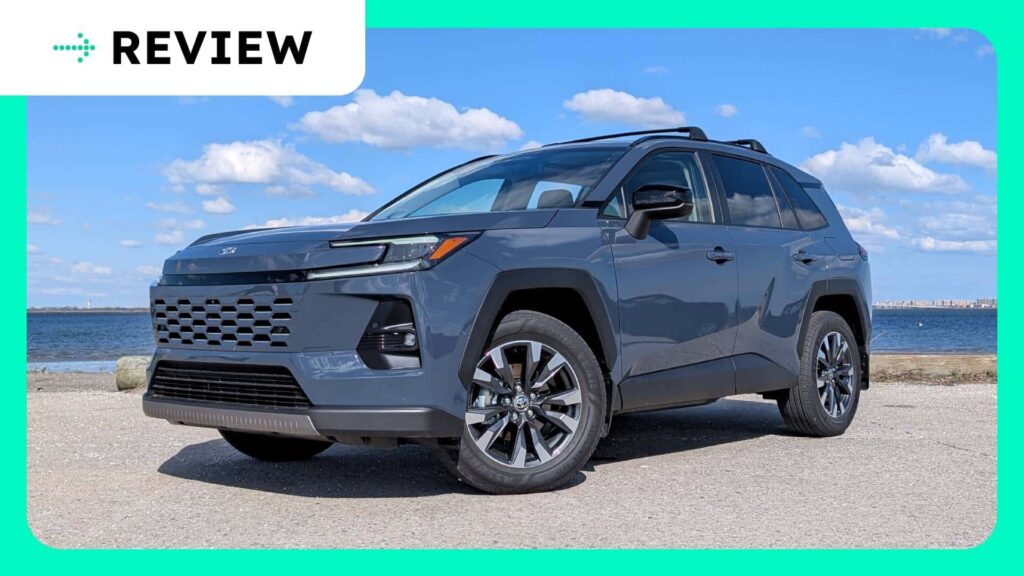
2026 Toyota RAV4 Hybrid Review: Better Than Ever
Since 2017, the Toyota RAV4 has been America’s best-selling non-truck, revered for its reliability and no-nonsense appeal. Now in its sixth generation and boasting comprehensive upgrades inside and out, I’m convinced the RAV4 is better than ever.
It’s roomy, comfortable, and—since it’s only available as a hybrid now—it requires very few stops at the pump while munching miles. The screens are a massive step up from older versions. And it’s among the most ergonomically sorted cars I’ve ever driven.
After testing one out for a week, I am happy to report that the new RAV4 now feels like the default answer to the question: “What should I buy?”

35
Source: Suvrat Kothari
I scratched my head trying to find faults, and I nitpicked a few things I’ll highlight throughout this story. But in an age of $6 gas in some parts of the country, the new RAV4 feels both timely and sensible for anyone who’s not quite ready to switch to EVs just yet.
[Full Disclosure: Toyota loaned me the new RAV4 for a week-long test with a full tank of gas and paid for tolls.]
2026 Toyota RAV4 Specifications
As-Tested Price
$46,883
Base Price
$31,900, before destination
Battery
1.0 kilowatt-hour, lithium-ion
Efficiency
47 mpg (observed)
Engine
2.5 liter, 4-cyl
Output
236 hp (AWD), 226 hp (FWD)
Transmission
e-CVT
Seating Capacity
5
Cargo Volume
37.8 cu-ft
Drive Type
AWD/FWD
Ride height
8.1 inches on most trims. 8.5 inches on Woodland, 7.5 inches on GR Sport
2026 Toyota RAV4 Design
The RAV4’s design evolution is more predictable than radical, with Toyota carrying over the same design language as the latest Camry. Messing with a car that sold nearly half a million units last year in the U.S. alone would have been risky, so Toyota has played it safe.
It still feels novel enough, with the C-shaped daytime running lights and color-matched grille with hexagonal elements making the fascia look modern without trying too hard.
Photo by: Suvrat Kothari
At 181 inches long, 73 inches wide, and 66.5 inches tall, its dimensions are nearly identical to the previous generation, except for the Woodland and GR Sport, which vary slightly due to their trim-specific cosmetic changes.
The overall stance has meaningfully changed. The proportions are now more upright and SUV-like. It looks more confident, more purposeful, and a good deal more mature.
2026 Toyota RAV4 Interior
Inside, nothing looks or feels like the old RAV4. The Limited variant has Softex-trimmed, heated, and ventilated front seats, which felt soft and comfortable but lacked adequate side bolstering, so expect some lateral movement around twistier roads.
The center console has a functional design, packing everything you need and nothing you don’t. The drive mode buttons, gear selector, and volume knob sit right where your hand naturally falls, with a gun-metal finish that feels upscale. You get two wireless charging pads, a storage cubby beneath those, dual 45W USB-C ports, twin cupholders, and a deep bin under the armrest.
Photo by: Suvrat Kothari
Weekly press loaners mean journalists like yours truly have to recalibrate their brains for every car’s setup. That doesn’t quite reflect how a real owner, with weeks and months of familiarity, actually experiences a vehicle. Still, the RAV4 was one of those rare cars where I didn’t need to recalibrate at all. Every function was exactly where instinct said it should be, with nothing essential buried behind menus.
For a vehicle that will serve as the daily driver for hundreds of thousands of families and countless rideshare drivers, this intuitiveness is welcome. The bigger highlight of this interior, however, is the gauge cluster and infotainment setup.
2026 Toyota RAV4 Software And Infotainment
The RAV4’s digital experience has finally come of age with its new 12.9-inch tablet-like infotainment screen (10.5 inches on lower trims) and 12.3-inch digital gauge cluster. The RAV4 also debuts Toyota’s latest Arene software-defined vehicle platform, which Toyota also plans to roll out to future models.
To be clear, the user interface here is nowhere near as advanced as what you find in EVs from Tesla or Rivian. But it’s still a big step forward from the tacky and cluttered gauge cluster and infotainment displays on current Toyotas, offering a more smartphone-like user interface and far more customizability.
Photo by: Suvrat Kothari
Shuffling through the gauge cluster menu via the steering wheel controls is now instantaneous and vastly simplified, improving day-to-day usability. The central touchscreen is sharp and responsive, and comes with wireless Apple CarPlay and Android Auto as standard.
For the first time, it now includes a built-in dash cam that uses front, rear, and blind-spot cameras to record driving. It records in continuous loops, automatically saves clips when it detects an incident, and lets you download footage via USB. You can also manually capture 20-second clips on demand. It’s a useful addition, making aftermarket dash cam units unnecessary.
However, the drive recorder kept flagging “driving incidents” for moments that felt perfectly routine and unremarkable. It’s a minor annoyance that Toyota could likely iron out with a software update.
2026 Toyota RAV4 Efficiency And Powertrain
At this point, “Toyota hybrids are efficient” ranks alongside death and taxes as one of life’s inescapable certainties. But the new RAV4 turned out to be more efficient than other Toyota hybrids I’ve driven. For a small crossover, it punches well above its weight when it comes to its road-tripping abilities.
Just like before, Toyota is selling a plug-in hybrid version of the RAV4. But I tested the standard hybrid variant, which will be the lineup’s primary workhorse and volume seller.
My press loaner arrived with a full tank of fuel—14.5 gallons—and an estimate range of nearly 600 miles. It has an EPA-rated combined efficiency rating of 41 miles per gallon. I observed a combined rating of 47 mpg and a city-only rating of up to 56 mpg, which borders on plug-in hybrid territory. To put that in perspective, you can drive from San Francisco to Las Vegas or from New York City to Columbus, Ohio, on a single tank of gas.
Photo by: Suvrat Kothari
So how does it pull this off? The 2.5-liter four-cylinder Atkinson-cycle engine produces 226 horsepower on front-wheel-drive trims and 236 hp on AWD versions. It’s paired to two electric motors and a compact 1.0 kWh lithium-ion battery. AWD trims add a third e-motor on the rear axle for extra grip.
The first e-motor functions as a generator, harvesting energy from the gas engine to top up the battery, and doubles as the starter motor, waking the car up in near-total silence, just like an EV. The second motor drives the front wheels and steps in under hard acceleration, while also recovering kinetic energy during coasting and braking and feeding it back into the battery.
Like most modern hybrids, the car can run on pure electricity at low speeds for short distances when the battery has sufficient charge,. When you need more punch, the engine turns on seamlessly and the transitions are nearly imperceptible. And crucially, that efficiency doesn’t come at the expense of performance.
Photo by: Suvrat Kothari
The 236 hp AWD powertrain has ample grunt for daily driving and confident highway overtakes. Better yet, unlike the Crown Signia or the Corolla Cross Hybrid, the RAV4 doesn’t punish you with a coarse, strained engine note when you put your foot down. Of course, you still feel that rubber-band effect from the e-CVT, but the cabin is far better insulated from those noises. It’s certainly more refined than before.
2026 Toyota RAV4 Ride And Handling
The RAV4 now features reinforced suspension mounting points and frame joints for improved handling and ride comfort. Toyota said there’s also a high-damping adhesive to reduce micro-vibrations and road noise. But other than that, the suspension is identical with independent struts at the front and a multi-link setup at the rear.
In practice, the ride felt marginally more comfortable than the outgoing model, and its character is distinctly comfort-first. It dives noticeably under braking, squats on acceleration, and has a certain wallowy quality that makes it feel larger than it actually is. None of that is particularly surprising for a vehicle engineered around daily commutes, highway cruising, and rideshare shifts.
Photo by: Suvrat Kothari
It absorbed NYC’s potholes—small and large—with real poise, keeping cabin jolts to a minimum. The steering felt appropriately light at low speeds and weighted up with the buildup of speed, though I’d welcome a touch more directness in its responses. The GR Sport trim will feel more dialed in by comparison, but it, too, wasn’t exactly fun to drive based on our testing early this year.
Verdict
At a starting price of $31,900 before destination charges, the new RAV4 comes in $1,000 cheaper than the outgoing base hybrid and about $2,100 more than the old base gas-only trim.
That’s a remarkable value for a vehicle that’s been comprehensively upgraded. Even the entry-level LE is well-equipped out of the box, with the new digital gauge cluster, phone mirroring, and dual-zone climate control. Add in the well-appointed cabin and that exceptional hybrid efficiency, and the value proposition becomes hard to argue with.
Photo by: Suvrat Kothari
The competition is pretty strong, too. The Honda CR-V, Hyundai Tucson Hybrid, and Mazda CX-50 Hybrid are all credible alternatives. But the RAV4 has a better fuel economy rating than every one of them, and it feels the most modern in that company. The Tucson and CR-V are still waiting on generational updates, which naturally puts them a step behind an all-new car.
I’d steer clear of the bloated Limited trim I tested. At $47,000 including destination, with $3,500 tacked on for options like a head-up display, crossbars, and premium floor mats, the math on this trim isn’t the best. The LE, SE, and XSE are the sweet spots, with little to no compromise on the features that actually matter.
All said, this is the best hybrid SUV I’ve driven, and the easiest one to recommend.
Contact the author: suvrat.kothari@insideevs.com