




Why are scientists studying gypsum in the Salar de Pajonales?
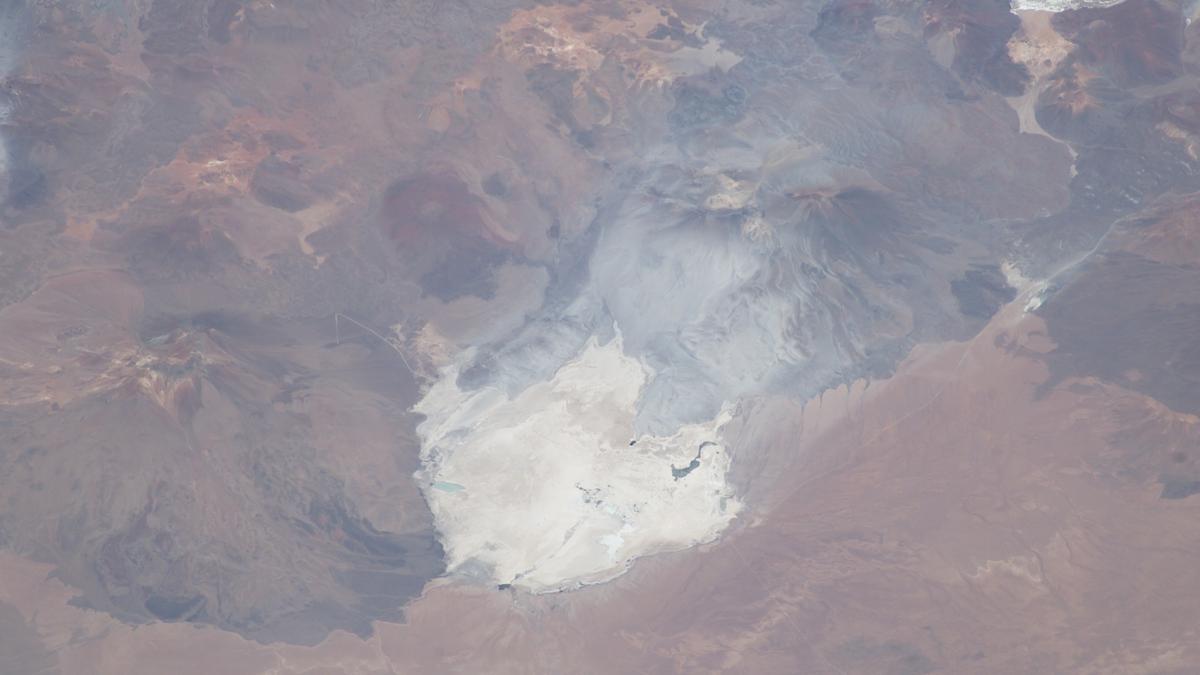
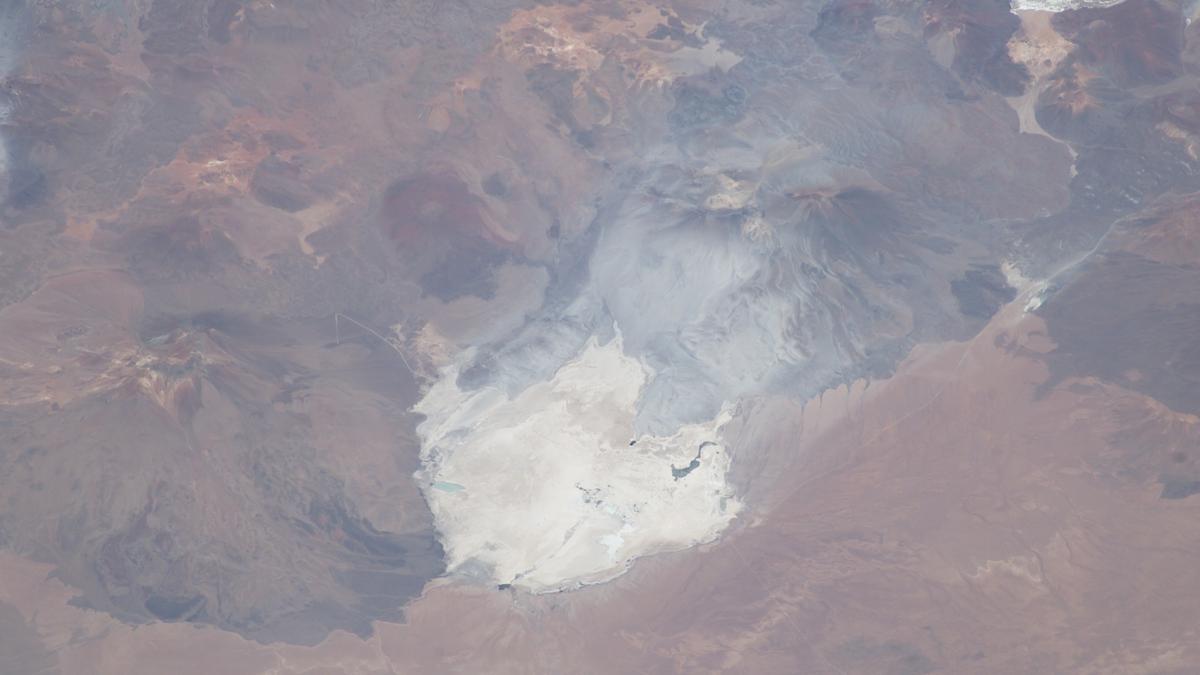
A view of the Salar de Pajonales from the International Space Station’s Expedition 6, 2003.
| Photo Credit: NASA
One of the best places to practice hunting for life on Mars could be in the Atacama Desert in Chile. Scientists recently studied the Salar de Pajonales, an incredibly dry and freezing salt flat located 3.5 km above sea level. Together with the fact that it is blasted by ultraviolet radiation, the Salar is a near-perfect analogue of the conditions on Mars.
The scientists focused on rocks made of gypsum, a mineral (CaSO4.2H2O) found on both the earth and Mars. Specifically, they looked at layered rock structures built by microbes over long spans of time called stromatolites. They found that this mineral has acted like a protective shelter for life in the Salar in two ways.
First, they found living microbes hiding just millimetres beneath the rock’s surface. Because gypsum is translucent, it allows enough sunlight in for the microbes to subsist on but blocks harmful radiation and traps small amounts of moisture. The resulting conditions allow life to survive in an otherwise hostile environment. Second, deeper inside the stromatolites, the team found fossils and chemical fingerprints of ancient life, meaning after the microbes died, the gypsum sealed their remains and preserved them.
The study is important because scientists know Mars has large deposits of gypsum, and orbiters and satellites could look there in future. If gypsum can protect microbes and preserve fossils in the earth’s most extreme desert, it’s reasonable to think it could be holding the secrets of ancient Martian life as well.
Published – March 01, 2026 08:30 am IST