




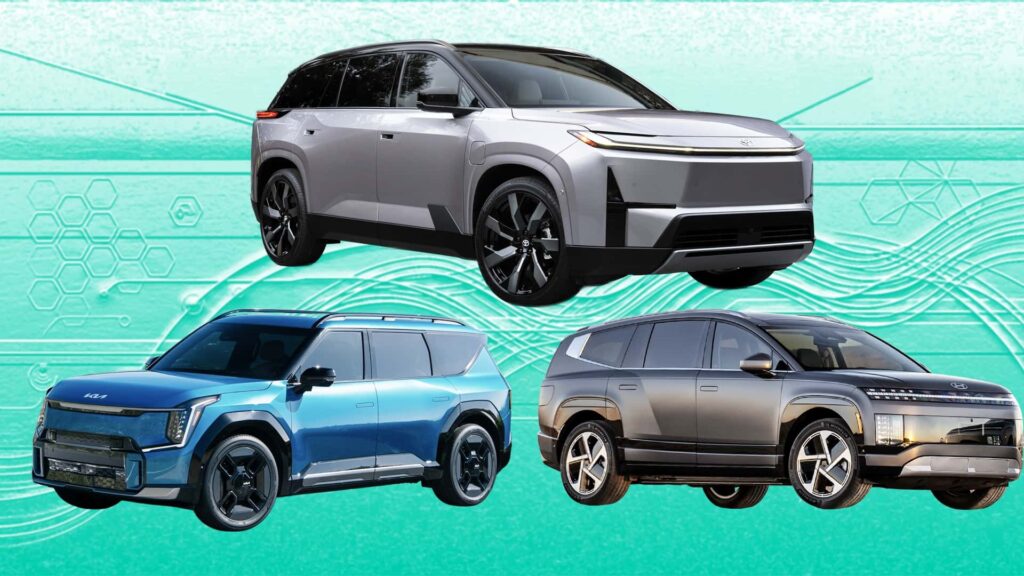
Which Three-Row EV Is Best?
Is Toyota finally getting serious about EVs? The recently revealed Highlander EV, a proper family-friendly electric SUV with three rows of seats, would seem to suggest so. It’s not just that Toyota wants to compete in this segment; its entrant seems well equipped to match its biggest rivals spec-for-spec.
Toyota definitely benchmarked the Kia EV9 and Hyundai Ioniq 9 when creating the Highlander EV. That makes sense, as the Korean options were the first mainstream three-row EVs to come in below the Rivian R1S’s and Tesla Model X’s price point. The Highlander, EV9, and Ioniq 9 are all pretty similar in size, specs, and features, although the two Korean models’ 800-volt platform gives them a clear edge in charging time.

Photo by: Toyota
There’s no wonder why it’s such a tight race. This is an important and growing segment. The Kia EV9 sold over 15,000 units last year, while the Hyundai Ioniq 9, launched in May 2025, recorded nearly 5,200 sales. Interestingly, the EV9 was outsold by the fancier, more expensive Rivian R1S, which shifted nearly 25,000 units, even though it’s about $20,000 more expensive than the Kia.
But the Toyota Highlander EV will directly rival the equivalent models from Kia and Hyundai, from a brand that people really trust on EVs. Let’s see how they stack up.
Size
Photo by: Toyota
The Hyundai Ioniq 9 is the biggest of the three vehicles, measuring 199.2 inches overall and sitting on the longest wheelbase at 123.2 inches. This gives it marginally more legroom in the third row than the Kia EV9, which comes in at just over 197 inches and rides on a 122-inch wheelbase, as well as more trunk space (21.9 cu-ft versus 20.2 cu-ft). The Toyota Highlander EV falls in between for total length (198 inches) but has the shortest wheelbase (120.1 inches) and the smallest trunk of the three at 15.9 cu-ft.
Fold the third row and the space rankings change. The Ioniq 9 is still the leader with 46.7 cu-ft, followed by the Highlander with 45.6 cu-ft, and the EV9 comes in third with 43.5 cu-ft.
Toyota has not released specs on the passenger room, but since it has the shortest wheelbase, the manufacturer will need to work some packaging magic to make it roomier than the Koreans. For reference, both the Kia and the Hyundai have 42.8 inches of legroom in the second row.
Photo by: Toyota
Hyundai lists third-row legroom at 32 inches, while Kia says it varies depending on which seats are in the second row, ranging from 32 inches (with second-row captain’s chairs) to 29.9 inches (with the larger relaxation seats in the second row).
The EV9 is the most like a traditional SUV out of the three, at least visually, with upright fascias and a tall greenhouse that makes the cabin feel vast and airy when you’re aboard. Both the Ioniq 9 and Highlander EV have more hints of a coupe roofline that falls toward the rear, making them look sportier and less utilitarian than the Kia.
Range
Photo by: Toyota
The biggest car of the three, the Hyundai Ioniq 9, also has the biggest battery. Unlike the other two, it doesn’t come with a cheaper standard-range pack. Powering all variants of the Ioniq 9 is the same 110.3-kilowatt-hour battery pack, which gives it up to 335 miles of EPA range in rear-wheel-drive form or 320 miles in the dual-motor all-wheel-drive variant.
You can get the Kia EV9 with a 76.1 kWh battery that’s good for 230 miles or range or upgrade to the 99.8 kWh pack, which pushes range to 305 miles. The Highlander EV will also be available with two battery options: 77 kWh and 95.8 kWh, and the latter should give it up to 320 miles of range, although this is a preliminary figure that may change.
Photo by: Toyota
Charging is where the E-GMP-based Ioniq 9 and EV9 shine. Their 800-volt architecture allows them to take full advantage of a powerful 350-kW DC fast charger, which replenishes their batteries from 10% to 80% in 20 minutes and 24 minutes, respectively. The Toyota has a 400-volt architecture, so it’s a bit slower to charge, with an estimated 30 minutes necessary for the 10% to 80% dash.
All three vehicles have native NACS charging ports, allowing them to plug into the Tesla Supercharger network without an adapter, and they all come with bidirectional charging.
The base Highlander will have a single 221-horsepower motor driving the front wheels, making it marginally more powerful than the EV9 and Ioniq 9, which have 201 hp and 215 hp in base trim, respectively, and are both rear-wheel drive. The dual-motor Highlander delivers 338 hp. That’s less than the other Kia and Hyundai, which make 379 hp and 422 hp, respectively. Kia was working on a hot EV9 GT, but it has now been postponed, and it’s not clear if it’s even coming to the U.S. at all.
Conclusion
Photo by: Toyota
Toyota clearly benchmarked these two vehicles when creating the Highlander, which matches them in most areas. It’s not setting new benchmarks for the class, but it’s close enough to be a real rival. What will make or break its success is pricing, which hasn’t been made public yet.
On paper, the Highlander looks more than capable of attracting the same buyers that would buy an Ioniq 9 and EV9, and it will all come down to the price. Some buyers may even choose the Highlander regardless, trusting the Toyota badge (and the brand’s recent EV upswing) more and waiting for the Japanese automaker to offer something in this space.
The Hyundai Ioniq 9 is the most capable and roomiest of the three, although it’s only the second-fastest to charge, and it’s around $5,000 more expensive than the Kia EV9. You do get the big battery as standard in the Hyundai, though, which justifies its higher price. Sales numbers show there is a market for vehicles like these, and what will make or break the Highlander EV will be its price.