





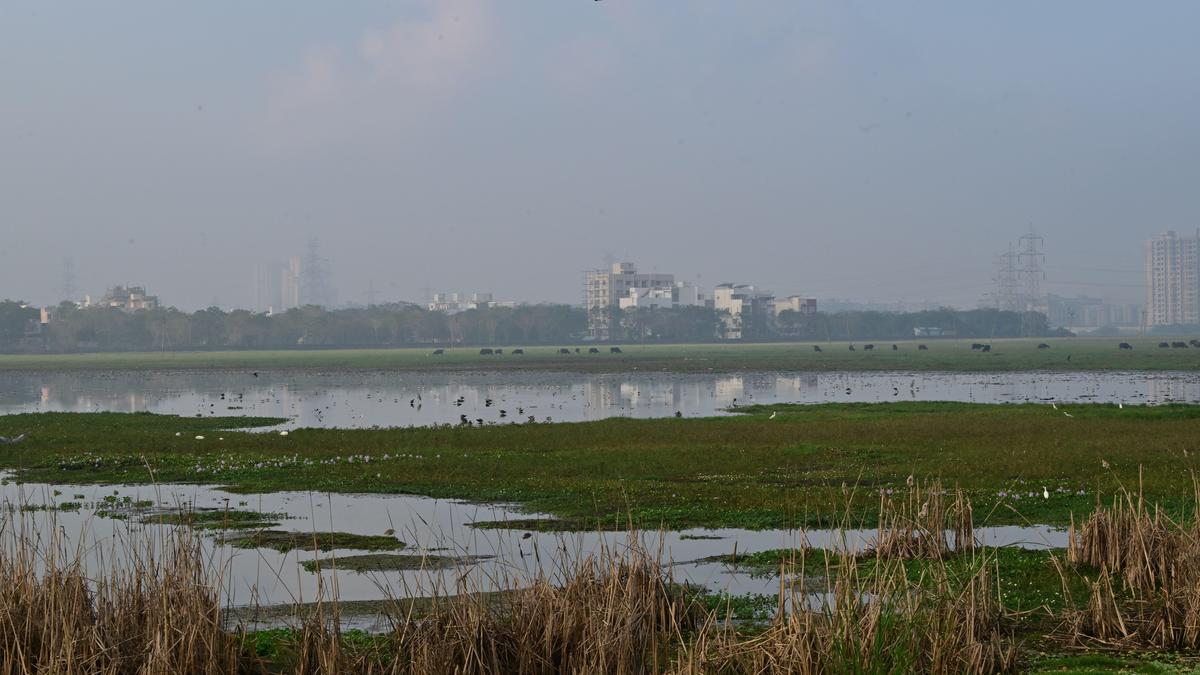
Wetlands as a national public good
On February 2, 2026, the world marked World Wetlands Day 2026 under the theme, ‘Wetlands and traditional knowledge: Celebrating cultural heritage’. In India, this theme feels especially apt. There is a rich history of communities sustaining themselves through wetlands following practices that inherently safeguarded ecosystems.
Traditional practices in Tamil Nadu’s wetlands revolve around ancient water management and community livelihoods, human-made tanks or kulams, forming cascading irrigation networks for paddy and other crops. In Wayanad, Kerala, shallow wells called kenis, crafted over 200 years ago, support drinking water, rituals, and festivals, while wetlands in Srikakulam, Andhra Pradesh, sustain traditional fishing practices. Such stories can be told from any part of India, where communities have thrived for generations around wetlands that are both ecology and economy, habitat and heritage, essential to social wellbeing.
But we must be honest. Although the benefits and services of wetlands abound, wetlands remain among the most threatened ecosystems because they sit at the intersection of land, water, and development.
Policy background, challenges at home
Policy and regulatory frameworks are often blamed, but India does not lack laws. It lacks consistent, high-quality implementation. The Wetlands (Conservation and Management) Rules, 2017 provide a framework for identifying, notifying, and managing wetlands through authorities to restrict damaging activities. However, nearly 40% of India’s wetlands have vanished over the last three decades, and around 50% of what remains show signs of ecological degradation.
Updated guidelines under the National Plan for Conservation of Aquatic Ecosystems (NPCA) push for structured planning, monitoring and outcome-oriented management. The Coastal Regulation Zone (CRZ) framework aims to maintain the ecological integrity of coastal wetlands, while Ramsar site designation offers global recognition and responsibility. The 98 Ramsar sites in India are not just badges but commitments that encourage action.
These instruments span freshwater, coastal, urban, natural, riparian and high-altitude wetland but must be coordinated into a single operational rhythm that starts with mapping, leads to notification and enhanced protection, enables restoration where needed, and continues monitoring through adaptive management.
Through site-based wetland conservation and restoration initiatives, organisations such as the M.S. Swaminathan Research Foundation have worked with State governments, local communities and stakeholders to support wetland mapping, participatory management planning, and livelihood-linked conservation.
Wetlands are “multiple-use” systems, which make them valuable and vulnerable. In a highly populated country, encroachment and land conversion have already erased around 40% of natural wetlands, replacing them with infrastructure, real estate and road networks. Even where wetlands persist, their catchments are often irreversibly altered, and old cadastral maps rarely match current ground realities.
Wetlands rely on timing and flow of water. Dams, embankments, channelisation, sand mining and groundwater over-extraction disrupt these flows, eroding their natural characteristics. Riparian wetlands and floodplains are especially vulnerable because they are treated as spare land rather than active river space. Urban wetlands are expected to store floodwater, receive storm runoff, absorb sewage, and remain clean and biodiverse, often without legal buffers.
Quiz |On World Wetlands Day
Growing pollution results in the eutrophication of water bodies when untreated sewage, industrial effluents, agricultural runoff, and solid waste are pushed into wetlands. When a wetland becomes a dumping ground, its biodiversity collapses, along with its ability to buffer floods and purify water. In coastal areas, sea-level rise, cyclones and shoreline change collide with ports, tourism, aquaculture and settlement growth. Mangroves and lagoons face a double bind: development pressure on landward sides and rising seas on seaward sides, leaving them little room to migrate.
Lastly, a major challenge is capacity constraints. State wetland authorities are often understaffed, underfunded, and stretched across competing mandates. Training gaps in hydrology, ecology, GIS, legal enforcement, and community engagement often translate into weak management plans, weaker implementation and continued degradation of valuable wetlands.
Pragmatic and contextual approaches
There is an urgent need to shift from “projects” to programmes, from “beautification” to ecological functionality, and from “departmental silos” to watershed-scale governance. Through coordinated, efficiently monitored approaches, we can begin to address this complex problem.
Here are some ideas to start with.
First, notification and safety of wetland boundaries. The 2017 Rules are only as strong as notification and demarcation, which should be paired with publicly accessible maps, grievance redress and participatory ground-truthing with communities where disputes are likely.
Second, treat wastewater before it meets wetlands. For urban and peri-urban wetlands, a key action is ensuring treated inflows. Wetlands cannot substitute for sewage treatment plants. Where feasible, constructed wetlands can complement but not replace primary treatment.
Third, protect the wetland’s catchment and hydrological connectivity. Wetlands must be managed as part of a basin or catchment system — restore feeder channels, prevent blockages by roads and embankments, stop solid waste dumping, and regulate extraction that alters water regimes.
Fourth, make coastal and riparian wetlands central to disaster risk reduction. Mangroves, mudflats, floodplains, and urban wetlands are nature-based infrastructure. Planning authorities should treat them as risk buffers, worthy of investment comparable to “grey” infrastructure. CRZ enforcement should be paired with livelihood-sensitive approaches that support coastal communities while defending ecological no-go areas.
Fifth, build skills and institutions. A national capacity mission for wetland managers with accredited training in hydrology, restoration ecology, GIS/remote sensing, environmental law and community-led governance. NPCA investments can be more transformative if paired with systematic capacity building and measurable performance indicators, including direct livelihood benefits to local communities.
There are already strides in this direction, with enhanced attention being given to wetlands by various state and non-state actors, and it deserves amplification. Better mapping and monitoring are now possible through satellite remote sensing, drones, and time-series analytics to track encroachment, inundation, and vegetation change.
Updated NPCA guidelines enable science-based, monitorable management plans for outcome-oriented design, while Ramsar’s focus on clear boundaries and wise use aligns with India’s needs — especially through community stewardship.
The 2026 World Wetlands Day theme highlights traditional knowledge that can strengthen restoration and compliance when treated as evidence.
Align science and policy
World Wetlands Day 2026 may have passed but let us make a societal pact. Governments must notify, enforce, fund, and coordinate; cities must stop treating wetlands as wastelands; industry must prevent pollution at source; research and education institutions must train the next cadre of wetland managers; and citizens must defend local lakes, ponds, floodplains, mangroves, and springs as shared heritage.
If we align science with policy, and policy with people drawing strength from both modern tools and traditional wisdom, we can restore wetlands not as museum pieces, but as thriving, working ecosystems. The future of India’s water — and a significant part of India’s resilience — depends on it.
Dr. Soumya Swaminathan is Chairperson, M.S. Swaminathan Research Foundation (MSSRF). Rupesh K. Bhomia is Director – Wetlands, M.S. Swaminathan Research Foundation (MSSRF)