




Used EV Batteries Are Way Healthier Than You Probably Think
- UK study of over 8,000 EVs found average battery health at 95.15%—better than early expectations.
- Age lowers capacity, but even older EVs often stay above the typical warranty floor.
- High mileage doesn’t mean a battery is bad, so a health test could be a good idea to check the actual degradation.
We’ve all seen the horror stories of EV batteries that go bad, saddling the owner with a repair bill well north of $10,000. While it’s certainly wise to be cautious when buying a used EV—especially if a deal sounds too good to be true—a new study found that used EV battery packs are healthier on the whole than you might think.
Generational, a UK-based firm that evaluates EV battery health, collected data from over 8,000 EVs tested in 2025. Most of the cars the company tested had healthy batteries with close to their original capacity.
“Battery degradation is not the systemic risk it was once assumed to be. Real-world data shows that most EV batteries comfortably exceed warranty thresholds, even at higher ages and mileages,” the company said in its report, adding that in “most cases, the battery is likely to exceed the lifespan of the vehicle.”
The average score was surprisingly high: 95.15%. The study included over 8,000 electric vehicles from 36 brands, ranging from ones less than a year old to 12 years old and with up to 160,000 miles on the clock.
The overall data set skewed toward younger EVs that were five years old or less, which helps explain the high average. Still, if you look at a breakdown of vehicle health by age, it’s clear that even older EVs are holding up fairly well. (Another important caveat: This data would exclude any old EVs whose batteries deteriorated to the point that the vehicle needed to be taken out of service.)
Age Brings Degradation. But It Varies A Lot
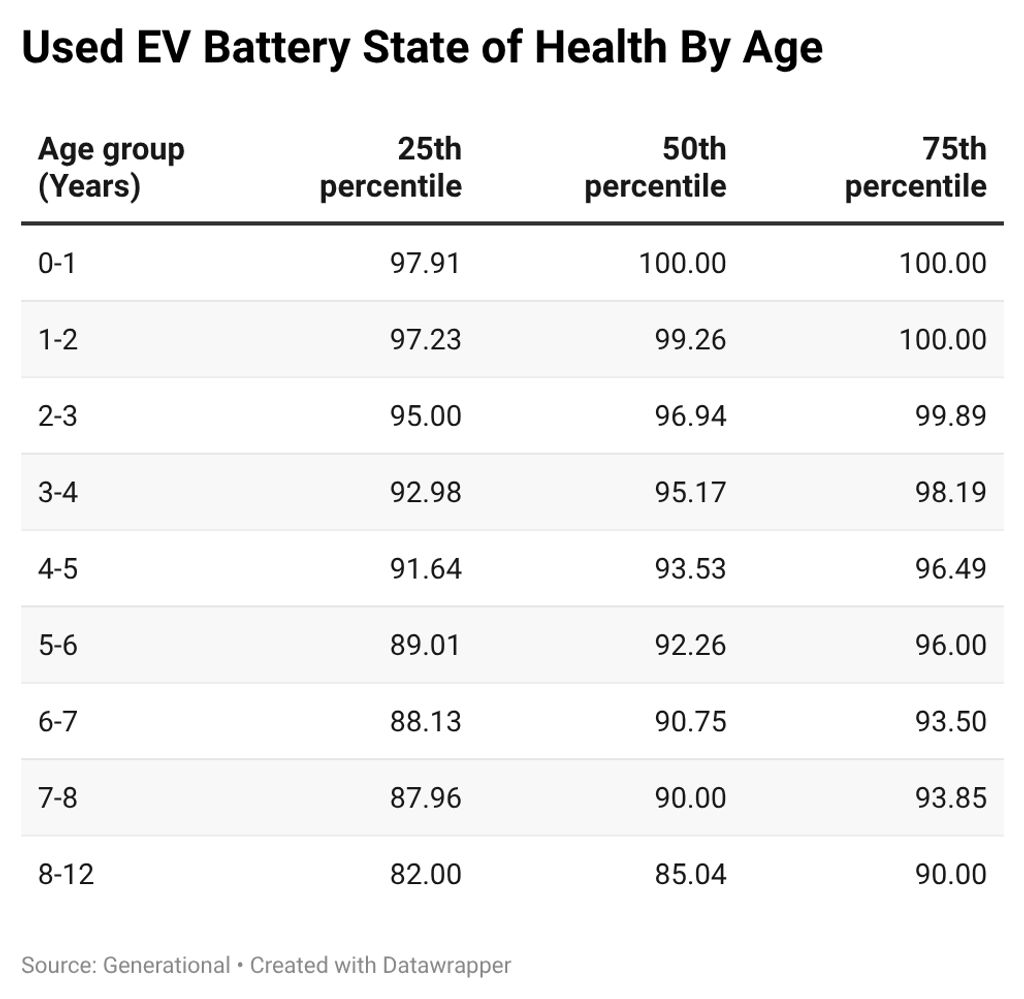
Photo by: InsideEVs
The median battery health of EVs that were 2-3 years old was 96.94%, dropping to 95.17% in 3-4-year-old EVs and going as low as 85.04% in EVs in the 8-12-year-old group. Clearly, while there are bad apples out there, there are still many older EVs with healthy batteries that keep the average reasonably high.
However, Generational also points out that the range of possible outcomes broadens as vehicles get older. And you can see this if you look at the 25th and 75th percentile numbers. The company notes that the lowest-performing 1% of vehicles in the 4-5-year-old bracket returned just over 80% of their original battery capacity—not great.
The findings mirror what we’ve seen in other studies: EV batteries are holding up remarkably well, and while the age of a battery can suggest a range of expected degradation, an old battery isn’t automatically bad or close to going bad. How frequently it was fast-charged, whether it was allowed to discharge close to empty and the climate it was used in can all accelerate degradation, especially in older EVs with less advanced battery chemistries.
Don’t Judge An EV Battery By Its Mileage
Generational says that mileage isn’t a perfect predictor of battery health either. EVs with over 100,000 miles still frequently demonstrated between 88% and 95% of their initial capacity, irrespective of age. We’ve seen a variety of outcomes anecdotally too. A 2019 Tesla Model 3 we recently covered with 113,000 miles had around 79% remaining capacity. It showed higher-than-average degradation because it was fast-charged a lot early on and lived its entire life in a cold climate.
Generational’s takeaway is that more widespread battery health testing is needed to provide better transparency into used EV purchases and raise residual values. It argues that uncertainty around EV battery health is holding back the secondhand market. And that’s fair: Two cars can appear identical, but how they were used up to the point of sale can create considerable variation in their potential remaining capacity and range.
But you can also look at the data another way. A growing body of evidence says that if you’re in the market for a used EV—especially one that’s only a few years old—you probably don’t need to worry too much about battery degradation.