


The right to walk – The Hindu

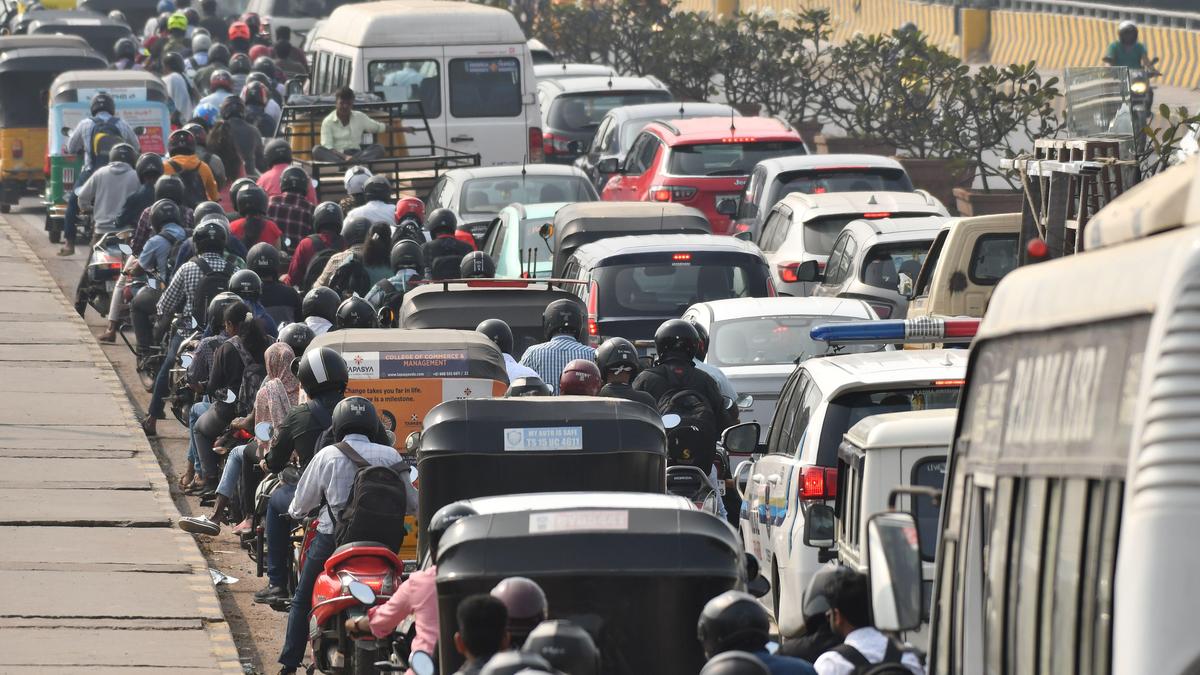
No space for pedestrians.
| Photo Credit: NAGARA GOPAL
I live in the Cyberabad region of Hyderabad city. Glitzy photos of this area do frequent rounds on social media. These glorious pictures, mostly aerial shots, show swanky skyscrapers scattered around freshly baked flyovers. The reality seen from ground will give a different picture.
My office is around 3 km from my home. Nearly a decade ago, I started to walk to my office instead of using car or scooter. This decade has been one hell of a ride — massive growth in IT sector, the pandemic break and economic downturn, work-from-home culture, post-pandemic buoyancy, back-to-office push, and now AI-induced insecurities. The population of the city and economic activity have grown leaps and bounds. But public transport did not keep pace with this development. As a result, more and more people have taken to private transport. Ride-hailing services also have proliferated. This has led to a precipitous fall in the number of pedestrians.
Cities breed anonymity. We often come across unknown faces. But with increasing proliferation of vehicles, cities are becoming faceless too. People sitting in vehicles see the roads and other vehicles. They have become oblivious to humans. I feel automobiles have become a species in their own right. They communicate with each other with horns and indicators. A pedestrian has become insignificant, even invisible. He is caught in an indifferent and inhumane world.
Lax enforcement of traffic rules makes life more difficult for pedestrians. Wrong-side driving has become common in Hyderabad. For a pedestrian, danger can come from any direction. Footpaths are often absent. This forces people to walk on the roads along with vehicles and sometimes dogs and cows. Of all the living things on the road, pedestrians are the most unfortunate. Even dogs and cows are better off.
Crossing a junction is a Maasai Mara-like adventure. There wildebeests cross a crocodile-infested river. Here pedestrians have to find a gap in a torrential flow of vehicles. But what exactly is this gap? A vehicle that appeared slow and distant a moment ago can suddenly become a rhino charging right at you. This gap is a quantum thing. It is there and it is not there. You know for sure only after reaching the other side safely.
Chronic stress is a common modern-day malady. Doctors and scientists explain how this is caused by our misfiring fight-or-flight response. They say this stress response was vital for survival of our forest-dwelling ancestors. In my opinion, this stress instinct is very much relevant in urban environment too. Many times after crossing a road, I have involuntarily taken a deep breath. The danger I perceived was real and the relief I felt was also real. The dangers faced by a pedestrian are no less than the dangers faced by a forest-dweller.
Obsessive honking has become another peculiar feature of Hyderabad drivers. When faced with an obstacle, their first instinct is not to apply brakes, instead they honk imperiously. I have seen motorists honking madly even at electric poles. It has become a force of habit.
One significant change in the past decade is that now even lanes are not safe. Even in the streets we are seeing fast and dangerous movement of vehicles. Speed and traffic violations are contagious. First, some people start driving outrageously. Then more and more people join their ranks. If governments are not interested in building footpaths, the least they can do is to curb traffic violations.
Pedestrians are a critically endangered species. After roads, now even lanes are being monopolised by vehicles. I have a basic question. Is this a city for automobiles or a city for people? Walking is a basic right and we need to zealously defend it. When people stop walking because it is not safe or convenient, they are giving away a basic right. Bipedalism is the most basic human trait. We should not throw it away.
meetibrahim@gmail.com
Published – February 15, 2026 03:00 am IST