

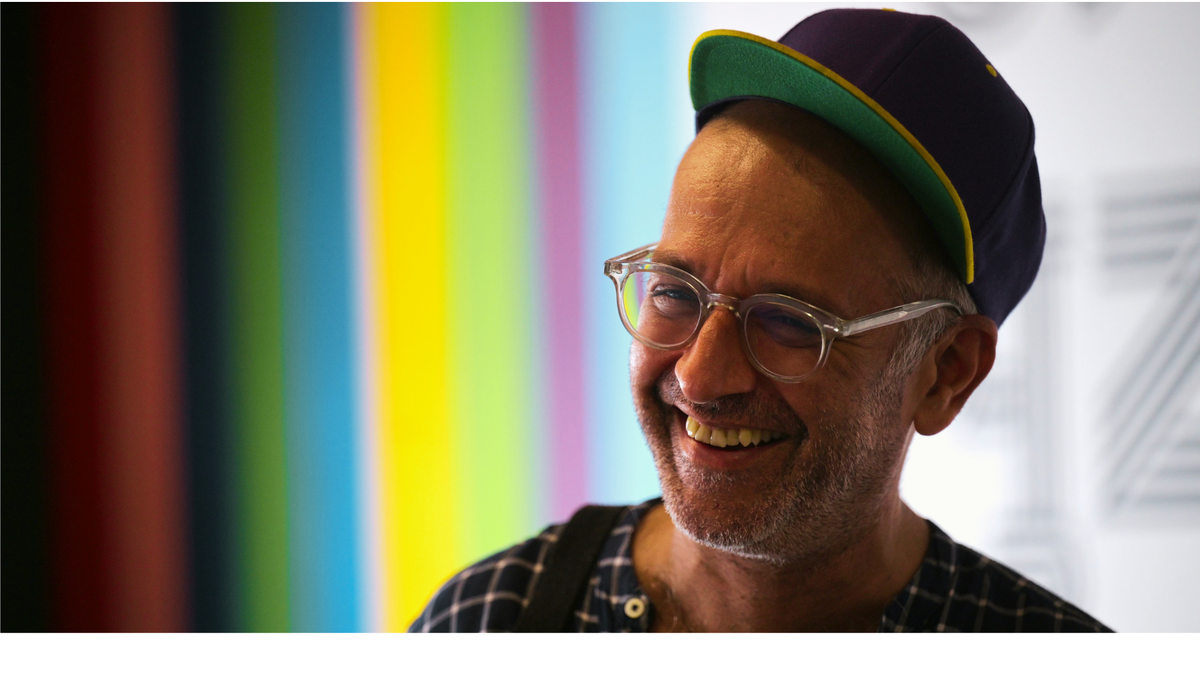
‘The Kochi-Muziris Biennale needs a self-analysis,’ says curator Nikhil Chopra
Nikhil Chopra is calm, if a little sweaty in Fort Kochi’s 34°C midday heat, as he walks into Aspinwall a week before the Kochi-Muziris Biennale officially ends. He tucks his cloth bag under a wooden chair, swaps his sunglasses for plain frames (for “eyes are the windows to the soul”, he jokes), and exchanges pleasantries with everyone present.
The curator of the sixth edition of the Kochi-Muziris Biennale has been in Kerala since last August, and now with the end in sight, he is in the mood to discuss the highs, lows, and surprises of the last few months, and his experience being a temporary local in a seaside town. “I think it’s a proud state, where everybody has a strong sense of identity and a desire to connect. What I’ve really enjoyed is making eye contact and taking the moment to say thank you,” he shares. “I know that if I come back, there will be many doors open to me, to hang out again with each other.”

With 66 artistic projects from 25 countries, working in high humidity and inside old derelict buildings, the 110 days of the exhibition have come with its fair share of difficulties. “There are horrific conditions around the world. So, even from an emotional place, for us to maintain our raison d’etre has been a challenge. How do we create in a turbulent world — socially, economically and ecologically?”
Edited excerpts from an exit interview.
Your response to why resources should be given to an art festival in fraught times like this?
We hold a mirror up to the world; we reflect on the state of the world. It’s not just Iran, it’s also Gaza, Ukraine and Russia, Sudan, Venezuela. We are in a place where we need to be very worried about the state of this world. But if you don’t make art, don’t write poetry, don’t sing, don’t express yourself, then it is an opportunity lost.
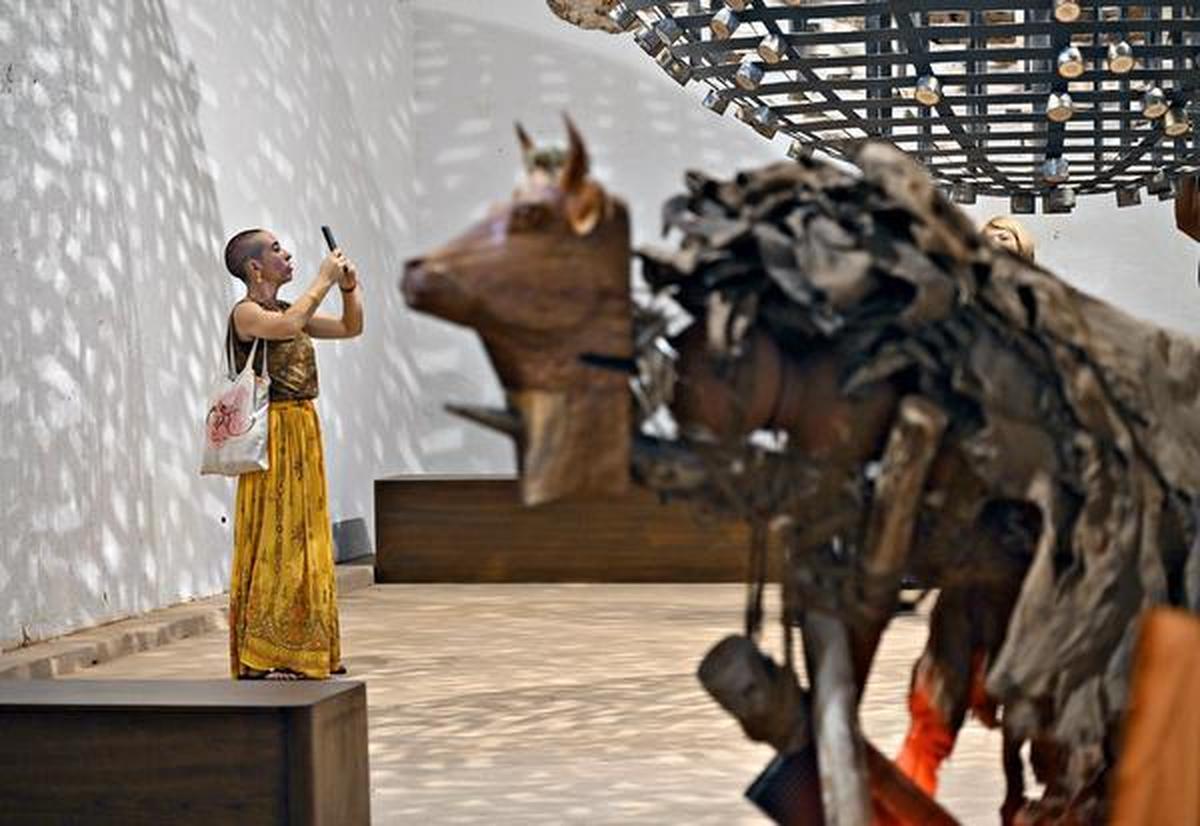
Installations at Anand Warehouse, Mattancherry
| Photo Credit:
Thulasi Kakkat
I’m of the belief as a performer that, no matter what, the show must go on. I like to think that what we are doing generates conversation and dialogue. We’re not here to decorate the walls of Kochi; we’re here to provoke conversations. We’re here to express our disagreement with the powers that be, challenge those powers, and use the soft power that we have as artists and thinkers and cultural makers to use this moment to express ourselves.
Over these last few months, has anything surprised you?
I think what surprised us was Island Warehouse. As a venue, we found ourselves having access to something that was so far away, and the freedom to imagine a completely different scale of the Biennale. That was probably one of the more risky aspects of what we’ve done as curators — to take the Biennale across the water. To bring people into another dimension of this event, and not feel that we need to hang on to a certain kind of nostalgia with Fort Kochi and Mattancherry. It also gave us an opportunity to pave the way for where the Biennale will go.
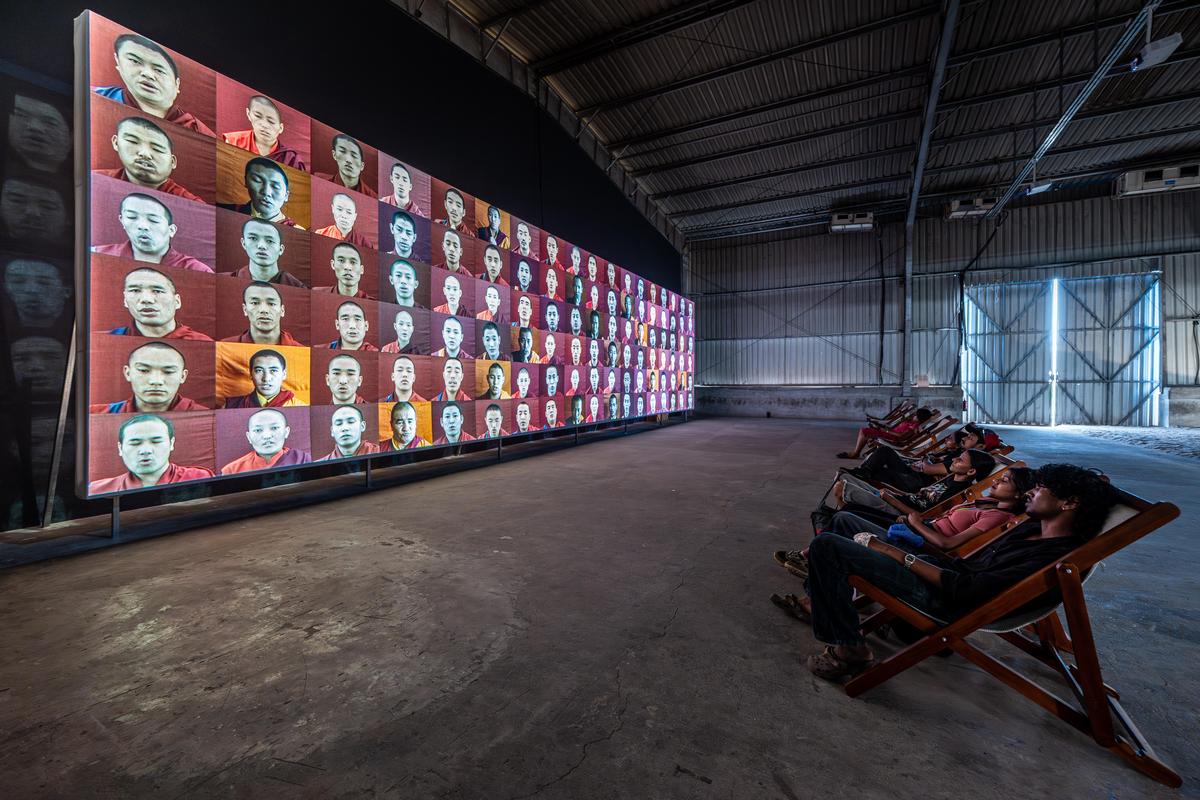
Marina Abramović’s Waterfall, an immersive, multi-channel video installation featuring 108 Tibetan monks and nuns chanting, at Island Warehouse
| Photo Credit:
Dhanuj Photography
KMB has rejoined the International Biennale Association. What are the non-negotiables for making it more stable and not lose its artist-led soul?
Artists should [continue to] be at the centre of the Biennale. It is also essential that the foundation treats its six editions as an important manual. It’s now ready to create a strong set of dos and don’ts as guardrails for the next curator. The Biennale needs to do a self-analysis in terms of what worked really well and where things can be better. And it needs to happen in a self-critical manner — not to beat oneself up about it, but to be progressive in the understanding of what this kind of civic responsibility means.

What do you think can be made better?
The Biennale Foundation cannot afford to rest. It needs to run year round, and have continuous engagement with the city. And that requires manpower, management, experience, and careful archiving. It also needs to create a system where the next curator has a lot of information for them to be able to fall back on, so that the same mistakes are not repeated again.
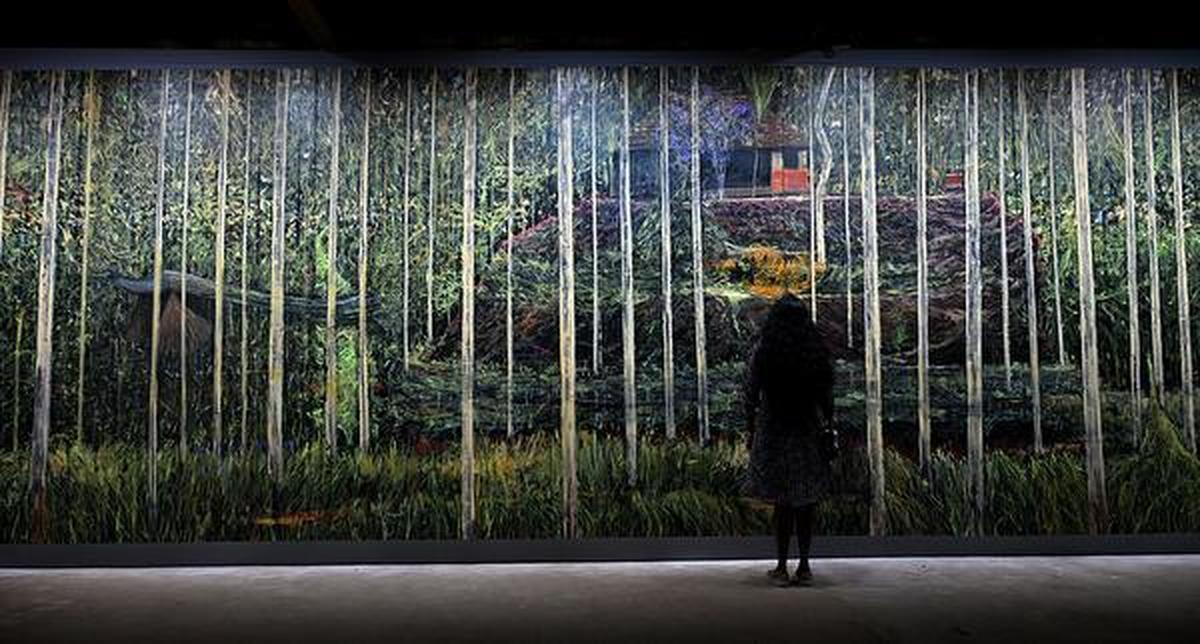
R.B. Shajith’s painting at the Kochi-Muziris Biennale 2025
| Photo Credit:
Thulasi Kakkat
I would be very happy to present a strong report, in which I am clear about what has been absolutely fantastic, what the gaps are, and where those gaps need to be filled. For instance, how the money is used — what funding is allocated for different aspects of the Biennale must be streamlined. I think this comes with experience.
Also, it needs to exercise a sense of diligence. The city is important, but so is the artist. We invite their talent, their vulnerability, their labour, their politics to the exhibition. So, it is very important for the Biennale to consider the well being of not just the artist but also of the people who are working to make that art.
With inputs from Surya Praphulla Kumar
The interviewer is a Kochi-based filmmaker and director at Curiouser.
Published – April 03, 2026 07:07 am IST