


The Donroe Doctrine, Venezuela’s fragile pragmatism
Statecraft often rides on contradictions. None is more evident than in the aftermath of the U.S. military intervention in Venezuela and its abduction of sitting President Nicolás Maduro. On January 15, as Venezuela’s opposition leader María Corina Machado met U.S. President Donald Trump at the White House and handed over the Nobel Peace Prize she had won in 2025 for leading Venezuela’s movement against “autocracy”, CIA Director John Ratcliffe was in Caracas meeting with Delcy Rodríguez, Mr. Maduro’s former Vice-President and now the interim President of the beleaguered country. On January 14, Mr. Trump had described Ms Rodríguez as “a terrific person” with whom the U.S. was “getting along very well.”
This spectacle, where the architect of an invasion is embracing a key figure from the regime whose leader he had just abducted, captures the essence of what might be called the “Donroe Doctrine”: an extension of the Monroe Doctrine that represents a departure from earlier forms of U.S. imperialism. Unlike the neocon interventions in Iraq and Afghanistan, which sought not only resource extraction but also “nation-building” and the installation of ideologically aligned regimes, the Venezuela operation is more nakedly transactional. Mr. Trump’s emphasis is on securing imperial control in order to maximise resource extraction, even while leaving in place a governing apparatus that is led by the very Bolivarians whose leader was snatched as “the head of the snake”, as long as it proves compliant.

Ghanaian leader Kwame Nkrumah, writing in 1965, defined this arrangement presciently: “The essence of neo-colonialism is that the [s]tate which is subject to it is, in theory, independent and has all the outward trappings of international sovereignty. In reality its economic system and thus its political policy is directed from outside.”
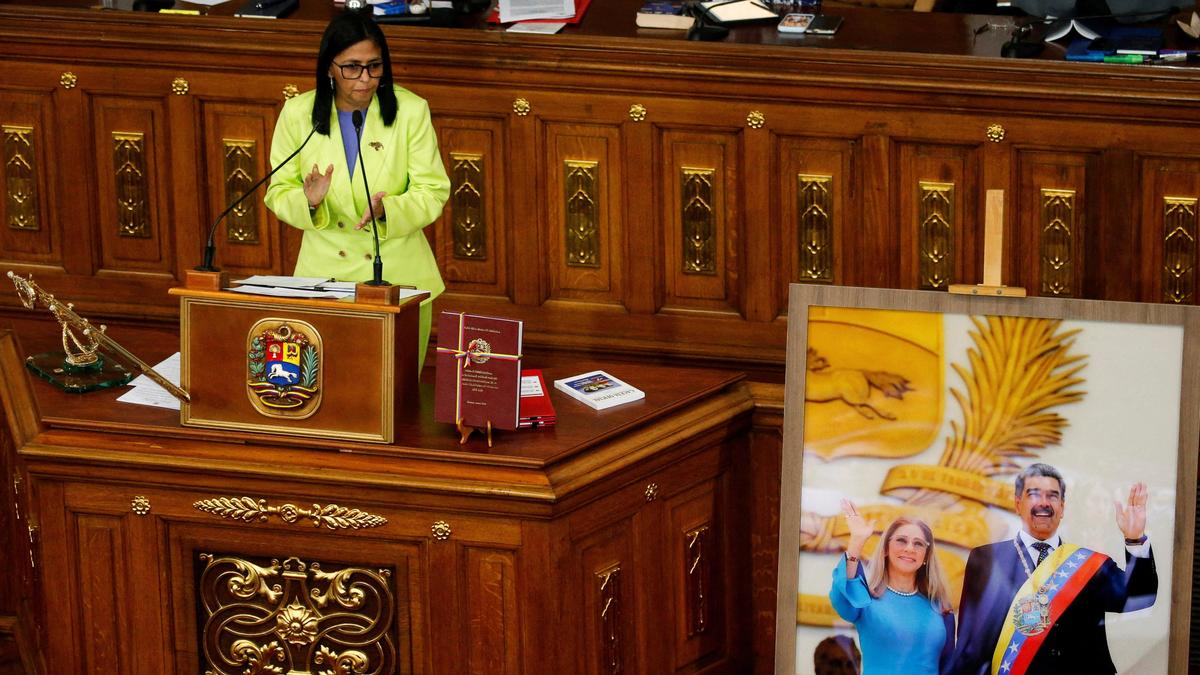
Venezuela today in a way fits this description. On January 15, Ms. Rodríguez delivered defiant rhetoric in her State of the Union address even as she had to negotiate the terms of her country’s economic subordination with the CIA director.
A case of ‘regime management’
The Trump administration’s preference for “regime management” over “regime change” is not out of any respect for Venezuelan sovereignty. The New York Times reported that senior policymakers explicitly discussed how removing the Bolivarian government would risk replicating the disastrous dissolution of Iraq’s army and bureaucracy. Mr. Trump has long criticised the military escalation in Iraq. Besides, his ‘Make America Great Again’ (MAGA) base, large sections of which opposed the interventions under the Bush, Clinton, and Obama administrations, do not want another quagmire.

In Ms. Rodríguez, Washington sees someone who can maintain equilibrium with the powerful armed forces led by Defence Minister Vladimir Padrino López and the ruling party’s ideologues such as Interior Minister Diosdado Cabello, who controls the PSUV party and the militant colectivos of the Bolivarian movement. The opposition, with its leadership having been driven underground and lacking institutional continuity, cannot offer this. Ms. Machado’s obsequious approval of Mr. Trump’s actions, including absurd claims about Mr. Maduro’s intervention in the 2020 U.S. elections, has so far earned her little. There has been considerable speculation about why the Bolivarians provided so little resistance to the U.S. actions, and why Ms. Rodríguez’s responses since the invasion have seemed like capitulation. Left-wing activist Tariq Ali, has in an interview put it bluntly: “I think Delcy has capitulated completely.” He concluded that “important sections of the Bolivarian state apparatus were prepared to let Maduro go”.
While this account is outlandish, the current choices for Ms. Rodríguez are limited. The country has been under crushing U.S. sanctions since the late 2010s, targeting its oil sector — the lifeblood of its economy — and brought hyperinflation and economic collapse.
To circumvent these sanctions, Venezuela redirected crude exports to China and other countries through a “shadow fleet” of aging tankers. It relied on Russia and Cuba. But now, with a naval blockade in place, ships carrying Venezuelan crude to Cuba and China have been seized and Chinese tankers have been denied access to Venezuelan waters.
Neither China nor Russia has shown any willingness to confront the U.S. in its self-declared backyard. In this context, the regime’s adoption of pragmatism, negotiating with Washington to ease sanctions, even while the blockade remains, in order to keep the economy afloat and preserve what remains of the welfare state, appears less like capitulation than the only available strategy for survival. From all accounts, this has been a consensus among the different wings of the Bolivarian state.

The Bolivarians were never opposed to economic partnership with U.S. companies. They were opposed to the terms of partnership which led to the late Hugo Chávez’s 2001 Hydrocarbon Law allowing foreign companies to participate only as minority stakeholders in joint ventures with the state oil company, PDVSA, and ensuring that Venezuela received the lion’s share of profits.
Those terms are now being rewritten under duress. But the alternative, attempting to maintain the old model in a sanctioned environment, with no access to world markets and no great-power protection, is equally untenable. The pragmatic calculation is to secure whatever economic breathing room is possible and wait for the geopolitical situation to turn.
Rodríguez and a balancing act
As Vice-President overseeing the economy under U.S. sanctions, Ms. Rodríguez managed to bring down hyperinflation and achieve modest GDP growth from a low base. Oil production, which had collapsed below 4,00,000 barrels a day, recovered to 9,00,000 barrels under arrangements she promoted, including the 2020 Anti-Blockade Law that allowed greater private investment and ownership in the oil sector, effectively trading some sovereign control for economic survival.

In her State of the Union address, she spoke of the U.S. crossing “red lines” and Venezuela’s willingness to “confront them diplomatically” while attacking the opposition for “[competing] to see who could grovel the most.” But in talks with Washington, she has sought to negotiate economic survival through the country’s key leverage: its oil.
Under the Biden administration, companies such as Chevron enjoyed limited licences allowing them to export Venezuelan crude while depositing proceeds in private Venezuelan banks — an indirect way for the government to earn foreign exchange. The Trump administration halted this before the invasion and oil revenues now flow through accounts in Qatar, accessible to the Venezuelan state only with American approval. Imports from these proceeds must be from American manufacturers. Reports indicate that despite the blockade, commodities traders Vitol and Trafigura have received licences to move Venezuelan crude, with initial sales reportedly worth $500 million. In essence, Mr. Trump is reversing the sanctions he initiated, but on his own terms. The country is being offered what it was denied under sanctions — U.S. investment and participation in oil extraction — but now as a subordinate partner.
Lessons beyond borders
Yet, Washington’s leverage faces its own constraints. Venezuelan crude is predominantly heavy and extra-heavy oil, expensive to extract and refine. ExxonMobil’s chief executive publicly called Venezuela “uninvestable”. With oil prices relatively low, the profit margins that would justify such investments remain uncertain. This economic reality may ultimately require the administration to allow broader market access for Venezuelan crude including sales to China and India through licensed intermediaries and more favourable revenue-sharing terms. The present situation is neither the regime change that Ms. Machado and her supporters in the West champion nor the sovereign resource control that the Bolivarian project promised when Mr. Chávez first came to power. Ms. Rodríguez will seek to preserve what she can of the welfare state. But she will remain constrained.
Venezuela’s travails offer a lesson for the developing world. Economic diversification could have mattered, but that alone is insufficient when a hegemon intervenes. The warning is about the limits of the emerging multipolar order: when the Trump regime moved against Venezuela, neither China nor Russia, for all their rhetoric about a post-American world, was willing to confront Washington in its declared sphere of influence. An alternative may only emerge if the Global South acts in concert rather than waiting for great-power rivalries to provide shelter.
srinivasan.vr@thehindu.co.in
Published – January 26, 2026 12:16 am IST