





The crisis of unemployment in J&K
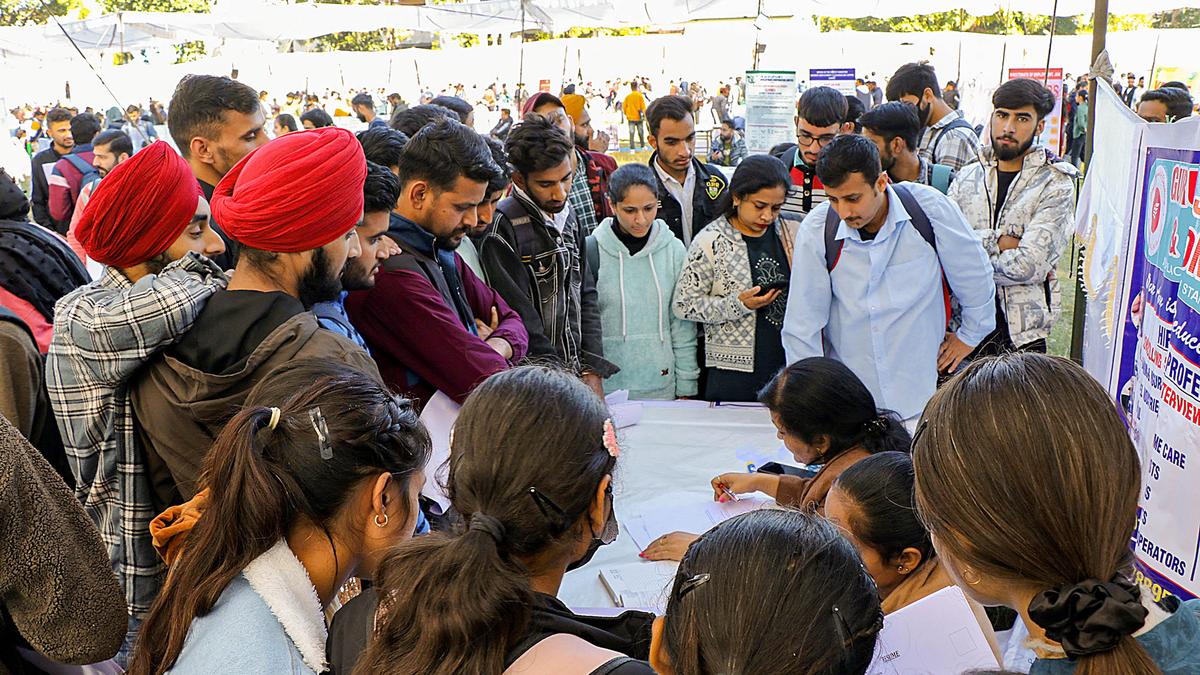
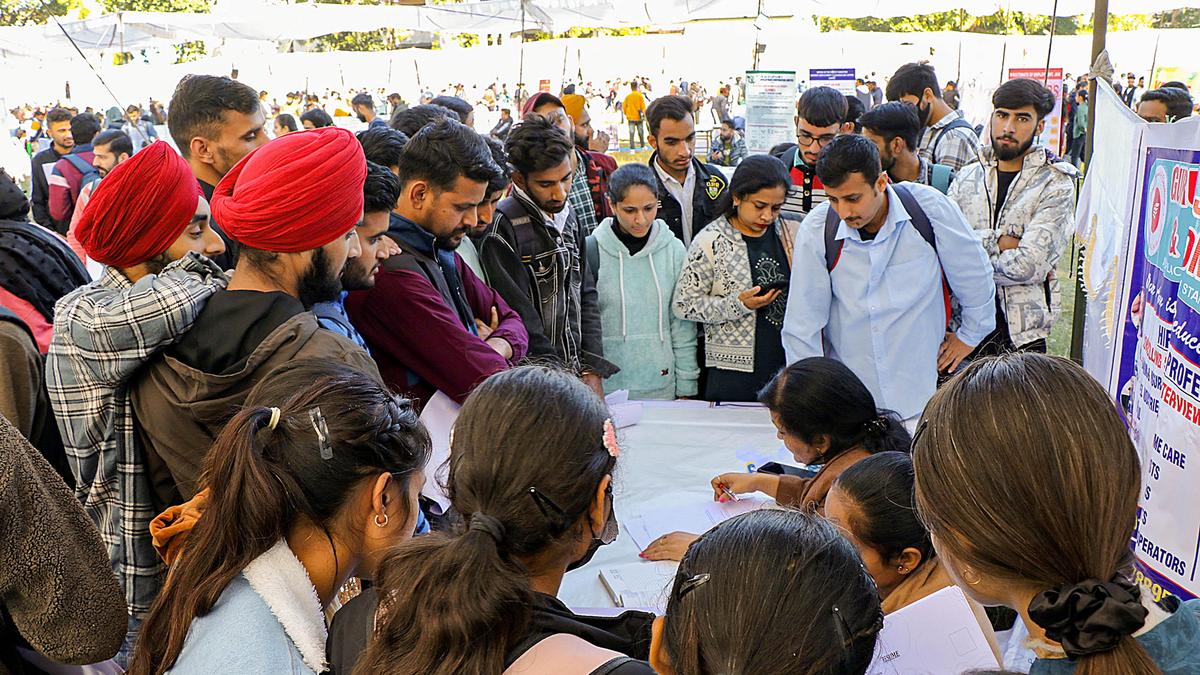
Aspirants fill out forms during a job fair organised by the Jammu and Kashmir Department of Employment in Jammu. File
| Photo Credit: PTI
Jammu and Kashmir (J&K) is grappling with an unemployment crisis. In recent years, the unemployment rate in the region has soared to alarming levels. Such an increase has forced thousands of highly-qualified youth into low-paying jobs.
In the Kashmir valley, hundreds of jobless youth have been struggling to find stable employment despite completing their education and acquiring various skills.
Myriad reasons
The unemployment rate of J&K is higher than the national average. In December 2025, Parliament said that J&K’s unemployment rate was 6.1% in July-September 2025, higher than the national average of 5.2%. Urban areas have shown sharper gaps with an unemployment rate of 10.6%, compared with the rural unemployment rate of 5.1%. As per estimates, the region has approximately 3.6 lakh registered unemployed youth, with roughly two lakh in Kashmir and 1.5 lakh in Jammu. The unprecedented rise in the region’s unemployment rate has been precipitated by its heavy reliance on the government sector in the absence of a robust private sector. Tourism and horticulture, traditional areas of the private sector, have been shrinking and are unable to absorb the growing educated workforce. The lack of a diversified industry has caused unemployment by limiting job creation in sectors beyond tourism and horticulture, leading to structural unemployment.
The delays in recruitment have further exacerbated this crisis. Almost 80% of all recruitment exams announced by the J&K Services Selection Board (JKSSB) and the J&K Public Service Commission (JKPSC), two premier recruiting agencies, have been delayed or challenged in court. Thousands of posts now lie vacant across different departments like health, public works and education. The absence of a fair and transparent recruitment mechanism has worsened the situation. On December 15, the J&K government terminated 103 employees of the Fire and Emergency Services Department after large-scale irregularities were revealed in the recruitment process.
The region’s economic unpredictability has turned entrepreneurship into survival ventures rather than growth engines.
Moreover, the absence of a well-defined public employment policy has replaced regular recruitment with contractual hiring. J&K has more than one lakh daily wagers across different departments who continue to work without job security or benefits. Their regularisation has been overlooked for decades by successive governments. The job crisis in the region is particularly alarming among highly educated individuals who account for 23.9% of the total unemployment rate.
This situation reflects a serious mismatch between educational attainment and job opportunities.
A swift response
J&K’s job crisis demands urgent and effective government intervention. A strong start-up culture and a robust entrepreneurship ecosystem can effectively address unemployment in the region. Over the years, some local entrepreneurs have established successful start-ups and provided employment to hundreds of youths. Therefore, the Jammu and Kashmir Entrepreneurship Development Institute (JKEDI), the premier public institute supporting entrepreneurship development in the Union Territory (UT), should be fully funded to be an effective platform for encouraging entrepreneurs to build new start-ups.
However, the public sector remains the main employment generator in the region. There should be massive recruitment drives to fill vacant positions and curb the unemployment graph, which continues to rise year after year. The government should appoint a monitoring agency which can oversee the selection process of recruiting agencies in the UT, so as to ensure transparent and time-bound recruitment to various government positions. J&K’s youth should be provided with equal employment opportunities in public and private sectors through fast-track recruitment, financial and logistics support, and market-oriented education with special focus on skill-based courses. Private investors should be encouraged to invest in the region’s talented human capital which will be a critical driver of productivity, innovation and economic growth.
Bilal Gani is with the faculty of Political Studies, Government Degree College Beerwah, J&K
Published – March 11, 2026 12:16 am IST