



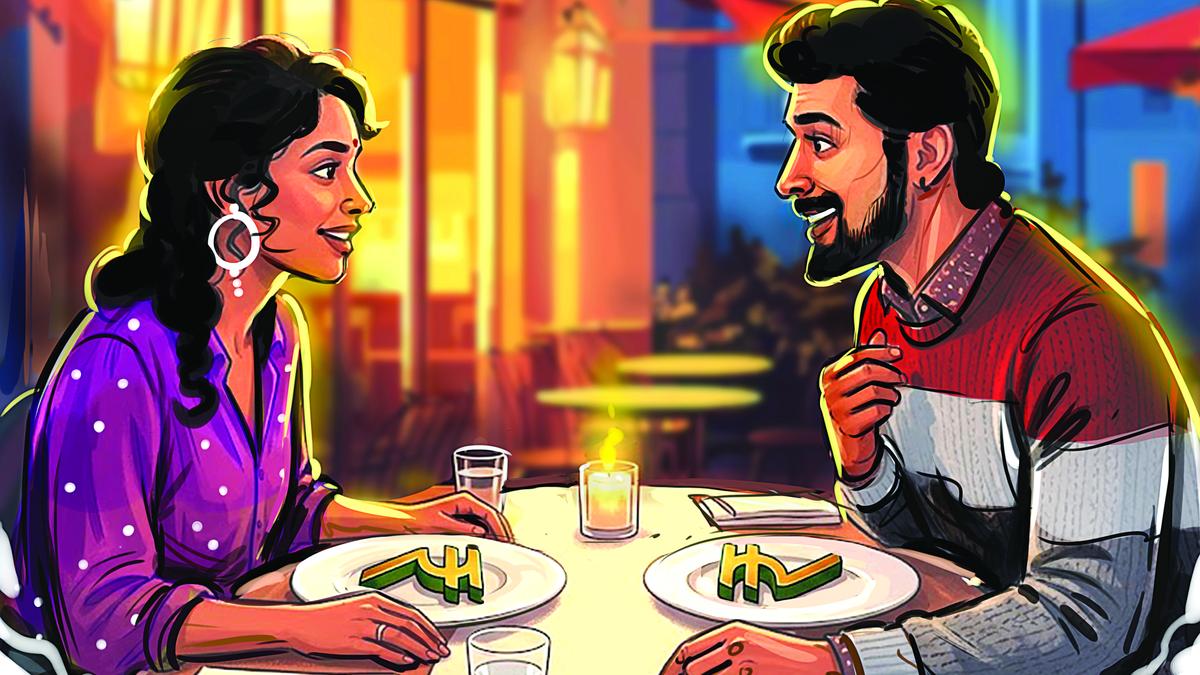
The cost of dating in India: Inflation, GST and the rise of frugal romance
An older millennial acquaintance, who considers himself fiscally cautious, gainfully employed, and chronically single, confessed to keeping a mental ledger of his dating life. Each evening out costs him between ₹6,000 and ₹7,000. With three to four such outings a month, he is spending close to ₹25,000 on dates and returning home, more often than not, with the distinct sense that he might have preferred a book and an early night. “This,” he told me, “is my economic reckoning.”
On paper, of course, none of this should feel particularly alarming. India’s retail inflation in early 2026 stands at 2.75% year-on-year, well within the Reserve Bank of India’s 2–6% tolerance band, according to Government Consumer Price Index (CPI) data released by the Ministry of Statistics and Programme Implementation. Food inflation is hovering just above 2%. The macroeconomic story is one of stability, even restraint. Groceries are not spiralling, fuel prices are not detonating, and yet dating in an Indian metro exists in a microclimate where the CPI feels like a distant abstraction. The CPI basket does not account for ₹1,500 cocktails, the 5% GST levied on most standalone restaurant bills, the 18% that may apply in certain hotel establishments, or the State excise duties that keep alcohol outside the GST framework altogether and firmly in its own expensive republic.
Alcohol, the quintessential date-night indulgence — even as Gen Z experiments with sober-curious evenings and artisanal mocktails — remains the millennial-coping mechanism of choice, particularly when the conversation falters. A 37-year-old marketing consultant put it plainly: “If the date is boring, at least let the drink be strong. But now the drink is weak, and the bill is strong.” She still pregames, unapologetically. “One gin at home, one cocktail outside. I’m not paying ₹1,500 for diluted rubbish most bars serve. I’ll be lucky if I get 60ml of alcohol despite the tall claims.” Between excise duties, GST on food, service charges that hover near 10%, and the rising operational costs restaurants quietly pass on, a casual dinner for two can potentially cross ₹4,000 before uttering the word dessert.
Who’s getting the bill?
What is emerging, then, is not miserliness but a kind of romantic recalibration. Frugal dating, as several people described it to me, is less about austerity and more about value. A 29-year-old start-up founder has moved his first dates from bars to bookstores, where the stakes are lower. “You learn more about someone by which shelf they linger at,” he said, with the serenity of someone who has abandoned the tyranny of reservations. “Worst case, I leave with a book. Best case, I leave with both.”
In Bandra, a 41-year-old divorcee has instituted what she calls the walk test. No dinner or drinks, just a long amble along Carter Road. “If we can walk for an hour and not check our phones, I’ll consider feeding you,” she told me. “Food is now a second-date privilege.” There is something radical in this sequencing of intimacy, where conversation precedes consumption and stamina trumps spectacle.
A Gen Z consultant in Bengaluru has her own rules, shaped as much by ideology as by budget. “We split everything. Even the auto ride,” she said. “I don’t want romance built on financial resentment.” For her, coffee is the perfect first-date instrument: a ₹300 cappuccino that buys 45 minutes of assessment. “If it’s bad, I’ve only lost caffeine.”
Meanwhile, a 38-year-old investment banker confessed that he has become adept at recognising what he calls the lifestyle audit. “If she suggests omakase on a Tuesday, I know I’m being stress-tested,” he laughed, without bitterness. He doesn’t necessarily object to paying, but he now counter-suggests mid-range restaurants with what he describes as “good conversation acoustics,” places where neither the music nor the menu overwhelms the point of the evening.
The appetiser-only philosophy has also gained traction. A 35-year-old fashion stylist explained it to me with admirable clarity. “Three small plates feel flirty. A ₹1,200 risotto feels like I’m committing to something I’m not sure about.” If she is still hungry later, she orders in. “McDonald’s has never ghosted me,” she added, which felt less like a joke and more like data.
Then there are the domestic realists, who have dispensed with the theatre of dining out altogether. A 32-year-old architect has begun inviting dates home, not recklessly but deliberately. “We cook together. Pasta is neutral territory. If he can chop garlic and talk about his childhood without mansplaining olive oil, we’re good.” They end the evening with a walk, partly to soften the intimacy and partly because, as she put it, “the walk costs nothing and tells you everything.” Another couple in their mid-30s rotates what they call budget themes—street food nights, museum days where tickets cost less than a cocktail or potluck-style dinners where each brings one dish. “Romance,” she said, “is not proportional to the bill.”
Even those who adore a well-made drink are selective about when to indulge. A 40-year-old creative director told me she reserves craft bars for celebrations. “Not compatibility testing. I’m not investing ₹8,000 to find out you call yourself a ‘sapiosexual.’” There is, too, a growing impatience with the choreography around the cheque. A 27-year-old lawyer now states her position upfront: “Let’s split unless you insist.” She is tired of the ritualised reach for wallets, the performative hesitation that often feels more exhausting than the date itself.
Perhaps this is the quiet thesis of dating in 2026. As one 36-year-old entrepreneur told me, with a shrug that suggested both fatigue and wisdom, “I don’t mind paying. I mind paying for mediocrity.”
It’s safe to say dating is not dying but being audited. And if someone can hold your attention without a ₹1,500 cocktail buffering the silence, that may be the most persuasive metric of all.
A fortnightly guide to love in the age of bare minimum
Published – March 06, 2026 05:23 pm IST