



Spend The Cash Now, Scale Later
- Rivian’s $24 billion cash burn has been called into question by investors.
- CEO RJ Scaringe says it was calculated in order “to become a very large company.”
- R2 could be the pivotal moment for Rivian where everything turns around.
If you’re building a car company from scratch in the 2020s, you basically have two options: Spend an uncomfortable amount of money, or just don’t build a car company. Rivian very clearly chose the first option.
In a podcast appearance on Buy Hold Rant, Rivian CEO RJ Scaringe defended the nearly $25 billion in cash set the automaker spent over the last eight years. This type of negative cash flow has raised the eyebrows of some investors, but Scaringe isn’t worried. In fact, his argument is pretty straightforward in that you don’t build a “very large company” by pinching pennies

Photo by: Patrick George
The topic came up during the podcast when one of the hosts displayed a chart plotting Rivian’s free cash flow compared to other automakers. On the surface, the chart looks damning, with Rivian’s spending down-and-to-the-right more than Ford’s EV segment, Lucid, Polestar, plus Fisker and even Faraday—essentially that it has spent more money over the same amount of time compared to pretty much every pure EV maker.
“Ultimately, we wouldn’t be building a business if we didn’t plan for the business to make money,” said Scaringe, essentially waving off the concern. He also noted that Rivian’s early years were not without speed bumps that made the dip a harsher than expected.
Unlike Tesla, which had the luxury of starting up when the EV niche was sleepy and very few (if any) North American competitors were serious about fully-electric cars, Rivian entered into the market where it already had an enormous competitor and other brands were hot on Silicon Valley’s heels.

On top of that, market dynamics during Covid significantly squeezed Rivian’s pockets. Due to supply chain constraints, Rivian’s component sourcing was done when the “auto industry was at an all-time high,” Scaringe said. This left the brand with very little leverage to buy on volume and skyrocketing input costs needed to build its first vehicle for consumers.
“It was very hard to get great pricing but we had to launch,” said Scaringe, referring to the volume production of the R1 that began in 2021. “We had to accept what we would think of as a significant premium on a lot of the components in the vehicle and we did that with the confidence that when we launched the volume that we’d be driving and the success of the product would allow us to renegotiate those contracts.”
R1 was never meant to be a high-volume product though. Scaringe called it Rivian’s “handshake with the world,” or a way to introduce the brand to consumers. The R2, however, will be a different story altogether.
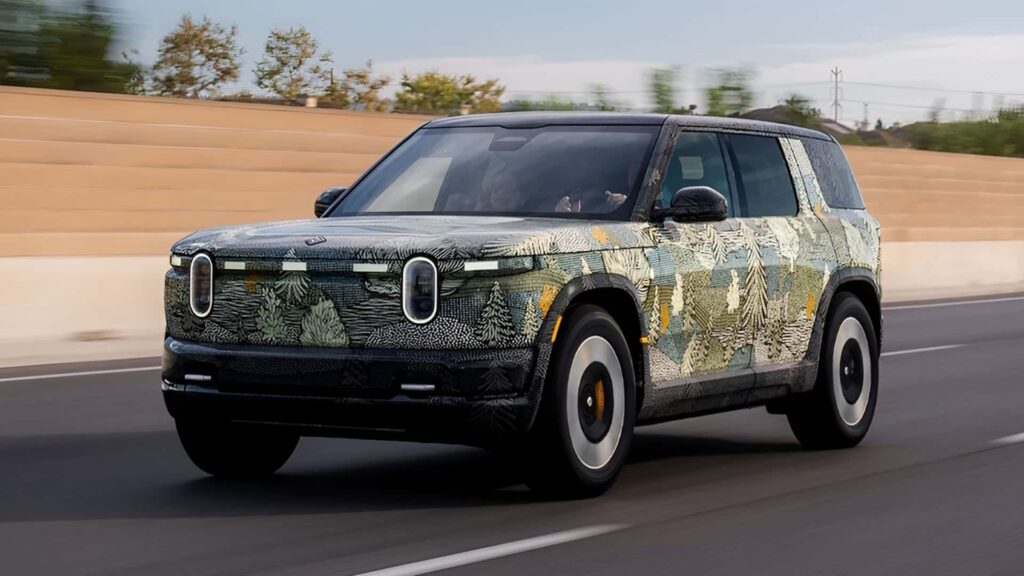
The smaller crossover is potentially Rivian’s Model Y moment. It’s a chance for Rivian to become a household name as the company gears up to pump out as many as 155,000 R2s annually—although significantly fewer for its first year of production in 2026. Of its 67,000 projected sales for 2026, Rivian anticipates as many as 25,000 (around one-third) could be from R2s.
This new SUV could be Rivian’s inflection point, but that doesn’t make the cash burn any less difficult for investors. The automaker’s stock is down 90% from its IPO highs. Scaringe said in December that Rivian projects to be able to do this without raising any additional outside funding.
We’ve all heard the old saying: “you’ve got to spend money to make money.” Rivian realizes graduating from niche truck builder to the next Tesla will require a huge hunks of cash. The R2 is the moment that decides how good an investment that $24 billion really was.