





Science for All Newsletter: Some moons may have conditions suitable for the emergence of life
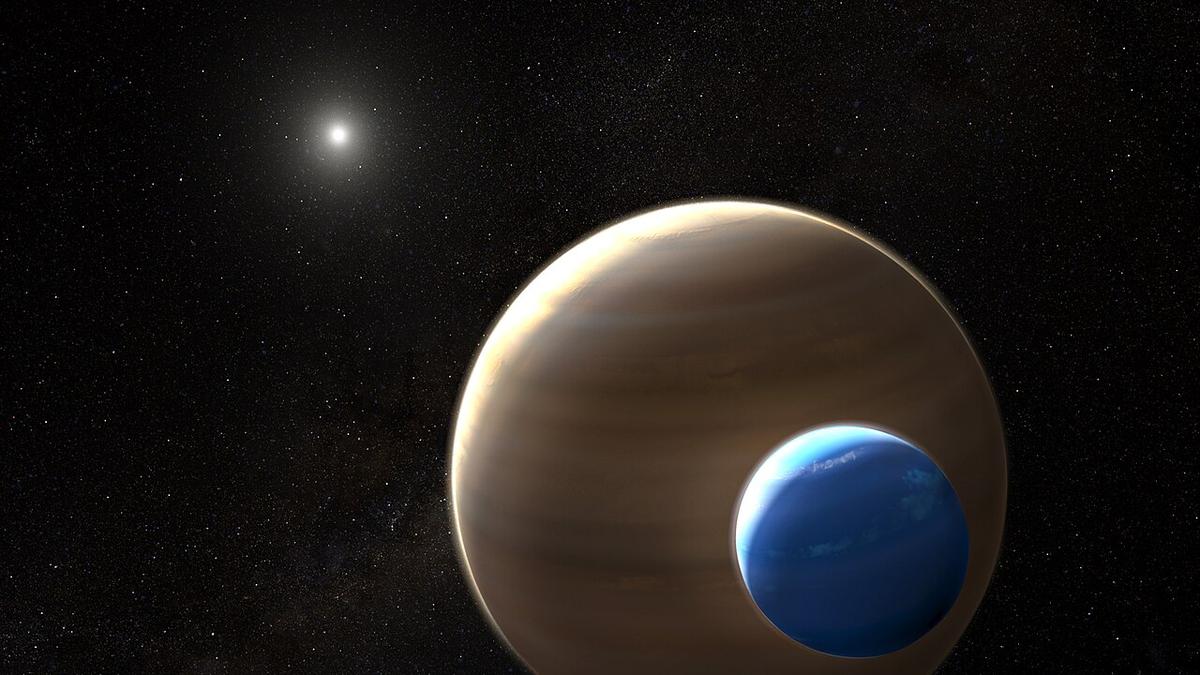
An artist’s impression of an exomoon. Dense hydrogen atmospheres and internal heating could keep these moons habitable for billions of years, finds a study.
| Photo Credit: Wiki Commons
The Hindu’s weekly Science for All newsletter explains all things Science, without the jargon.
In an astonishing discovery in 2009, a mission to the moon chanced upon traces of water on the craggy celestial body 3,80,000 km from Earth. Now, scientists have said that distant moons, far away from planets and even the sun, may have conditions suitable for life.
In a new paper in the Monthly Notices of the Royal Astronomical Society, scientists have shown that these ‘exomoons’ around free-floating ‘rogue’ planets — those that have been flung out of their orbits by other planets, and with no parent star — can keep their water oceans liquid for 4.3 billion years, or for almost as long as the Earth has existed and life developed on it.
This is thanks to dense hydrogen atmospheres and tidal heating (or the process of being heated internally). The way the exomoon orbits these free-floating planets keeps changing: the orbit becomes so elliptical that there is a constant change in their distance from the planet, and with this change, the moon gets deformed as its interior is compressed. This push-pull of stresses begins to generate heat through friction.
And so, in this in the icy interstellar space, without a stellar energy source, the tidal heat can still be adequate to keep the liquid water, found the study.
This “definitely expands the possibilities for life to emerge in the universe, as free-floating planets are currently estimated to be at least as numerous as stars in our galaxy,” David Dahlbüdding, doctoral researcher at the University of Munich, and lead author of the study, told The Hindu. “While we could soon detect a first exomoon, detecting life and its biosignatures is another question. For this, one needs to observe the atmosphere and its composition, which is already hard for small rocky planets like the Earth, and likely even more challenging for exomoons,” he added.
The authors simulated a stable hydrogen-dominated atmosphere by combining accurate calculations of atmospheric temperatures with feedback on the chemical composition, mainly through condensation, for a range of carbon-, oxygen- and nitrogen-abundances. This results in the most realistic — albeit still approximate — simulations of such moons to date. They found that such atmospheres can “effectively trap heat” in the exomoon and maintain surface temperatures suitable for liquid water for time-scales of up to 4.3 billion years.
We know that on Earth, a carbon-rich atmosphere retains more heat. While the Earth is heated by the sun, exomoons receive no such radiation. They retain heat, not because they’re carbon-rich, but because they are hydrogen-rich.
“The cradle of life does not necessarily require a sun,” said Dr. Dahlbüdding in a release. “We discovered a clear connection between these distant moons and the early Earth, where high concentrations of hydrogen through asteroid impacts could have created the conditions for life.”
In future work, the scientists will explore habitable configurations beyond a hydrogen-dominated atmosphere and test whether they are stable and can trap sufficient heat, they wrote, adding that increasing the complexity of the model “will allow us to better assess the habitability of these unseen worlds.”
From the Science Pages
Question Corner
Why do some people believe the whole universe is a simulation? Find out here.
Flora and Fauna
Published – March 17, 2026 07:26 pm IST