



Sarah Taylor interview: ‘It’s scary to think where India will be in five years’ time’
Sarah Taylor has been a trailblazer in women’s cricket in many ways.
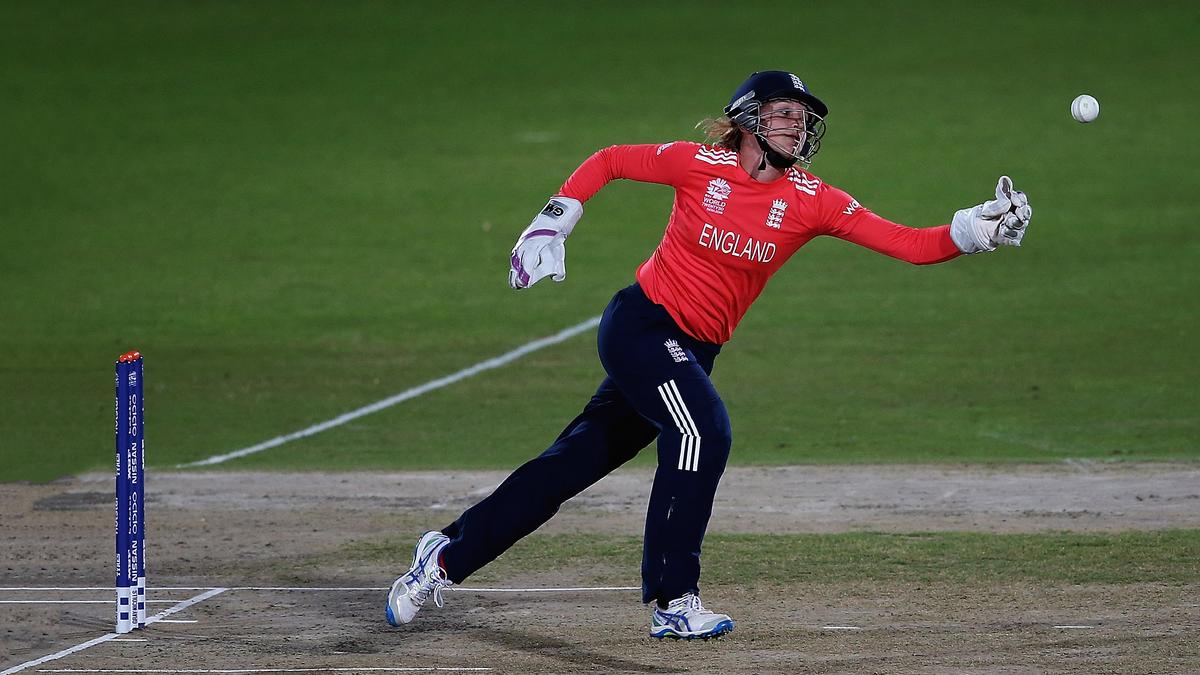
During her distinguished playing career for England, spanning a 13-year period (2006 to 2019), she was a wicketkeeper of such supreme skill that Australian legend Adam Gilchrist, in 2018, described her as the best in the world – male or female – behind the stumps. Known particularly for her sharpness standing up to the wicket, she effected 104 stumpings in 226 matches across all formats.
A long-standing battle with mental health forced Sarah to retire from international cricket at the age of 30, but it hasn’t deterred her from continuing to leave her stamp on the willow game.
In 2021, she made headlines around the world for breaking the glass ceiling when she was roped in by County side Sussex as part of the support staff for the men’s team. A year later, she became a specialist wicketkeeping coach for Manchester Originals in the men’s Hundred. Currently, she is part of the coaching staff helmed by Andrew Flintoff at England Lions, which acts as a feeder to the senior men’s set-up.
In mid-2025, her induction into the International Cricket Council’s Hall of Fame alongside M.S. Dhoni, Matthew Hayden, Graeme Smith, Hashim Amla, Daniel Vettori and Sana Mir was another feather in an already-ornate cap.
Sarah has now made her way to the Women’s Premier League as well as fielding coach of the Gujarat Giants. In a wide-ranging interview with The Hindu on a breezy Sunday morning, the 36-year-old opened up about her induction into the ICC Hall of Fame, her coaching assignments, mental health, and her fondness for the craft of wicketkeeping…
This is your first involvement as a coach in the WPL. What took you this long?
I struggled with travel. So, the idea of coming to India, lots of people, lots of fans, I found it quite overwhelming. So, it never happened, but also, I didn’t even think I’d get a chance to come to a tournament like this.
And then, I got asked, because I was doing the Hundred with Manchester Originals. Once you get your foot in the door of franchise cricket, people look around in that bubble. And so, I was lucky enough that Gujarat looked at me last year and asked, “Would you like to come?” It just didn’t happen. But I did say, please ask me again. So, yeah, it has taken a little bit of time, but I’m glad I’m here.
You were inducted into the ICC Hall of Fame in 2025. What did that recognition mean to you? What is your proudest moment as an England cricketer?
I cried when I got the email. I couldn’t believe it was for real. I just didn’t realise that my career was probably as recognised in that regard anyway. So, to have that recognition was insane. It was absolutely unbelievable. You think that you’ve done a good job, and then something like that is obviously a little bit more than a pat on the back.
Look, the ODI World Cup win at Lord’s in 2017. That will always be… yeah, I can still hear the sound of the ball hitting the stumps when Anya Shrubsole took the last wicket, and my screaming at the top of my lungs.
I actually look back on my career now, and realise how amazing it was when we won so many things. We had an era of England cricket that was so good, and our XI just picked itself. But also, I learnt so much from the times when it was so hard, and we were struggling to find a win. That journey was probably what I was most proud of.
You have been involved as a coach in men’s cricket since 2021. Did you have apprehensions stepping in? It did seem to polarise opinion when you first got involved…
I was working with wicketkeepers at Dulwich College in London after my retirement. Richard Halsall, who was Sussex Academy lead at the time, saw a need to bring in a keeping coach at Sussex. He asked me to come and work with the Academy keepers, and then it was, well why doesn’t she work with the pro keepers if it’s going well? So then it just built from there.
It just happened really organically, and I was lucky to be surrounded by people like Ian Salisbury, James Kirtley and Grant Flower. They were so supportive that I never had any apprehension. I did see the comments online, and I can’t hide from those, and I was a bit in a place of like, well, I’ll prove you wrong.
Do you feel you have proved cynics wrong?
You still get the comments. Even with the England Lions stuff, I still get comments that I shouldn’t be working with the guys. But it’s the opinion within the cricket world that matters most to me, and if you can get those jobs, and people are approaching you for those jobs, then you must be doing something right.
I don’t necessarily know if I’ve proved people wrong, but, I’m still coaching, and I’m still doing the Lions stuff. I’ve just got a contract with the England & Wales Cricket Board (ECB), so I must be doing something.
Do you feel more women can go down your route and become a coach with men’s teams?
Yeah, absolutely. You’ve got to have a certain way about you to understand the men’s environment. The way they deal with things, the way they approach things, and you have to have that understanding, as any male coach would have to understand going into a female set up. I think there are some personalities out there who could absolutely cross that line. It’s just whether the coach can facilitate what the players need, and there are certainly female coaches out there who can facilitate what a guy needs. Wicketkeeping lends itself to it a little bit, just because the nature of catching a ball is exactly the same.
During your playing days, you said that you didn’t believe in saying a lot behind the stumps, but wanted to have a presence. How did you go about managing that?
If you ask anyone that I played against, I didn’t say too much. I said a lot to my teammates, but I never said too much to the batters.
But if I catch everything, batters know that as soon as they edge it, they are gone. Or if they miss, I am going to knock off the bails. It was about trying to get that into their head, so that was where the presence came from. I’ll always try to pass that on.
Different ’keepers have different techniques. Dhoni, for example, had a unique way of gathering the ball to effect quick stumpings and run-outs. When you’re coaching ’keepers, what is the way you go about teaching technique?
I probably moulded myself a little bit on Dhoni towards the end of my career in terms of the speed from my gather to the stumps. A lot of stumpings now are a foot just raising slightly, and that’s it. That’s the difference sometimes, and the taking of the ball back is going out of the game because the time is not there. I find that exciting. I love coaching speed, and showing them how quick they can be, so that is going into the game.
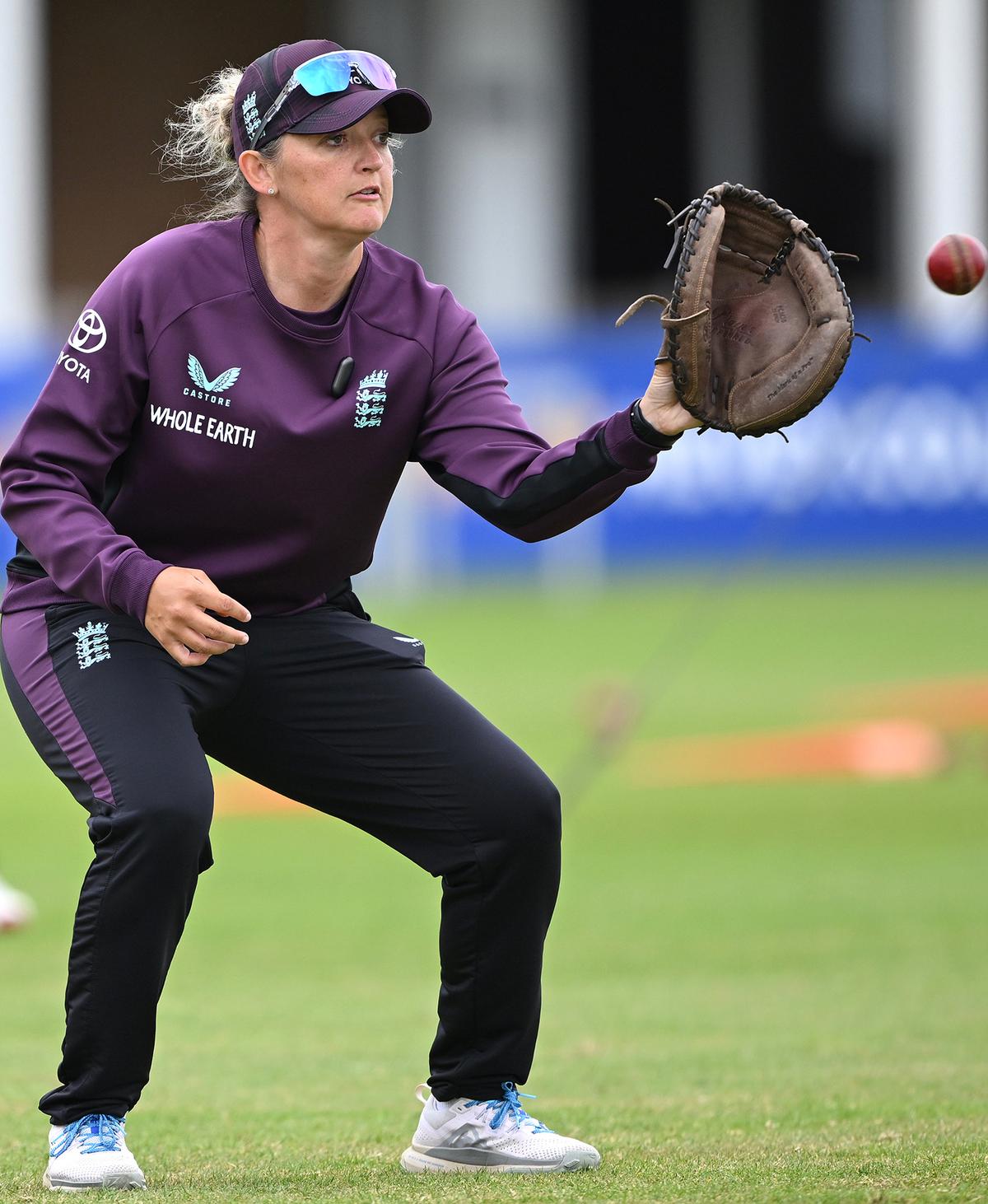
Taylor revealed that towards the end of her career she moulded herself like Dhoni.
| Photo Credit:
Getty Images
Teams are constantly gravitating towards batters who can keep wickets rather than specialists with the gloves. What is your view on that?
As a traditionalist, I always want the best wicketkeeper to play. But I understand the need for balance in a side. If you can have that batter towards the end who can bat with the bowlers, and sometimes the best ’keepers aren’t necessarily that batter, I get that. But if you’ve got your best ’keeper, they will affect the game in a way that the batter-keepers won’t.
Who are the wicketkeepers that you enjoy watching most?
Beth Mooney, just don’t tell her that I like watching her (laughs). Amy Jones will always be one, she’s phenomenal.
Alex Carey is pretty good. I absolutely love watching Ben Foakes. He just makes it look so easy that it’s ridiculous. I used to love watching Dhoni when he was playing for India. I like Quinton de Kock as well, just because he’s so carefree with it. It amazes me how good he is. I’ll just keep watching ’keepers, I’m a bit of a badger. That’s the first thing I notice during a cricket match.
You’ve been candid about your mental health struggles, which led to your international retirement in 2019. Seven years on, are cricketers more equipped to deal with these issues?
Yeah, definitely better. Earlier, less people spoke about it, so you didn’t know what you had. You didn’t know that what you were dealing with was a thing. I only learnt once I spoke out that other people were going through the same stuff. It’s ADHD (attention deficit hyperactivity disorder) that I have. I’ve relaxed about it now, whereas earlier I was so stressed that I was feeling this way.
The girls now have access to so much. It needed me to stop playing cricket and go into hypnotherapy, and that was the best thing for me.
When you were playing, Australia and England were the two dominant sides. New Zealand won the 2024 T20 World Cup, and India won the 2025 ODI World Cup. Is women’s cricket more competitive than ever before?
Absolutely. It’s exciting. The franchise leagues have then opened that up. It’s scary to think where India will be in five years’ time because of the exposure they are getting. I’m so glad now that you can look at a World Cup and say I don’t know which team is going to win — South Africa, India, England, Australia or New Zealand. That’s cool.