






Researchers use sound waves to detect elusive helium gas leaks

A simple Kagome lattice. The name comes from the Japanese for “basket” and “eye”, referring to the pattern when woven with bamboo leaves.
| Photo Credit: N. Mori
Helium is famous for making balloons float, voices squeak, and as a critical resource for MRI machines and aerospace engineering. Helium is expensive and scarce, finding leaks quickly is essential, but that’s easier said than done because helium is also chemically inert and sensors, which usually rely on chemical reactors, have a tough time detecting it.
In a new study, researchers from Nanjing University in China have reported a sensor that uses sound waves instead of chemistry to ‘hear’ helium leaks. The study paper was published in the December 2025 issue of Applied Physics Letters.
Most gas sensors work like a sponge that reacts when it touches a particular liquid. They work by absorbing gas or using chemical reactions to change an electrical signal. Since helium is chemically stable, it doesn’t react with these sensitive coatings. And while existing methods like mass spectrometry can detect helium, they’re often bulky and expensive.
In the new study, the researchers took a different approach. They designed a sensor based on acoustic topological materials. These are structures that can trap sound using a particular geometric pattern called a Kagome lattice.
The Kagome lattice is made of interlaced triangles and hexagons. In their specific design, the researchers used rigid cylinders connected by small tubes, creating an effect called topological corner states. Essentially, sound waves introduced into the structure get trapped at the three corners of the triangle and are unable to escape into the middle or from the sides.
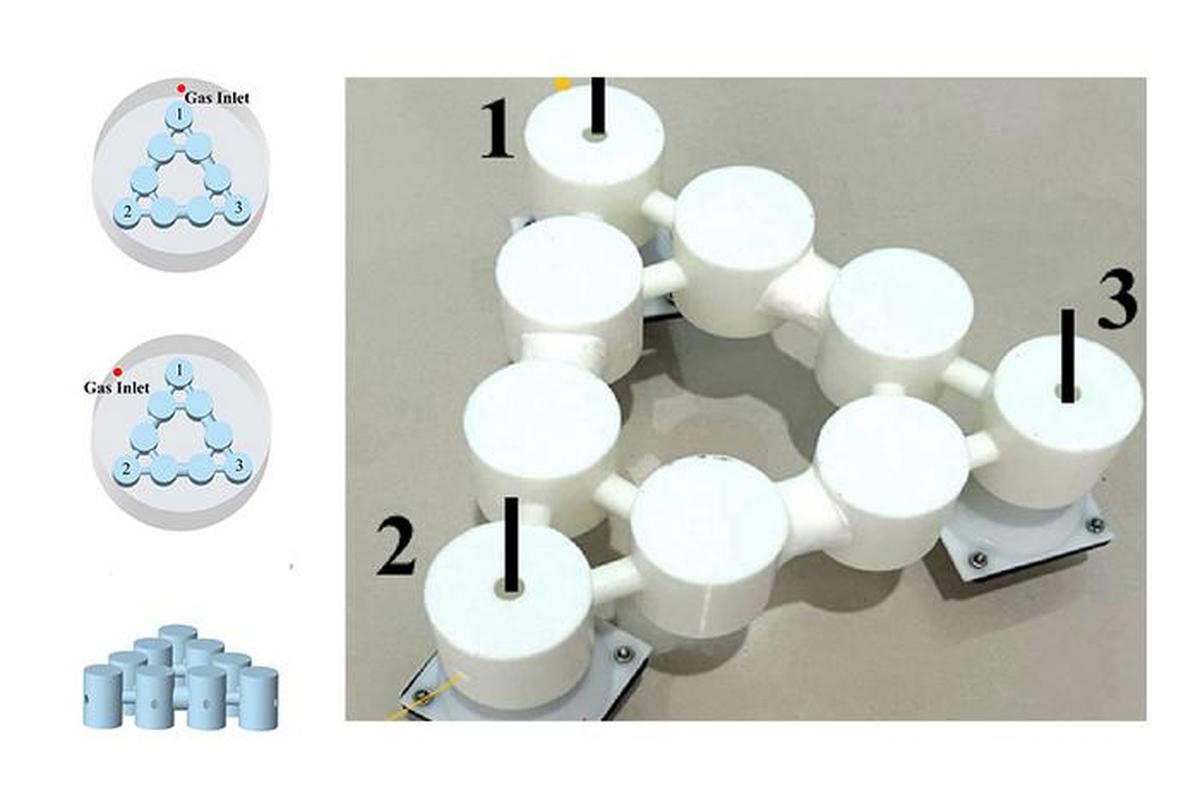
Helium detection device inspired by Kagome. Left: The device’s triangular structure helps determine the location of helium leaks in a 2D space.
| Photo Credit:
Wang et al.
Sound travels at different speeds through different gases. When helium leaks into the sensor and mixes with the air inside, it changes the speed at which sound waves travel through the tubes. This change in speed changes the frequency (or pitch) of the trapped sound at the corners. So by measuring this shift in frequency, the sensor can instantly calculate the concentration of helium present.
The acoustic approach offers several advantages over traditional chemical sensors. Because it doesn’t rely on delicate chemical coatings, the sensor is incredibly tough. It works well in temperatures ranging from a comfortable 26º C to a freezing –34º C. It also ignores changes in humidity and thus doesn’t need to be constantly recalibrated like other sensors.
The topological nature of the sensor means its ability to trap sound is very stable. The researchers found that they could drill large holes in the sides of the cylinders to let gas in faster and the sound trap still worked well. This means the sensor can detect leaks rapidly as the gas doesn’t have to seep in slowly.
And because the sensor is a triangle with three distinct corners, it can do more than just say whether helium is present in the air. By comparing the timing of the signals at each of the three corners, the sensor can triangulate the direction the gas is coming from. If the frequency shifts at corner 1 before corner 3, for instance, it would mean the leak is closer to corner 1.
According to the research, this device could make it much easier and cheaper to protect valuable helium supplies in industries ranging from medicine to space exploration.
Published – January 28, 2026 12:40 pm IST