




On gravity’s role in the earth’s journey through space
A fresh year has just started, and we are already a month old. Year endings and startings are always occasions to ponder. Here in IIT Kanpur, where some of us teach, the first week of January is always hectic. A new semester just started, students are back after winter breaks, and people are rushing through foggy mornings towards their classes.
As people meet on the way, we invariably greet each other ‘Happy new year’. However, if you belong to that category of people, who have felt that last year wasn’t really that remarkable, let me try to convince you otherwise. The secret, as always, lies in the physics behind.
The discovery of gravity
As the common folklore states, Issac Newton, about 400 years back, discovered gravity while sitting beneath an apple tree. That things attract each other just because they have some weight is quite extraordinary. And we see this everyday — when we fall, we fall towards the floor and not towards someone else (unless, of course you are falling in love). This is because, on earth, the heaviest thing around us is the earth itself.
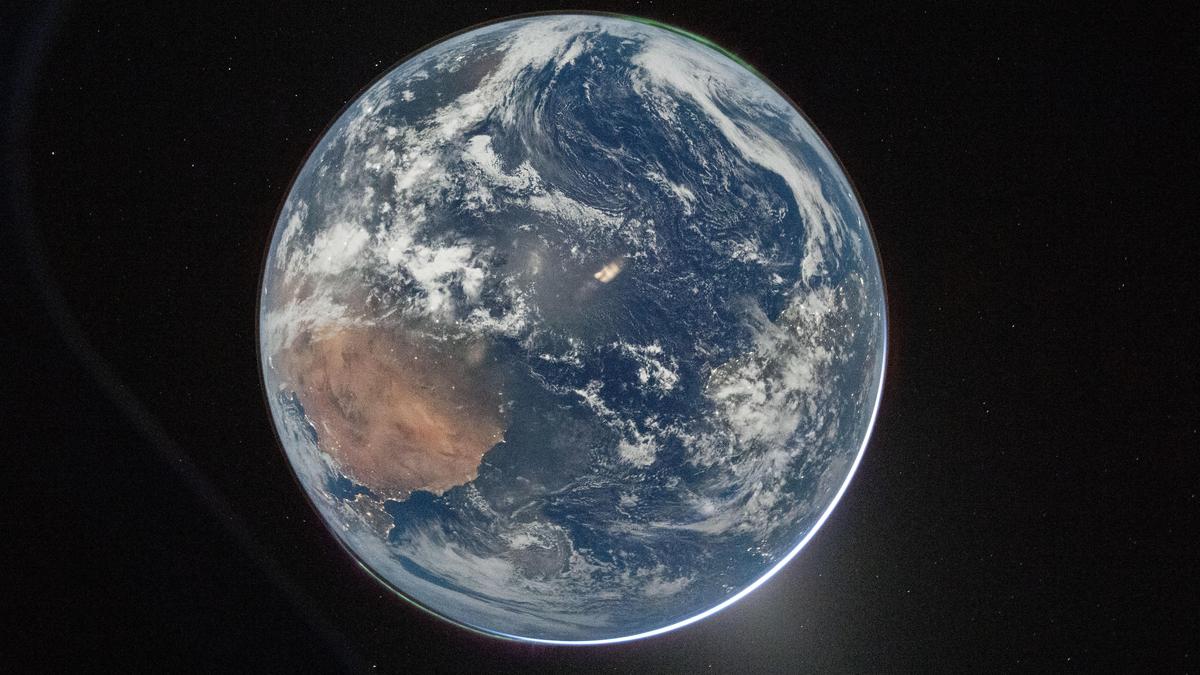
In fact all of us, animals, humans, oceans and even our air is essentially stuck to this massive piece of toffee-like liquid filled rock which we call earth. All life, our leaders, their wars, are essentially the result of this cohabitation — the result of gravity.
But then, when two things attract because of gravity, it’s not necessary for them to get stuck to each other. A thing attracted to another may decide to just revolve around it. In the language of physics, we say this is when the gravitational pull acts as the centripetal force. Centripetal force is a force which acts towards a centre.
Roller coaster
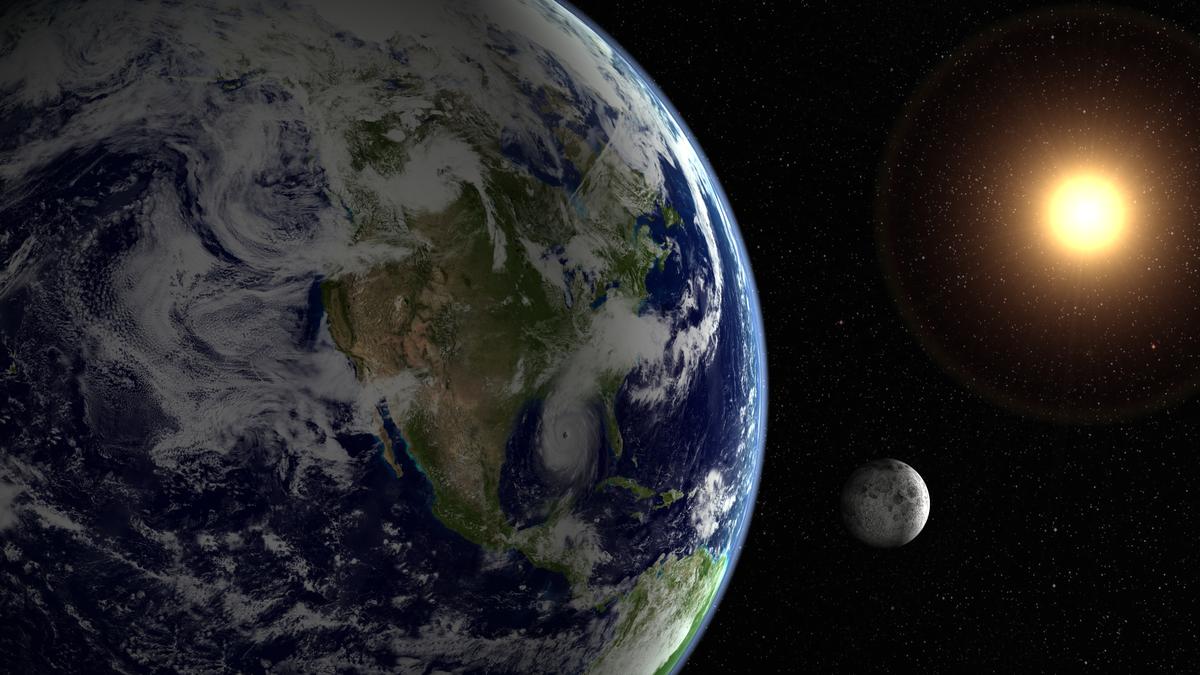
That pulling something towards you can rotate it is not something unusual. For instance, imagine you are tying a strong rope to the seat of a kid riding a bicycle and try to pull the cycle towards you. As you pull, instead of the cycle coming directly at you, it will make the cycle circle around you. If you continue to do so, the cycle may make a full turn. Here your pull acts like a centripetal force. And this is what the earth does to the moon through gravitational pull. The moon is attracted by the gravitational force of earth, but it makes the moon revolve around us. This very behaviour is repeated by the earth and the sun.
The earth takes one whole year to make a complete revolution around the sun. Can you guess how much distance the earth travels in that one year? It’s about 1,000,000,000 kilometres. If one travels from Delhi to Chennai — that’s about 2,500 kms. And if one plans to travel via car and drive it at a high speed of 100 km per hour (all the time, with no breaks and no toll booth stops), it will take approximately a day. Now imagine travelling that same distance, 4,00,000 times. How much time would you take? About 1,000 years.
Well, earth covers it in just 365 days, that is one year. The earth moves at an extraordinary speed of 1,07,000 kilometres per hour. No roller coaster can ride you at such high speeds.
But who or what is fuelling the earth to continue on this speed? After all, even to maintain a car at 100kms/hr, one needs to keep supplying it with oil (one of the reasons why many countries are obsessed with oil).
Friction and aether
The reason one needs to supply oil to our car even to maintain it at some speed is because the road has friction. If we just leave the car on its own at some speed, it will eventually come to a stand-still. This friction is caused by the surroundings which pushes back a bit to anything which tries to move due to other forces. For instance, a car may feel it from the road, a bird by the air, a fish by the water it is in.
But then what about earth? Are planets or even the sun moving in some liquid?
This was a question which puzzled scientists for a long time. While we now know that the earth lies in vacuum — which means essentially nothing — at some point people thought that the earth and all celestial objects are in an invisible material called “aether”. Michelson and Morley, two American scientists, did an experiment 140 years back (in 1887) trying to detect aether. The result is considered one of the most famous “failed” experiments: experiments which disprove something it was designed to prove. They showed that aether doesn’t exist.
The earth thus continues to move at this extraordinary speed without anything to resist it or slow it down. And as it does, it continues to rotate around the sun.
The advent of space study
The study of planets, galaxies and the way they form is called astrophysics. One of the most celebrated Indian physicists working in this area was Prof. Jayant Narlikar who passed away last year. Apart from being a researcher, he wrote many science stories. He also became the founding director of the Inter-University Centre for Astronomy and Astrophysics (IUCAA) in Pune, an institute dedicated to astrophysics research in India and was awarded the Padma Vibhushan in 2004 by the Government of India.
Apart from being a cosmologist who came up with theories of how the universe came along, he also did experiments to disprove many of our superstitions which arise from celestial events. If you have a free weekend, and want to learn more about astrophysics and our everyday unscientific superstitions, consider watching “Brahmand” a TV series which was written by Prof. Narlikar which ran in Doordarshan between 1994-95. The episodes are now available on the YouTube channel of Doordarshan National.
One may still wonder how did scientists really disprove the existence of aether? You may also wonder if we are able to explain all the things we see in the night sky — the stars, how they form, how they die. Well, it turns out there are many things we still don’t understand and if you are interested to learn more, you will need to learn physics, for example in an institute like ours, where there are undergraduate programmes in it.
Next time, on a serene morning, if you are staring at a water pond, as birds chirp next to you, wondering how calm everything around you is, imagine for a second how you are really on a rollercoaster traveling in space at an extraordinary speed.
And when this year ends; even if your regular earthly life has been ordinary, don’t forget to congratulate yourself, and your fellow life forms on earth, on the extraordinary space travel you all have together completed.
Adhip Agarwala is an assistant professor of physics at IIT Kanpur.
Published – February 10, 2026 08:30 am IST