




Mumbai author Lindsay Pereira on the fractures of migration in his latest novel, Super
Mumbai-based author Lindsay Pereira gravitates towards marginalised communities of society; he says, “I empathise with them more”. He graduated from St. Xavier’s College, Mumbai, and holds a PhD in Literature for his work on gender attitudes implicit in 19th-Century Indian fiction from the University of Mumbai.
It is the sort of academic detail that feels subtly operative in shaping a fiction that is attentive to subtext, and omission. In his latest novel, Super (published by HarperCollins India), the canvas expands.What expands with it is not just geography, but the scale of inquiry. Lindsay moves beyond the contained worlds of his earlier work into a terrain that is both widely familiar and insufficiently examined — the steady outflow of young Indians chasing the promise of stability elsewhere. The novel draws from a sharply escalating reality, one that Lindsay himself grounds in data and observation, yet it resists turning that reality into a fixed argument. Instead, it lingers on the motivations that precede departure and the quieter reckonings that follow it.
This preoccupation with lives in transition is not new in his work so much as it is extended here into a broader, more uncertain terrain. His debut novel, Gods and Ends (2021), put him on the literary map, earning shortlistings for the JCB Prize for Literature and the Tata Literature Live! First Book Award. His second, The Memoirs of Valmiki Rao, was longlisted for the 2024 Crossword Book Award and went on to win the Mumbai Literature Live! Literary Award. A collection of short fiction, Songs Our Bodies Sing, followed in 2025, continuing his interest in the often overlooked negotiations that shape everyday lives.

Lindsay Pereira
| Photo Credit:
Special arrangement
Super explores a phenomenon that has, in recent years, acquired both urgency and fatigue: the steady migration of young Indians to countries like Canada, propelled by a mix of financial stability and inherited aspiration. The novel follows Sukhpreet Gill, who mortgages his family land and leaves behind the woman he loves, from Jalandhar to Canada in pursuit of a better future. Running parallel to Sukhpreet’s narrative is Maynard Wilson’s story, a Canadian grappling with unemployment, mounting debt, and a resentment simmering over the shrinking opportunities in his country. When their lives intersect, the novel exposes their vulnerabilities — the one that drives people to leave their country, and the one that seeks stability at home.
Lindsay, who is also a journalist, is unusually direct about the empirical scaffolding behind the novel. “Between 2014 and 2024, for instance, there was an increase in international student enrolment, from India to Canada alone, by over 1,200%. By 2023, India contributed to the major inflow of international students in Canada, with 278,065 officially documented,” he says, adding, “I used that data to try and understand what was driving this surge, why students felt a need to get away, and what they hoped to find in a foreign country. I also read multiple reports about the impact of migration on local communities, which helped me shape these characters. The aim was to try and become a neutral observer, which I hope to have managed.”
The cost of migration
The novel’s central figures, Sukhpreet and Maynard, are conceived, in Lindsay’s words, as “emotional anchors for two opposing points of view… both of which were authentic for me, and worthy of consideration.” This tension is sharpened from the outset, with the novel opening on an untimely death that decisively alters its emotional register. Without revealing too much, the incident shifts the narrative away from aspiration towards something more precarious. It becomes a way for Lindsay to examine how the promise of a new life is complicated, even undermined, by the realities awaiting those who arrive to an environment that is not always welcoming, and often marked by a scepticism, even a thinly veiled disdain, towards migrants from those who consider the country their own. Migration, after all is structured by vastly different stakes.
“Super isn’t just about crossing borders,” he says. The novel’s most persistent concern is what he calls “the loss of self… an erosion of identity that occurs when one is displaced from a place of familiarity.” It is an idea he returns to with deliberation, describing a state in which “there arises a risk of becoming emotionally adrift.” Super captures the gradual drift — the way displacement settles in through small, accumulative adjustments.
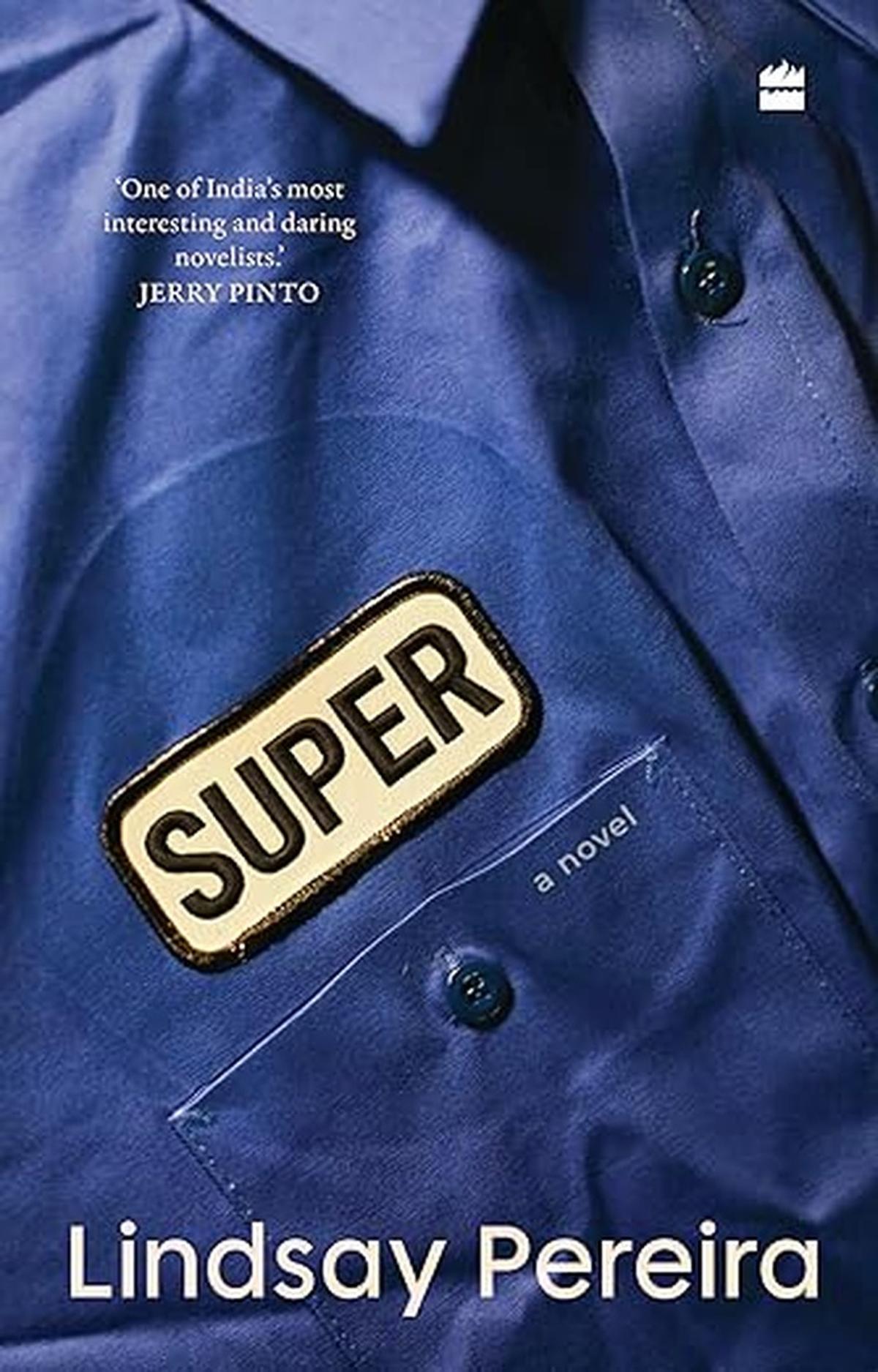
The book cover for Super
| Photo Credit:
Special arrangement
Yet this emphasis on interiority also shapes the novel’s limits. Lindsay often approaches the material conditions of migration — labour, legality, systemic exclusion — at an angle, allowing them to remain present but not fully interrogated. “To resist a grand narrative is conscious,” he says. “It is only by illuminating moments that I can try and spark ideas about a bigger picture.”
When asked whether life abroad is, in any meaningful sense, better — a question that shadows both the novel and the larger discourse around migration — Lindsay declines the premise. “It’s impossible for me to proclaim that life abroad is better or worse,” he says. “That can only be defined by individual circumstances.” What he offers instead is a reframing. “There always is a cost. What one is prepared to give up determines the level of satisfaction with where one is.”
Where the novel feels most assured is in its attention to isolation as erosion. “There is also the impact of isolation, which is often dismissed,” Lindsay notes. “That loss of firm ground can have devastating consequences that play out, like in the case of both Sukhpreet and Maynard.” For Sukhpreet, it is about leaving behind the woman, and family, he loves in Jalandhar and stepping away from a life that, however limited, is familiar. For Maynard, it is about a different kind of loss — the feeling of being sidelined in his own country, of watching stability slip in ways he cannot quite control. What the novel stages, then, is not a simple opposition but a shared erosion of ground, where both men, in different ways, are forced to reckon with what it means to no longer feel secure in the place they thought they belonged.
Lindsay is more direct when speaking about politics. “Everything we do is political whether we choose to accept that or not,” he says. And yet, in fiction, he opts to “use characters or situations that stand in for arguments like these,” a strategy that aligns with his broader suspicion of overt messaging.
If there is a coherence to his approach, it lies in his commitment to writing as a form of inquiry. “I began writing fiction only when I felt I had something specific to say,” he notes.
“I am less interested in a review than I am in observations about how a book fits into a larger context,” he says. “Where it comes from, why it exists, and what it says about us all.” It is, perhaps, the most useful lens to view Super: not as a definitive account of migration, but as a novel that registers its emotional weather while remaining ambivalent about its underlying systems.
Whether that ambivalence reads as restraint or evasion will depend on the reader’s expectations. Lindsay, for his part, appears content to leave the question open, which may be the point, and also the problem.
Super is available at bookstores and online