


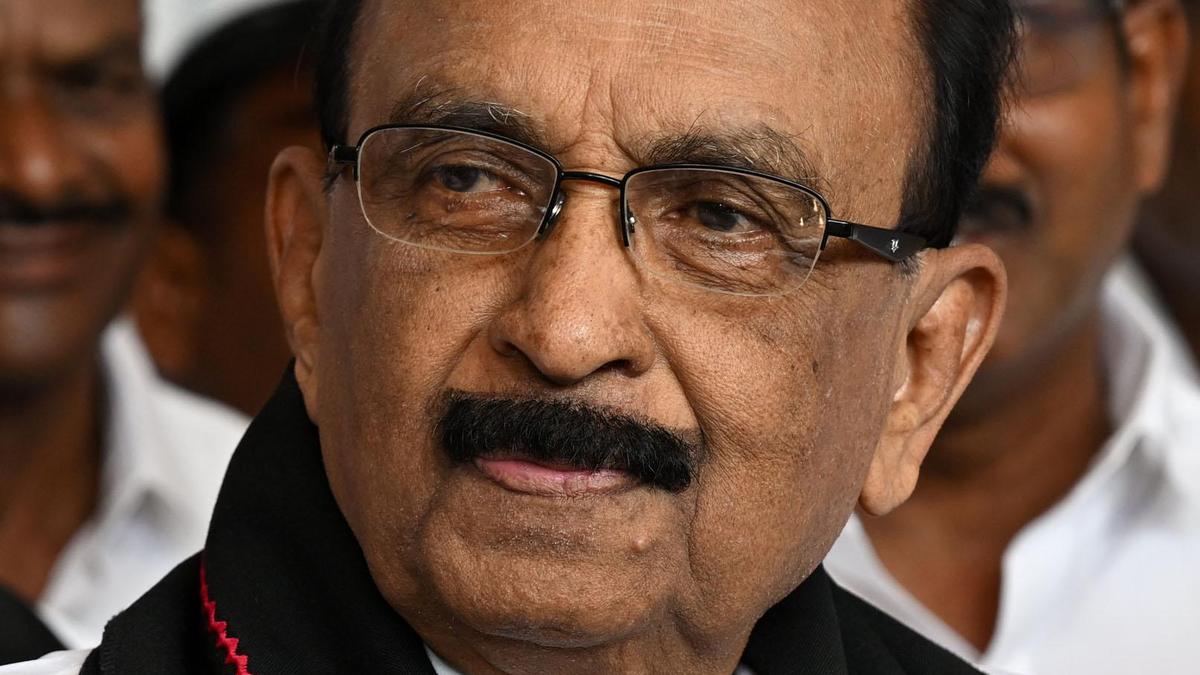
Madras High Court dismisses Vaiko’s case against ban imposed on LTTE under UAPA
The Madras High Court on Tuesday (February 24, 2026) dismissed a writ petition filed by Marumalarchi Dravida Munnetra Kazhagam (MDMK) leader Vaiko, who had challenged an order passed by the Unlawful Activities (Prevention) Act tribunal on November 7, 2012, confirming the Centre’s May 14, 2010 notification declaring the Liberation Tigers of Tamil Eelam (LTTE) as an unlawful body.
A Division Bench of Justices Anita Sumanth and Mummineni Sudheer Kumar rejected the plea after hearing the arguments advanced by Mr. Vaiko in person and Additional Solicitor General (ASG) AR.L. Sundaresan, appearing for the Union Ministry of Home Affairs as well as the UAPA tribunal. Though the petition was filed 13 years ago, it remained pending all along despite being listed for hearing thrice in 2018.
In his affidavit, the writ petitioner had claimed that the Sri Lankan government had been carrying out genocidal attacks on the Tamils living in the northern and eastern parts of the island nation for the past 50 years with the intention of annihilating the entire Tamil race, taking possession of their traditional lands and settling the military as well as Sinhalese people in those acquired areas.
“Nearly three-and-a-half lakh Tamils have been massacred. More than 10 lakh people were forced to leave their native soil and take shelter in a number of countries all over the world. In Tamil Nadu alone, more than one-and-a-half lakh Sri Lankan Tamils, who are known as Eelam Tamils, have settled as refugees,” the affidavit read, and stated that the Eelam Tamils were fighting for their legitimate rights.
Mr. Vaiko said the Centre had declared LTTE as an unlawful association on May 24, 1992 and extended the notification from time to time. All those notifications were periodically confirmed by a tribunal constituted under Section 5 of the UAPA of 1967. When the 2010 notification was referred to a UAPA tribunal constituted in 2012, the petitioner approached the tribunal to oppose the declaration.
Claiming that he was not given an opportunity to present his case effectively, the petitioner challenged the tribunal’s order on the grounds of violation of principles of natural justice and denial of permission for him to get impleaded as one of the parties. Further, “the activities of pro-LTTE organisations, individuals and sympathisers cannot be a reason to declare the LTTE as an unlawful association”, he argued.
On the other hand, Mr. Sundaresan argued that Mr. Vaiko was not a person aggrieved by the ban on the LTTE. Since he was not a member of the LTTE, he would have no locus standi to challenge the ban, the ASG said, and pointed out that the banned organisation had not challenged the Centre’s notification. He also contended that the writ petition ought to have been filed only before the Delhi High Court.
Assisted by Central government senior panel counsel K. Venkataswamy Babu, the ASG said: “This writ petition filed before the Madras High Court is not maintainable at all. A similar writ petition filed by the same writ petitioner challenging the 2010 notification was dismissed by this court in 2013. Hence, the present writ petition is also not maintainable. The ban imposed on the LTTE is in the interest of national security.”
Published – February 24, 2026 06:39 pm IST