



Lutyens and the politics of symbolism
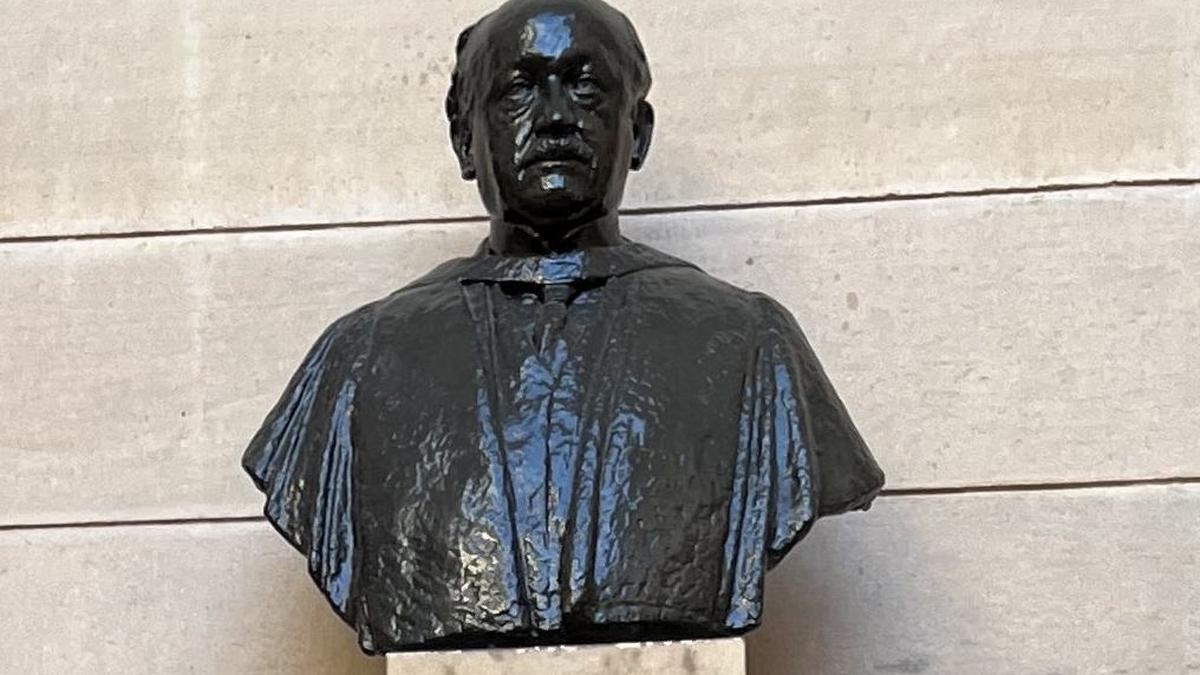
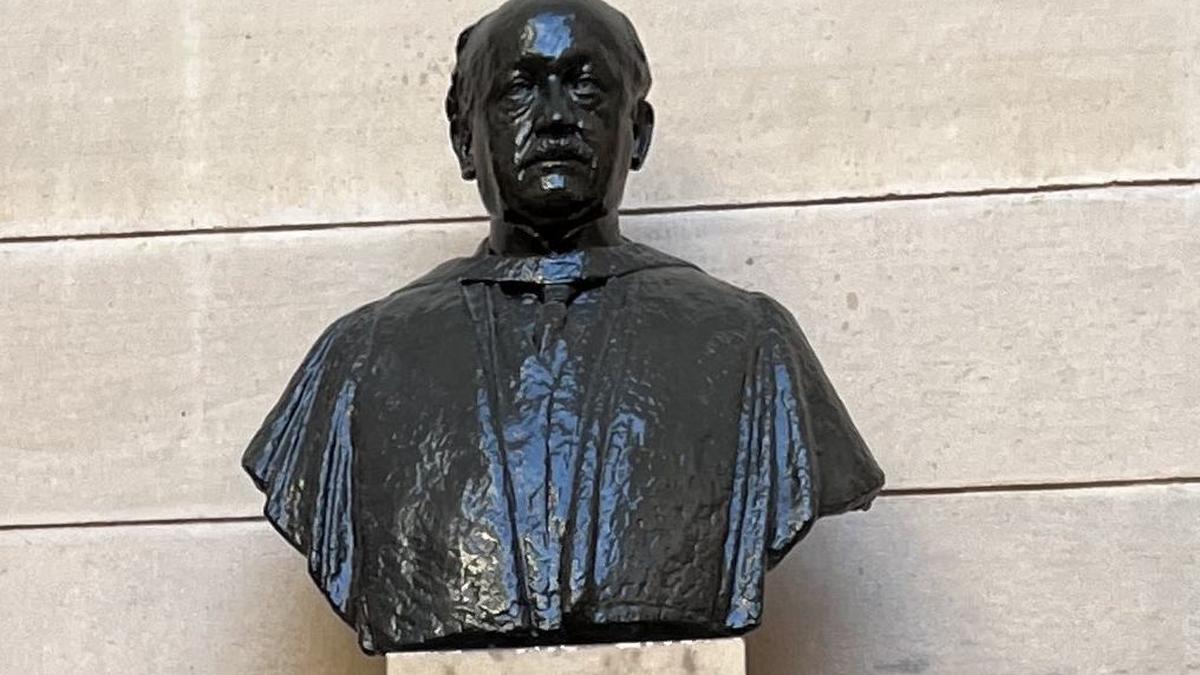
Bust of Edwin Lutyens. Image taken from the X post by his great grandson and biologist Matt Ridley. Photo: X/@mattwridley
On February 23, 2026, Edwin Lutyens’s bust was removed as part of the government’s ongoing decolonisation drive. In its place now stands the bust of C. Rajagopalachari, the first Indian Governor-General of independent India. Prime Minister Narendra Modi framed the move as an act of “leaving behind symbols of slavery,” while the Opposition, predictably, criticised it in familiar and unimaginative terms. This is not the first time a statue — or in this case, a bust— has been taken down. Such acts are attempts to wreak vengeance on the past and rewrite the future.
There is no need to shed tears for Lutyens or what he represented. He is perhaps the only architect in modern history whose name has, for nearly a century, been synonymous with an entire city. Pierre Charles L’Enfant, who designed Washington D.C., has a handful of city landmarks named after him, such as a plaza, a metro station and promenades, in the city he shaped. His name as the city’s architect was erased and resurrected only a century later. Today he lies buried in the Arlington cemetery overlooking the city, where he was interred 84 years after his death. Walter Burley Griffin, the Chicago architect who planned Canberra has a lake and a 276-km road named for him, but not a city.
The move to India
Lutyens was an ambitious man. At 19, with little architectural training, he struck out on his own. He was convinced of his talent; he was also aided by his social connections. His wife, Lady Emily, was the daughter of the Earl of Lytton, the former Viceroy of India. Lutyens had to turn to India because England was changing; an assertive middle class was elbowing the aristocracy out of power. High taxes on the wealthy introduced in 1909 meant fewer and fewer country houses to build. However, he hated India and was uncharitable towards Indians. An unrepentant racist, he wrote to his wife Emily: “The Taj by moonlight becomes so bald and indefinite… It is wonderful but it is not architecture, and its beauty begins where architecture ceases to be.” This was hardly an isolated remark. In another letter, Lutyens complaining about the ineptitude of Indian craftsmen, wrote mockingly, “… It will be difficult to find the men — Government ought to breed them! A job for the Eugenic societies!”
The Lutyens legacy
Lutyens was one of a three-member committee sent from London to select the site for New Delhi and later design it. When he arrived in Delhi, he had no experience in town planning. He was, fundamentally, a country-house architect who rose to prominence partly through brilliance and partly through influential social connections. He was not the sole architect of the capital; he shared responsibility with his friend-turned-rival Herbert Baker. He did not design the bungalows currently occupied by Parliamentarians that bear his name. Lord Hardinge, who spent months negotiating with Lutyens and the London bureaucracy on Delhi’s design, has been erased from the city — Hardinge Avenue became Tilak Marg in the 1960s.
Lutyens ultimately secured near-exclusive credit for the city’s design not just because he was talented, but because he was an exceptional public-relations strategist. His friendship with the publisher of Country Life, a magazine devoted to English architectural beauty, ensured that nearly every house he designed received glowing coverage. Robert Byron’s effusive praise of the Viceroy’s House (now Rashtrapati Bhavan) in the 1931 Architectural Review further elevated his standing, even as Byron dismissed buildings such as the Parliament House, designed by Baker. But, there is no denying Lutyens’s brilliance: he completed roughly 800 projects, an enviable body of work in both scale and variety.
Political jousting
It is unlikely that the government went into such minutiae before deciding to remove his bust. In the last century, his name has transitioned from an adjective to a pejorative. Any English-speaking liberal elite who benefitted from the old order is marked as ‘Lutyens Elite’. Removing the Lutyens bust is also a measure of shadow-boxing with this elite. The decision to put Rajagopalachari’s bust in his place is politically expedient for the ruling party in view of the upcoming Tamil Nadu Assembly polls, especially when it is supplemented by the narrative that Rajaji had been ignored by the previous Congress governments.
Our pugilistic public discourse, of course, demands that we pick a side. The Opposition’s response here was banal —lamenting that “whatever is left of Lutyens’ design history will be broken down” and folded into a narrative of purging colonial remnants.
Yes, preserving history matters. Successive governments have had a shameful track record with preserving history. Whatever monuments remain, often exist without any context. For the British did not build New Delhi out of generosity. They shifted the capital from Calcutta to consolidate the new King’s authority and manage the political fallout from the partition of Bengal. Similarly, the Narendra Modi government did not begin redeveloping New Delhi during the COVID pandemic because there was a pressing urban need. Both the British and the Modi government were driven by the same impulse: to stamp their imprint on the city. Thus, the government’s “decolonisation” effort is less about historical justice and more about shaping headlines. And that, ultimately, is the real story here — not Lutyens, but the politics of symbolism.
sobhanak.nair@thehindu.co.in
Published – March 05, 2026 12:56 am IST