




Limits of neutrality in addressing caste
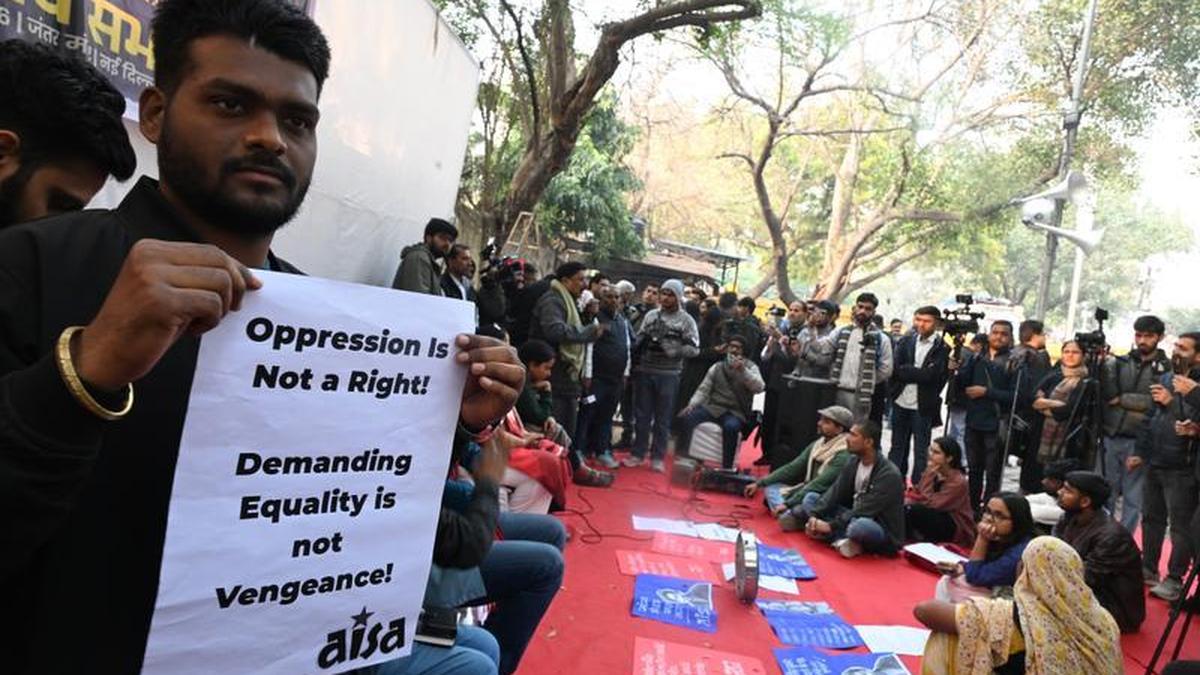
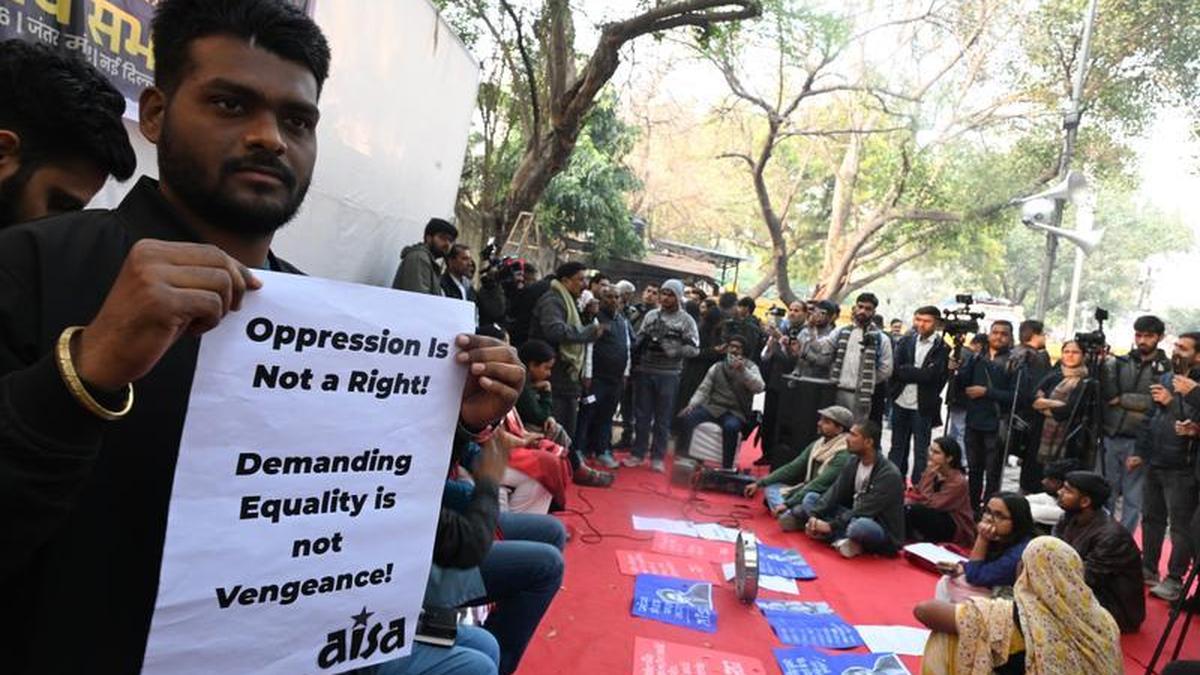
A group of professors and students protest in Jantar Mantar, New Delhi against the Supreme Court stay on UGC’s equity rules. File
| Photo Credit: The Hindu
The interim stay by the Supreme Court on the UGC Promotion of Equity in Higher Education Institutions Regulation, 2026, as reported by the Supreme Court Observer, arrives at a pivotal moment. These regulations emerged from Abeda Salim Tadvi v Union of India, a pending case before the Supreme Court concerning caste-based discrimination and student suicides in higher educational institutions. The case highlights institutional failures in creating an equal and inclusive learning space.
When discussing caste discrimination in higher education, it is essential to clarify what is being addressed. The 2026 regulations under 3(c) define “caste-based discrimination” as discrimination based on caste or tribe against members of the Scheduled Castes, the Scheduled Tribes, and Other Backward Classes. This specificity is not exclusionary; rather, it is necessary to recognise caste as a continuing structure of marginalisation rather than isolated incidents.
Why neutrality fails
The definition has been criticised for excluding ‘general category’ students, with suggestions to adopt a caste-neutral definition that includes them, in line with Article 14 of the Constitution, which guarantees equality before the law. However, this reasoning misunderstands both how caste discrimination operates in practice and how equality is understood under the Constitution.
Editorial | Stay the course: On the UGC’s Promotion of Equity in Higher Education Institutions rules
The Constitution does not mandate an abstract, one-size-fits-all neutrality. Article 15 not only prohibits discrimination but also empowers the State to make “special provisions” for socially and educationally backward classes, SCs and STs to ensure substantive equality. Equality, in this framework, is substantive rather than formal.
Formal equality assumes that discrimination operates symmetrically and that all social groups require identical protection. However, caste discrimination is structural, embedded in graded hierarchies that shape access to dignity, resources, and institutional power. Including “general category” groups into a caste-neutral definition risks collapsing this structural inequality into a universal grievance framework, where systemic oppression is equated with isolated interpersonal bias. Such neutrality does not expand protection; it dilutes the law’s ability to address caste as a system of power.
For decades, SC and ST students have experienced social exclusion, unequal treatment, humiliation, and institutional bias. In several cases, such structural discrimination has led to mental distress and suicides. These realities, reflected in the pending case under which the equity regulations were formulated, show that the framework is grounded in systemic concerns, not isolated incidents.
A caste-neutral definition would flatten unequal social positions into a formal notion of sameness that the Constitution itself does not endorse. Articles 14 and 15 permit differential treatment precisely to remedy historical and social disadvantage. Treating caste-based oppression as symmetrical across groups disregards the hierarchies through which caste operates and shifts the focus away from structural exclusion to abstract individual grievances. Therefore, defining caste-based discrimination through historically marginalised groups is not arbitrary. It recognises that discrimination operates through power structures that advantage some while disadvantaging others. This is not “reverse discrimination,” but an acknowledgement that equality requires fairness in practice. A caste-neutral approach would obscure these structural realities and weaken the law’s capacity to address caste-based exclusion in higher education.
Enforcement matters more
The equity regulations in higher education, including a focused definition of caste-based discrimination, are not meant to exclude others from protection. Rather, they aim to create a baseline of dignity and inclusion for those who have historically been excluded. This approach aligns with Articles 14 and 15, which allow differential treatment to remove disadvantage and achieve substantive equality. In a society shaped by caste, constitutional equality cannot be achieved through context-blind neutrality.
More importantly, the question is how effectively they may function on the ground. The failure to address caste-based discrimination lies largely in weak implementation and poor institutional accountability.
Instead of diluting the scope of the UGC regulations, the focus should be on strengthening them — by ensuring independent complaint mechanisms, time-bound inquiries, transparency in outcomes, and clear consequences for institutional non-compliance. The UGC guidelines must be supported by monitoring, regular audits, and meaningful oversight. A framework meant to prevent caste-based harm cannot succeed unless institutions are made answerable for how they respond to discrimination in practice.
Shifting the debate away from enforcement and towards abstract concerns about neutrality risks missing the core issue. For students facing everyday exclusion, the question is not inclusive definitional purity, but whether the system will respond when discrimination occurs. Strengthening the functioning of the UGC framework is therefore essential to fulfilling the constitutional promise of equality and dignity in higher education.
Priya Chaudhary is a Research Associate, CLPR
Published – April 08, 2026 01:33 am IST