



Key evidence disappears from Tesla involved in bizarre crash
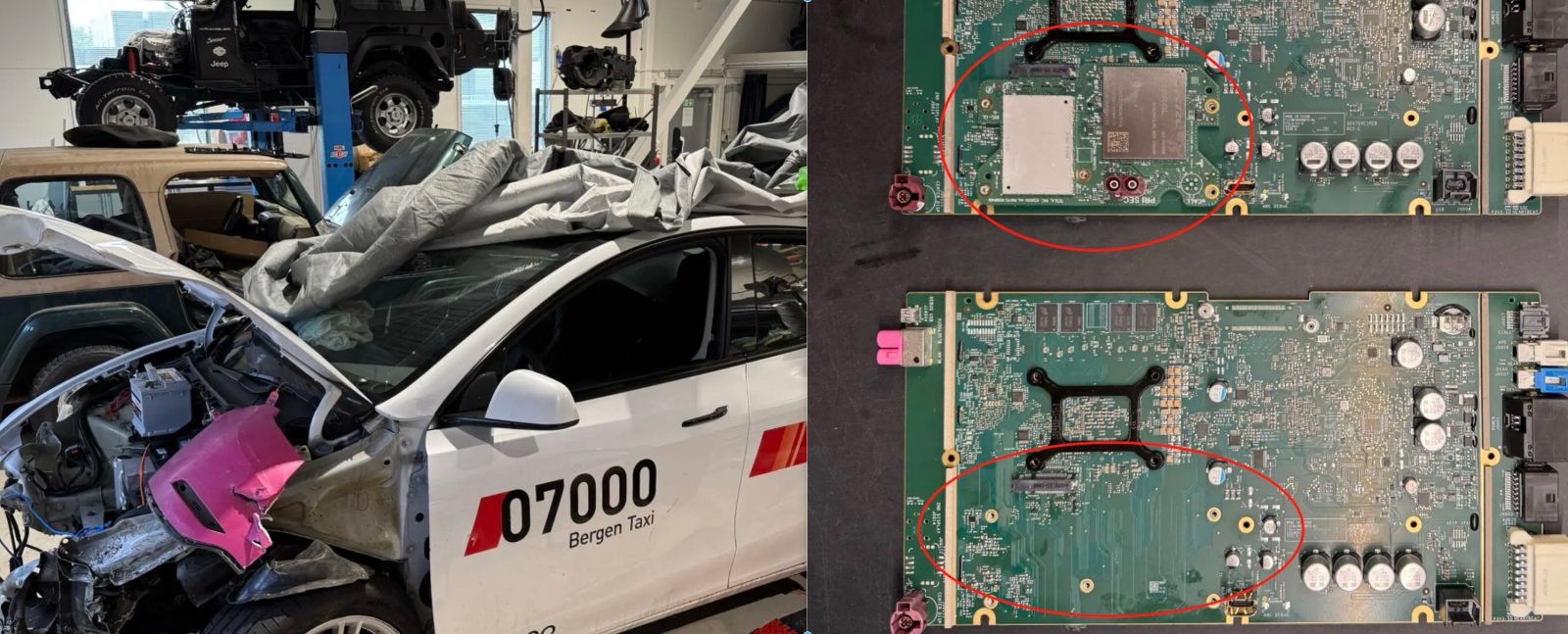
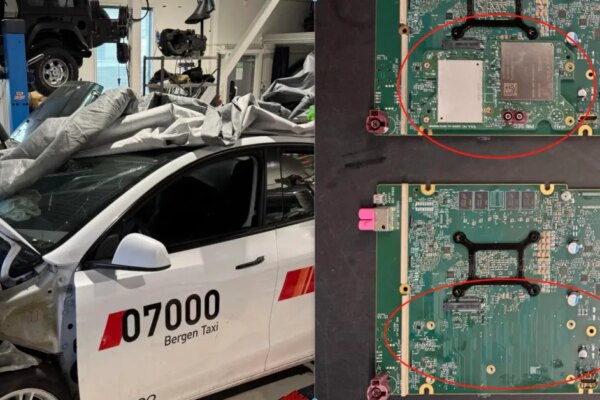
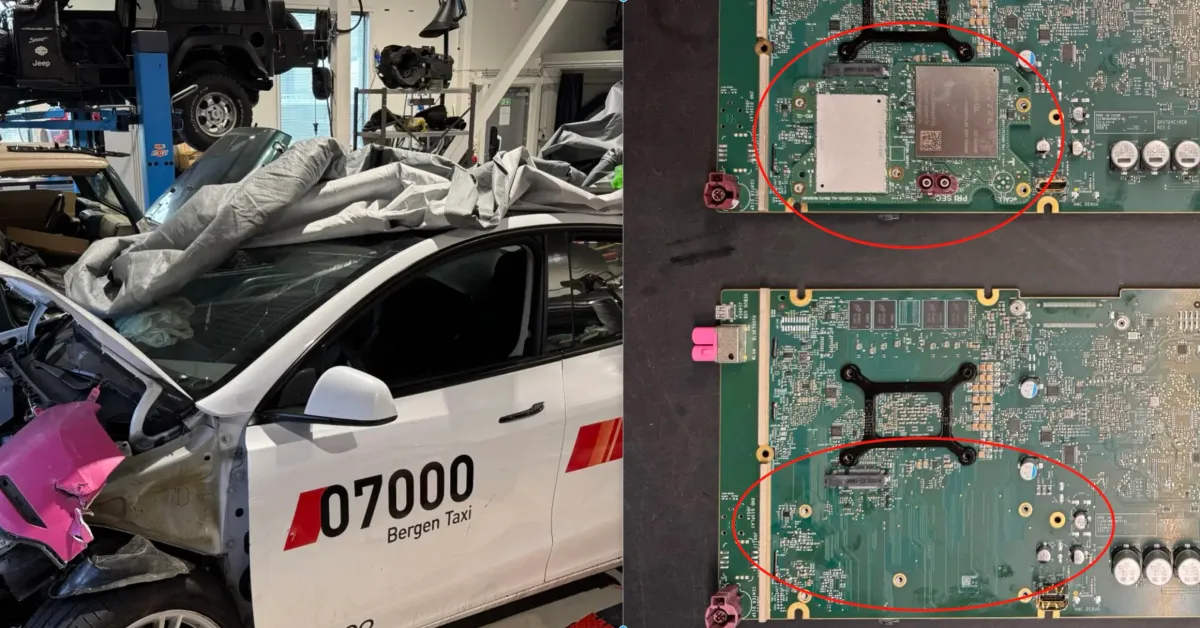
Someone stole a critical piece of evidence from a Tesla Model Y involved in a violent crash in Bergen, Norway — the network card responsible for storing and transmitting crash data to Tesla’s servers.
The revelation raises serious questions about the integrity of the investigation into the 2023 crash, in which the Tesla taxi accelerated to 90 km/h and launched into the air before slamming into a kiosk.
The crash
In the early morning of May 13, 2023, a Tesla Model Y taxi crashed violently through Torgallmenningen, one of Bergen’s busiest public squares.
Dashcam footage from the vehicle, first published by Motor.no, shows two distinct collisions in rapid succession. The driver was reversing into a parking spot when the car suddenly accelerated forward, jumping the sidewalk and smashing through the outdoor seating area of Lille Bar. After a brief pause, the car accelerated violently again, reaching 90 km/h as it raced down Torggaten. Two pedestrians fled into a nearby supermarket as the vehicle approached. The driver swerved, hit a monument base, then launched up stone steps and crashed into a Narvesen kiosk.
It’s remarkable nobody was killed. Had this happened a few hours later, the plaza would have been packed.
The driver — a 12-year veteran taxi operator who was not intoxicated — maintained from the start that “something was wrong with the car.” He was initially charged with negligent driving and had his license suspended.
The data gap and the brake light mystery
Tesla’s event data recorder (EDR) shows the accelerator pedal was pressed throughout both collisions, but crucially, Tesla claims it lacks six seconds of data from the interval between the first and second impacts — the company says the vehicle stopped uploading after the first collision.
The dashcam footage tells a different story than what you’d expect from simple pedal misapplication: the brake lights are clearly illuminated during both collisions. Norway’s Road Authority (Statens vegvesen) attributed this to the car’s automatic collision-avoidance braking system activating but being “overridden” by continued accelerator input. The EDR shows no brake pedal activity until the final impact with the stairs.
But independent experts disagree with the conclusion that the accelerator signal necessarily means the driver’s foot was on the pedal. Simen Huse, one of only five authorized Bosch CDR tool operators in Norway, and researchers from Sintef, argue that electronic malfunctions, software errors, or voltage spikes could produce the same accelerator signal in the data — without the driver ever pressing the pedal.
Bergen police dismissed the criminal case in December 2024, stating they could not “establish with sufficient certainty that the traffic accident resulted from driver error, nor can technical malfunction be ruled out with certainty.” The driver was declared innocent.
The stolen network card
Now, a new investigation by Motor.no reveals that when the vehicle was finally sent to independent data analyst Simen Huse for examination, a critical piece of hardware was missing from the car.
The vehicle was transported over 500 km from Bergen’s Road Administration facility to Huse’s lab in Østfold. When Huse opened up the car, he said he “couldn’t believe his eyes.” The dashboard area had been stripped — multiple plastic fittings were removed, loose screws were scattered on the floor, and electrical connections in the ceiling area had been severed.
Most critically, the network card — the component that handles continuous data storage and transmission between the vehicle and Tesla’s servers — was completely gone from the main computer. This is the very component that would have stored or transmitted the data from those missing six seconds that Tesla claims not to have.
No one has been able to explain who removed the card or when. The defense attorney, Torkjell Øvrebø, noted that it is “highly unlikely” an experienced taxi driver would confuse accelerator and brake twice consecutively, and pointed to the video evidence showing brake lights illuminated throughout. He called for “a comprehensive independent investigation” and suggested that a police raid on Tesla’s servers would be warranted to recover the missing data.
Police have announced they will review their own investigation procedures.
Electrek’s Take
I want to be clear: I have no proof that Tesla is behind the removal of this network card. Someone stripped parts of this car’s dashboard and removed a very specific component — the one piece of hardware that connects the vehicle to Tesla’s servers and could have contained the missing crash data. But I can’t tell you who did it.
That said, we know for a fact that Tesla is willing to lie to and mislead the police to hide evidence in crashes. In the fatal Autopilot crash trial in Florida last year, the evidence was damning. Within three minutes of the 2019 crash, the Model S had uploaded a “collision snapshot” — video, CAN-bus data, EDR data — to Tesla’s servers, and the car then deleted its local copy. Tesla was the only entity with access to that data. When the police asked for it, Tesla’s own attorney told the investigating officer exactly what to write in his request letter — carefully wording it to exclude the collision snapshot. When police tried to extract data directly from the Autopilot computer at a Tesla service center, a Tesla technician claimed the data was “corrupted.” Forensic analysis later proved the data was intact and had been accessed by Tesla that very same day. They had the data. They used it internally. They lied about it for years. A jury found Tesla 33% liable and ordered the company to pay over $240 million.
Is it possible Tesla did something similar in Norway? The circumstances are strange. The brake lights were on throughout the crash. Someone clearly went into the car and removed this specific network card — not some random part, but the exact component linking the car to Tesla’s servers. The police appear to not fully understand the vehicle’s data architecture — reports indicate they keep confusing the network card with the SD card. If anyone would know exactly which component to remove to eliminate the evidence trail, it would be Tesla.
But I want to be honest — these are motives and circumstantial evidence. Not proof. What is clear is that a critical piece of evidence is missing, the investigation has been compromised, and Norwegian authorities need to take this far more seriously than they have so far.


FTC: We use income earning auto affiliate links. More.