



I Tried Mercedes’ Futuristic New Steering Yoke. It’s Better Than It Looks
Mercedes-Benz isn’t the first manufacturer to offer steer-by-wire in a production car, but its system might just be the best one out there. That’s what I found after trying it on an EQS prototype a few weeks ago, back-to-back with a regular EQS.
But first, what is steer-by-wire? As the name implies, you steer the car through electricity rather than a physical connection between the steering wheel and the steering rack. Eliminating the direct connection allows manufacturers to change how a vehicle steers in several important ways.
Firstly, such a system has an infinitely variable ratio. With a standard steering setup, that ratio is set from the factory. But in a car equipped with steer-by-wire, the amount of lock you need to apply can vary with speed and driving mode, altering how the car feels. With a steer-by-wire system, you don’t have to turn the wheel anywhere near as much as in a conventional car—say, to make a three-point turn—and this makes the driving experience easier.

8
Source: Mercedes-Benz
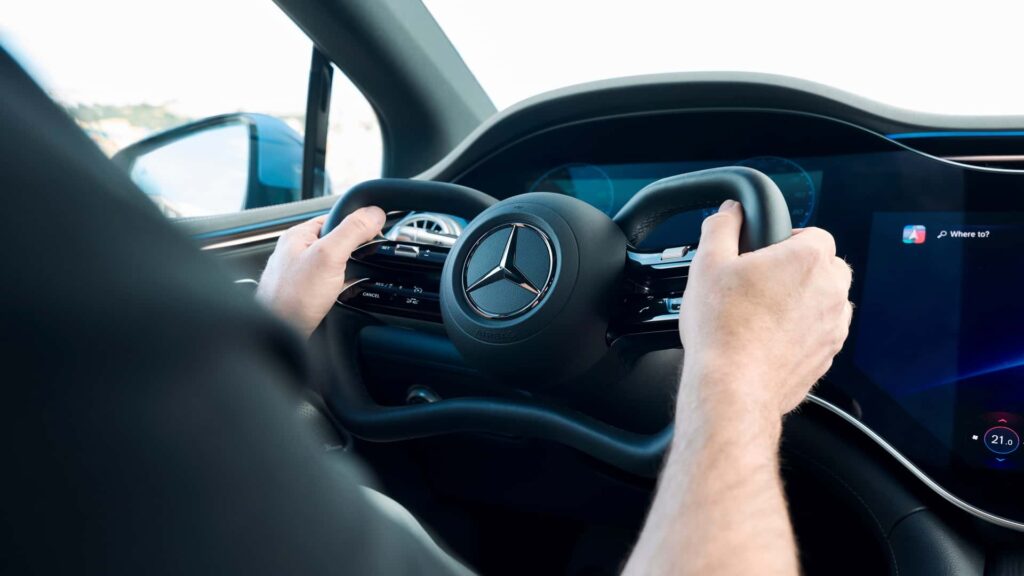
Manufacturers can also play with steering-wheel design and replace the traditional steering wheel with something closer in style to an aircraft yoke. That’s what Mercedes did with the steer-by-wire EQS, which has a steerer similar in shape to what you might see in a race car.
The engineer riding shotgun during my test drive described it as ‘lazier,’ which sounds rude but is actually accurate. You do less. Much less. There’s none of that bus driver hand-shuffling you think you’re going to need in a big luxury sedan. You literally just point the thing where you want to go.
But this ‘laziness’ isn’t the whole story, because the first thing that hits you is how absurdly alert it feels. The nose reacts so quickly that your brain needs a brief moment to stop expecting limousine responses from a car the size of a small yacht. It’s less effort, yet somehow more dramatic.
In something sporty, this could be brilliant. Not because it makes you feel more connected in the old-school sense, but because it makes the front end feel sharp and a bit impatient—like it’s already halfway into the corner before you’ve finished the thought. It feels like the kind of thing that literally wants to take a bite out of that early apex out on track.
The obvious concern is feel. Modern cars already isolate you from the front axle so thoroughly that even sports car steering often feels numb and disconnected. A fully electronic setup should, in theory, make that worse, but Mercedes says the opposite is true, since it uses two electric motors to simulate feedback and help trim latency to nearly nothing.
The low-speed course that I got to try the system on didn’t really highlight this, but it should be more noticeable at higher speeds and when going around corners quickly.
On the point of latency, you would think that having a conventional steering column would automatically result in an instant, latency-free connection between your hands and the wheels. But it’s not that simple. The Mercedes engineer explained to me that, between the joints in the steering column, the rubber used there, and the fact that this feeds into an electrically assisted steering rack, you still get lag.
He did say that the Mercedes steer-by-wire system has less lag than a conventional solution, though, with a one-millisecond delay. I tried quickly moving the yoke from side to side while the car was stationary to see if the movement of the wheels fell behind, but, at least visually, it didn’t appear to be the case.
Jumping back into the standard EQS made it feel older immediately. Not bad. Just older. You suddenly notice the extra arm work, the slower responses, the faint sense that this big luxury EV is asking more of you than it needs to. I still want to try steer-by-wire on an actual road before declaring it a revolution. But on first impression, Mercedes has used a feature that sounds like a gimmick to make normal cars feel obsolete.