


How Pedal-Assist Mini-Trucks Are Transforming Cities
Climbing onto the Honda Fastport eQuad is, quite literally, just like getting on a bicycle, except easier. With four wheels and broad diamond-plate running boards on either side, ingress and egress is as simple as swinging my leg over and stepping on and off the pedals, no kickstands involved. This makes sense, as the e-bike-based mini box-truck has been custom designed and constructed by the Japanese transportation company for the constant stop-and-go of urban e-commerce package delivery.
“With electrification, delivery bikes have gone from an unusual option to kind of an expected part of the mobility landscape,” says Cary Bearn, senior manager or multimodal design and programs for the National Association of City Transportation Officials (NACTO), an organization that helps urban departments of transportation create solutions to contemporary challenges.

Honda’s Fastport eQuad is set to go into production this summer.
Photo by: Honda
Planned for mass production at Honda’s Performance Manufacturing Center in Ohio in the summer of 2026, the Fastport eQuad is an all-new commercial vehicle created on the fly for this rapidly expanding category. “It was designed in collaboration with logistics and delivery partners, and went from paper to prototype in just 18 months,” says Adam Elsayed, head of product at Honda’s skunkworks special projects office.
The vehicle is motivated by Honda’s swappable Mobile Power Pack. These self-contained batteries—which weigh 22 lbs., dock in the undercarriage, charge in 4 hours on a standard outlet and carry 1.3 kilowatt-hours of energy—provide the bikes with up to 20 miles of range and, with five levels of pedalassist, a limited top speed of 12-15 mph. The version designed with the American market in mind can carry up to 650 lbs. of cargo in its enclosed and eminently configurable fiberglass hold. And, most notably, it is scaled to allow it to use a human-powered vehicle infrastructure that is rapidly becoming a key part of our urban landscape.
“They can use bike lanes. So they can get where they’re going faster,” says Doug Gordon, an alternative transportation advocate, host of “The War on Cars” podcast, and co-author of the new book “Life After Cars.” “And one of the biggest things is that they don’t require parking. They can squeeze between parked cars or even just be left on the sidewalk, so it’s easier and quicker for the operators to get where they’re going, run in, and drop off a package. So, even though they can’t go faster than a regular car, the limiting factor in cities is traffic. They’re kind of like Get Out of Traffic Free cards for delivery companies.”
Pedal-assist delivery vehicles like the eQuad can speed up urban deliveries by making better use of bike-lane infrastructure.
Photo by: Honda
All of these forms of flexibility are extremely relevant in logistics. Current estimates indicate that in New York City alone, over 2.5 million packages are delivered every day. And, according to Elsayed, the so-called “last mile” of delivery—between an urban distribution center and your door or stoop—accounts for about 50% of the cost of moving a parcel.
Honda has limited the eQuad’s development and retail cost by cleverly sharing half of its components—such as those in its suspension, braking and power delivery systems—with those from other areas of its business, which includes scooters, ATVs and motorcycles. It has also contracted with precision German e-bike manufacturer Movaria to supply the pedal-by-wire powertrain, which incorporates regenerative braking, but can also recharge if the bike is stationary by pedaling backwards.
Honda’s eQuad can cover 20 miles on a full charge, has swappable batteries and can travel at up to 15 mph.
Photo by: Honda
With the proper gear engaged, pedaling backwards also reverses the bike. Direct rearward visibility is limited to a pair of side mirrors, so a supplemental backup camera displays visual information on the central tablet. A variety of device mounts and charging ports occupy the area between the handlebars. Ergonomic seating, a fan and a windshield wiper for the front of the open-sided UV-tinted canopy comprise the rest of the “creature comfort” suite.
Because the choreography of hopping on and off the bike and accessing the cargo compartment are key to the product’s efficiency, powering up and shutting down the vehicle, as well as opening the freight doors, is all controlled by a single fob or an app-based virtual key.
Honda is not the only company that has taken note of our emergent delivery needs. “We are on a monotonic trend in consumer expectation for getting things quickly, and the world is densifying,” says Chris Yu, the president and co-founder of Also, an electric micromobility spinoff of EV manufacturer Rivian. “If you consider simple geometry, you have these fixed metro centers, and the answer to these needs isn’t large things that we don’t have enough space for.”
Also’s TM-Q is a four-wheeled e-assist cargo delivery platform designed in collaboration with Amazon, already in the Rivian orbit due to the companies’ joint work on the large EDV delivery van. It was designed and optimized from the ground up to consider and respond to a strenuous commercial duty cycle—loads, mileage and roughness of urban terrain—as well as to take advantage of the fleet management, battery life and maintenance capabilities that Rivian and Amazon have already been exploring. It is set to enter the Amazon fleet in the spring of 2026.
Rivian spin-off company Also plans to roll out the an electric quad, the TM-Q, for use in delivery fleets such as Amazon’s.
Photo by: Also
And not a moment too soon. According to Emily Barber, Amazon’s director of global fleet and products, the company delivered 60 million packages to New Yorkers via micromobility solutions in 2024 and is expecting growth in that area. “We have more than 15 different models of electric vehicles across our global network, including electric delivery vans, three-wheelers and e-scooters,” Barber says.
Such hardware is only one part of the larger plan. “What we’re building is a mature e-mobility network—not just the vehicles themselves, but the maintenance, service and parts infrastructure needed to support and grow the fleet,” Barber says.
The benefits to the companies involved are myriad. “The assumption is that these vehicles are a lot lower cost to buy and operate than a van just because of energy consumption, and reduced maintenance, and that’s accurate,” says Yu. “But a lot of the excitement, even more so, is the fact that the throughput—the number of packages that can be delivered per unit of time—is much higher. Throughput of a large-scale van is often limited by congestion or parking issues. By using a smaller vehicle and being able to leverage favorable infrastructure like a bike lane or shoulder, more jobs can be done in a unit of time.”
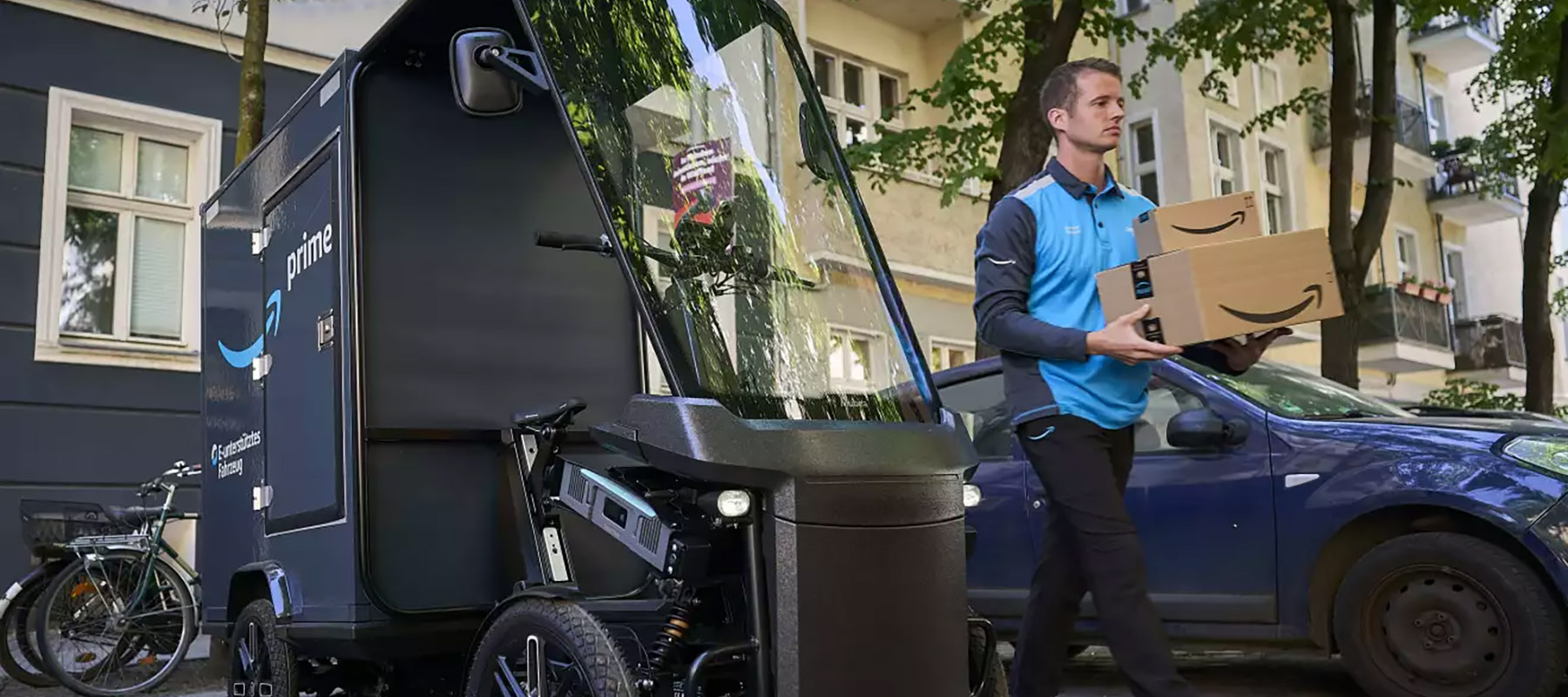
Amazon has been incorporating more micromobility vehicles into its urban fleets.
Photo by: Amazon
NACTO’s Bearn quickly rattles off the additional benefits that such vehicles bring to the dense urban landscape: scale, agility, decreased traffic congestion, lower impact to roads and sidewalks and particularly reduced emissions. According to a recent NACTO white paper, the New York City Department of Transportation found that “20 cargo bike miles per day replaced 20 van or box truck miles, resulting in a per-bike CO2 savings of approximately 7 tons per year.” With thousands of such vehicles planned for deployment, this is nothing to (not) cough at.
And, of course, all of this yields a diminished risk for motorists, and especially for pedestrians. Injuries and deaths to vulnerable road users from motor vehicle collisions have skyrocketed in recent years, and are significantly impacted by the height, weight and speed of vehicle strikes. “The more you’re shifting trips from our largest vehicle to our smallest vehicles, the safer our streets are for everybody,” Bearn says.
The advantages of these vehicles go well beyond these concrete realms. Somewhat surprisingly, they create intriguing opportunities for alliances with other stakeholders in the urban environment, especially those advocating for alternative transportation. While the increasing commercialization of bike lanes—which were originally intended to encourage alternatives to commuting or shopping by car—might alienate core constituencies, quite the opposite is true.
“We see the scale and quantity of these delivery vehicles as an opportunity to start arguing for wider bike lanes or more space for bike parking in places where there are delivery hotspots,” says “The War Against Cars’” Gordon. “This could be a great opportunity for companies like Amazon or UPS to work together with advocates like myself to petition for better infrastructure that works for everybody.”
Such surprising collaborations are already yielding effects in the urban fabric. “Our thinking has been changing dramatically every couple years,” Bearn says. “Fifteen years ago, we were designing three or four-foot-wide bike lanes. That’s not acceptable anymore. Now we’re designing seven- or eight-foot bike lanes.”
Increasing the space devoted to compact pedal-powered vehicles—and reducing that devoted to large-scale cars and trucks—certainly affords a greater and more efficient flow of delivery vehicles. But it also benefits other users. “Wider lanes allow us to accommodate two cargo bikes side-by-side, or cargo bikes being passed by individual bikes,” Bearn says. “But it also gives space, for example, for a caregiver and a child riding side-by-side. So, everyone wins.”
Of course, a city cannot just widen bike lanes and hope that this will spur orderly adoption and development. It should take in the needs of various stakeholders, and have a thoughtful, and locally specific, plan for fostering implementation. “In an unregulated market, you run the risk of chaos in any industry,” says Gordon.
Also President Chris Yu argues that conventional delivery vehicles are not the solution to moving packages faster in increasingly dense cities.
Photo by: Also
On-street battery-swapping options can provide safer charging infrastructure and keep drivers working efficiently. All the better if such power re-ups occur at micro-hubs built by industry or in collaboration with the municipality, loci that can also accommodate short-term package storage, pick-ups, drop-offs, or driver transfers. “This could be a storefront or even a shipping container,” says Bearn, noting the success of such a street-front pilot program in Toronto that used these ubiquitous standardized corrugated metal crates.
Parking and pull-offs are also key. “We need well-spaced bike racks where people can park larger cargo bikes or make transfers from a truck to a bike,” Bearn says. “Or even allowing cargo bikes to use metered parking spaces without paying.” And safety is paramount. Battery charging, maintenance and storage infrastructure must be regulated and regularly inspected to prevent mishaps, and fire departments need to be educated on the specifics of extinguishing battery conflagrations.
Since these vehicles do not typically require any kind of driver licensing, education and safety training must be required of operators as well. “We’re working with municipalities, and industry, to create certification programs for drivers,” Bearn says. “As the volume of businesses using commercial bike fleets increases, then there’s opportunity to regulate just that commercial activity and not the bike itself, to create a commercial or business permit that can help establish rules and safety standards.”
While it is important not to completely stifle the creativity and invention imbued in emergent technologies like this, as industries arise and mature, regulation and enforcement become increasingly relevant. “As programs become permanent, they usually have fees, or fee structures, for using curb space if you’re giving that space over to a specific entity to support their operations,” Bearn says. “And while it’s early nationally speaking, New York City has a commercial bike unit that is tasked with safety violations, and the police are tasked with moving violations and abandoned bikes.”
Ultimately, as with many things in densely populated areas, it comes down to the need for consideration, and for a reasonable and equitable distribution of scarce resources, especially as it pertains to shared public infrastructure.
“I do think we’re asking a fundamental question of who is entitled to space in the city, what is the city for, and who is it for?” Gordon says. “Certainly, I want my deliveries as much as anybody else. But in a city where the competition for space is as fierce as it is in New York, it really comes down to that question of what are streets for, what are sidewalks for, what are bike lanes for? Not a hundred percent of every square inch of the city needs to be dedicated to commercial activity.”