



How energy efficiency drives seasonal mountain bird migration worldwide
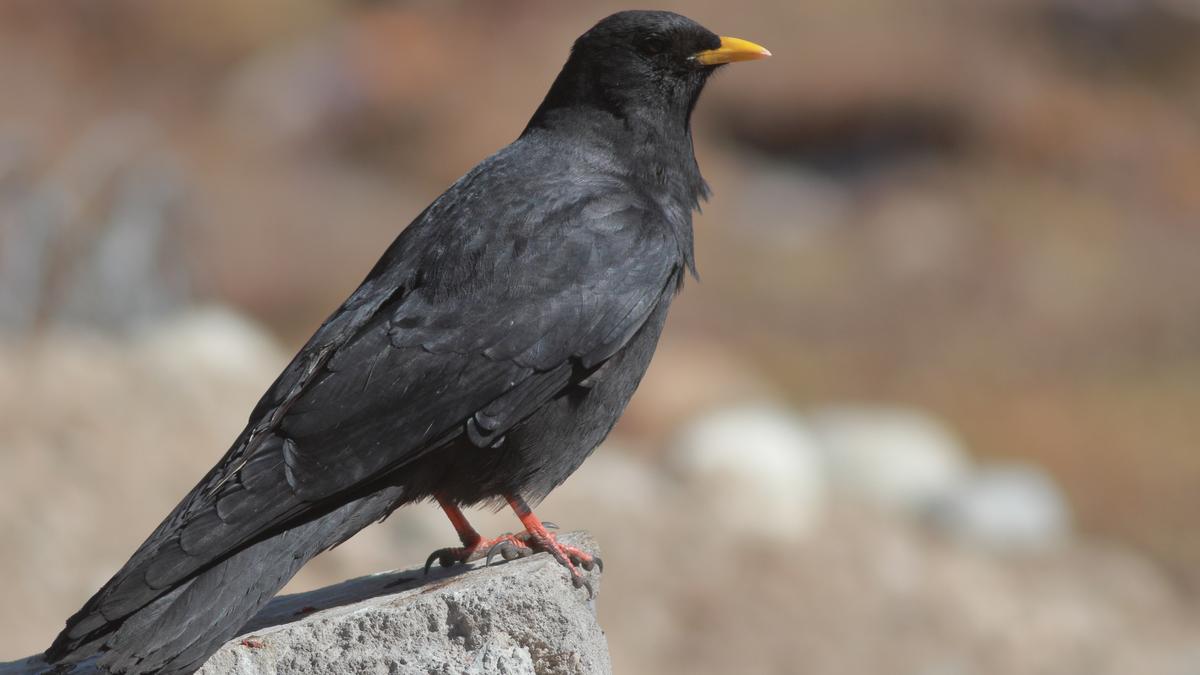
Migration is the movement of birds across long distances, from temperate to tropical regions during winters, and vice versa. The birds move to areas with more or increasing resources and to stay within the climate niche to which they are adapted.
They also migrate short distances up and down mountains around the world. And a long-standing hypothesis as to why they do this was that they were moving away from warmer areas to cooler ones.
However, a new paper in Science Advances has now challenged this predominant theory to paint a more complex picture.
Against the gradient
In the study, researchers from the U.K., U.S., and Taiwan analysed citizen science data across 34 mountain regions worldwide and found that elevational migration in birds is widespread even in the equatorial tropics, where the temperature on mountains changes very little across seasons. The data reportedly showed that 36.5% of all migrant mountain bird populations would be in the temperature sweet spot if they stayed put instead of moving around.
“A lot of birds actually move upslope during winter, which means they go against the temperature gradient,” Marius Somveille, lead author of the paper and ecology and conservation lecturer at the University of East Anglia in the U.K., said.
Instead, the researchers have argued that the seasonal movement of birds in mountains is driven by a need to optimise their energy budgets.
“Using citizen science data, we were able to show that birds in mountains across the world move for ease of access to food, to escape competition with other species, and to minimise thermoregulation costs — each contributing towards optimising their energy budget,” Dr. Somveille said.
Energy efficiency
The energy budget is the finite amount of energy a bird has to spend on various activities, including staying warm, finding food, protecting itself, rearing its young, etc.
The researchers examined seasonal bird distribution data of 10,998 populations belonging to 2,684 species in the 34 mountain regions. Then they compared real-world distribution patterns recorded in the eBird database with a simulation that related the energy available to the birds in their environment to their energy demands.
The simulation was run on the ‘Seasonally Explicit Distributions Simulator’ (SEDS) model — which scientists had originally developed to project the seasonal distribution of birds.
“Here, we adapted it to the case of elevational gradients in mountains,” Dr. Somveille said. “Essentially, it simulates how birds should be distributed if they were optimising for energy efficiency.”
The simulation assumed that the energy available on a mountain is proportional to how green the plants nearby were.
“The idea is that the greener the environment, the more productive it is and therefore the more energy is flowing across its food webs,” Dr. Somveille explained.
‘Revealed a global pattern’
“We begin with a mountain empty of birds, and then we start simulating bird populations one by one. Initially, they position themselves in an area with the most resources and favourable temperature,” he added. “But once more bird populations are added, leading to competition for food, populations start dispersing and positioning themselves differently, and then at one point, they start to migrate because that’s the best strategy.”
The simulation stopped once all the resources in the mountain had been depleted. When the team compared the seasonal distribution from the simulation with the real world, 28 of 34 mountain slopes matched.
“The model creating distribution patterns similar to the real world gives us some confidence that it is capturing something that potentially explains what the birds are doing,” Dr. Somveille said.
Tarun Menon, who recently completed his PhD on seasonal elevational migration in the Himalaya at the Indian Institute of Science, Bengaluru, commended the unique SEDS model: “There has been previous research from tropical mountains where birds are tracking fruit availability, which need not be correlated with temperature. But this study looks at mountain ranges worldwide and has revealed a global pattern in terms of energy efficiency.”
‘A better understanding’
When the simulations ran with the worst-case climate scenarios by 2100, it found that the pattern of bird distribution along mountain ranges was largely similar.
“The direct effect on birds will be small, but through affecting energy efficiency, it would still be enough to generate some movement towards higher elevation,” Dr. Somveille said. The model predicted an average upslope shift of around 129 m in this time for mountain birds.
While the study highlighted broad patterns that could guide habitat and species management, Dr. Somveille expressed hope to adapt the model to study specific species guilds: “Now, with the availability of numerous remote sensing products, can we maybe estimate the density of fruits or insects across a whole mountain? Then we could see which group of bird species could be more affected by, say, agricultural change or land use change,” he said.
“We found that in the winter, there are relatively more terrestrial and flying insects at lower elevations, while in the summer, they are relatively more abundant at higher elevations,” Dr. Menon said, referring to his PhD work on insectivorous birds. “The study found a corresponding pattern in the abundances of the birds that feed on these groups as well,” he said.
Dr. Menon’s field-based findings from the Himalaya are consistent with the energy efficiency hypothesis and conclude that seasonal fluctuations in food availability may be a more important predictor of elevational movement in mountain bird species.
Dr. Somveille also stressed that resources affect the way birds are distributed in mountains much more than temperature: “Be it human activity or climate change, a better understanding of what affects resource distribution is key to making predictions for how it will impact birds.”
Nikhil Sreekandan is an independent journalist.
Published – April 06, 2026 07:30 am IST